
Friday Leadership Report | Alan Kearns, Founder & Managing Partner, CareerJoy
Happy Friday,
On Sunday morning, I stood near the National War Memorial in Ottawa with a coffee in one hand and my phone in the other, trying to track two runners at once. One was a colleague from CareerJoy. The other was our daughter. Both were running the Canada Army Run, and both had a harder road to the start line than anyone watching would have guessed.
If you have never been to the Army Run, it is worth the early alarm. The races start with cannon fire instead of a starter’s pistol. Soldiers in uniform line the finish and hang dog tag medals around the necks of runners as they come through. This year was the 19th edition, with about 15,000 people running, walking, or rolling through downtown Ottawa and out through Rockcliffe. Since 2008, the event has raised more than $5 million for Support Our Troops and Soldier On, the charities that care for ill and injured members, Veterans, and their families.
For us, it is personal. The Army Run supports a community we have worked alongside for years, and it highlights one of our most important partners. So we cheered a little louder than usual.
And both of them finished. In the way they wanted to. Our family was proud, and so was our organization.
I have been sitting with that all week, along with a line I cannot shake.
Two weeks ago, Jean Chrétien stood in a hockey arena in Gander, Newfoundland and Labrador, for the 25th anniversary of September 11. Gander is the town that opened its homes to thousands of stranded travellers in 2001. At 92, the former prime minister gave a speech that brought the room to its feet. His line was simple: “Never mistake our tolerance for lack of determination.” He followed it with another: “And never, never mistake our kindness for softness.”
He was speaking to a country, and frankly, to a neighbour. But I heard it as a leadership sentence. It names something we Canadians do not always say out loud about ourselves. We are patient. We are polite. We will hold the door and apologize when you bump into us. None of that means we are going to quit.
I saw that same quality on Sunday, twice.
Our daughter is a natural athlete. Running has always come easily to her, which is exactly why this training block was so hard. Her knee started acting up, and it was not a question of effort or fitness. It was mechanical. When your body will not cooperate, determination looks less like pushing harder and more like adjusting, resting, rebuilding, and then showing up again. Quietly. Without drama. She did the unglamorous work of finding a way through, and she crossed the line on her own terms.
My colleague loves to run. But loving something and training for it are two different things. Training takes hours that have to come from somewhere, usually early mornings before work and weekends that could have gone to something easier. Nobody claps for the 6 a.m. run in the rain. That is where the race is actually won.
Neither of them looked fierce. Both of them were relentless.
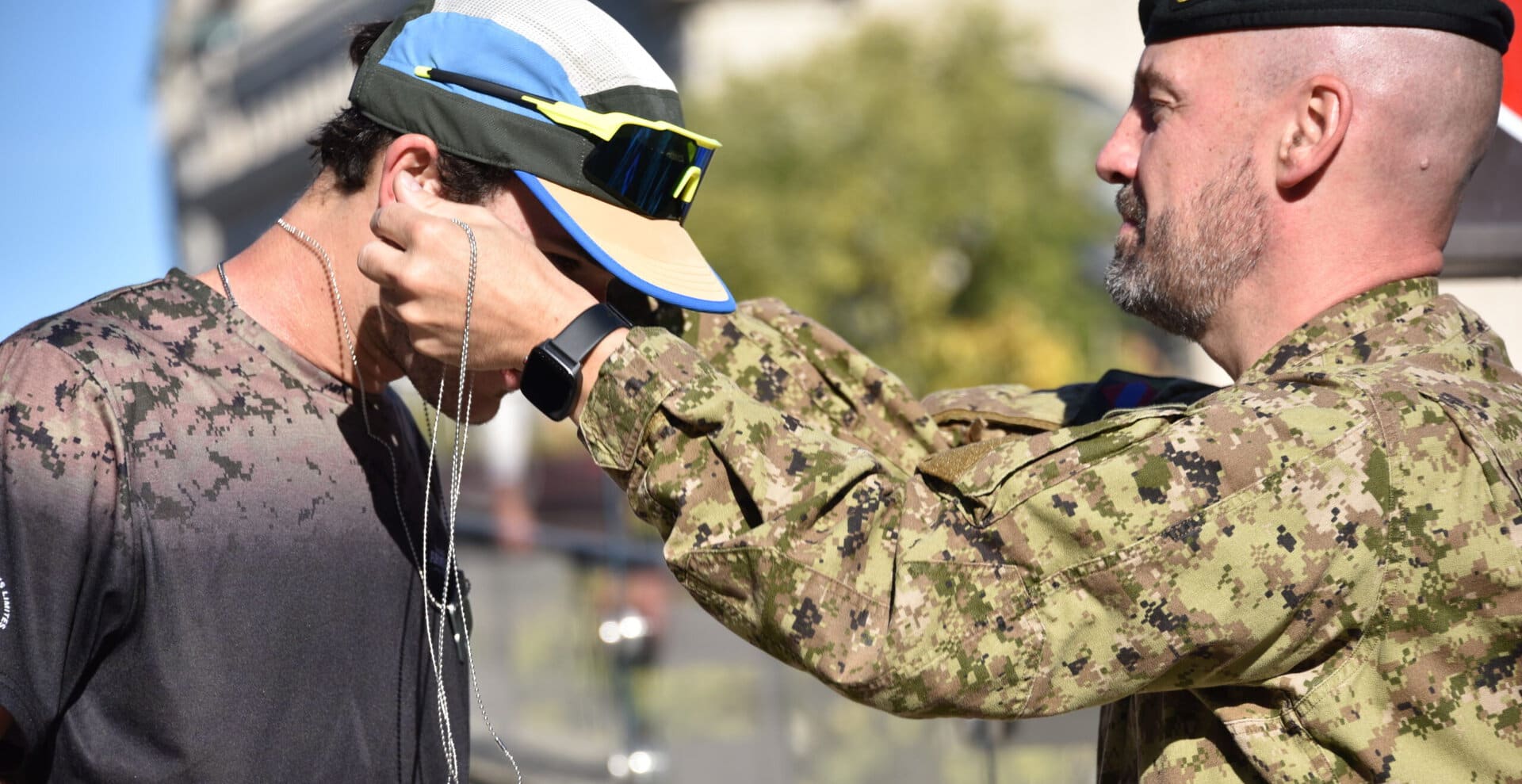
Here is where the race connects to our work.
For several years, CareerJoy has delivered career transition support to spouses and partners of Canadian Armed Forces members, in partnership with Canadian Forces Morale and Welfare Services. We think of it as a parallel way of supporting a military career. When a member is posted every two or three years, the whole family moves. And the person who is often left rebuilding from scratch, again, is the spouse who is also trying to build a career of their own.
The numbers make this concrete. The Vanier Institute of the Family reports that military families in Canada move three times more often than civilian families, and the 2021 Census counted roughly 54,000 active military families. Statistics Canada’s portrait of those families found about 39,600 military spouses or partners, and nearly 94 percent of them are women. Close to 8 in 10 of those women hold a postsecondary credential, compared with about 66 percent of women in non-military couples.
Read that again. This is a highly educated, highly motivated group of professionals. Their employment rate is actually on par with their civilian peers. The challenge is not willingness to work. The challenge is continuity. Every posting means a new city, new networks, sometimes a new province with different licensing rules, and a resume that starts to look like a series of fresh starts rather than a steady climb.
That takes a particular kind of determination. Not the sprint kind. The kind that says, I will rebuild my professional identity in Petawawa, then Esquimalt, then Gagetown, and I will not let three moves in eight years define what I am capable of.
I have met hundreds of these spouses over the years. Many of them could teach a masterclass in adaptability to any executive team in the country.
When we published our Work. Made Better. Report, we recognized CFMWS as one of the organizations genuinely making work better in Canada. Vanessa Walsh and Todd Stride and their team integrated coaching directly into the support they offer military spouses, partners, members, and families. What struck me in those conversations was not the program design, as good as it is. It was the posture. They refused to accept that constant relocation had to mean a constant career reset.
That is determination at an organizational level. It is also kindness. Those two things were never in competition.
The same report pointed to a tension worth naming. Drawing on Gallup’s workplace research, we noted that 63 percent of Canadian employees describe themselves as thriving, almost double the global average, while 55 percent also report daily stress. Canadians thrive and struggle at the same time. We carry on. We rarely make a fuss about it. And leaders can misread that steadiness as ease when it is actually effort.
If you lead people in Canada, that should give you pause. The calm, capable person on your team may be training through a sore knee you cannot see.
It would be hard to talk about determination this month without talking about the country.
Whatever your politics, it is fair to say Prime Minister Mark Carney has made rebuilding the Canadian Armed Forces a defining priority. Canada reached the NATO target of 2 percent of GDP on defence this spring, years ahead of the earlier schedule, and has committed to a path toward 5 percent by 2035. Every CAF member received a raise, the largest in a generation, and the government reported that applications to join the Forces rose nearly 13 percent.
You can debate the pace and the price. Canadians will, and should. But the underlying message echoes what Chrétien said in Gander. A country known for being tolerant can also be resolute. And when a nation asks more of its military, it is asking more of its military families too. More postings. More moves. More spouses restarting careers in new cities. If we are serious about strengthening the Forces, supporting the people standing beside them is not a side project. It is part of the mission.
Determination, it turns out, trumps a lot. (Yes, pun fully intended.) It trumps a knee that will not cooperate. It trumps a posting message that upends your plans. It trumps a tense moment with a neighbour who has forgotten who stood beside them.
This is the part I most want leaders to take into next week.
Determination does not mean you have to be mean. (Pun intended there too.)
Somewhere along the way, a lot of us absorbed the idea that resolve requires hardness. That the determined leader is the one who raises their voice, grinds people down, and treats kindness as a luxury for easier seasons. I have coached leaders across the federal public service, the Canadian Forces, and financial services for close to three decades, and I can tell you the opposite is usually true. The leaders who last are the ones whose determination is anchored in their values. They do not have to become someone else to hold the line.
Chrétien’s pairing matters. Tolerance and determination. Kindness and strength. He did not say choose one. He said do not mistake one for the absence of the other.
Our daughter didn’t reach the finish line by being hard on herself. She got there by being honest about her limits and faithful to her goal. My colleague did not get there by resenting early mornings. She got there by loving the thing enough to do the boring parts. Military spouses do not rebuild careers by becoming bitter about the system. They do it by staying true to who they are while everything around them changes.
That is what I mean by character-based leadership.
At CareerJoy, this is exactly why we built [LQ] Leadership Intelligence. Determination without character tends to burn people out. Character without determination tends to stall. The leaders Canada needs now can hold both, and hold them together, especially when the course gets hard.
Where on your team might you be mistaking quiet steadiness for ease? Ask someone this week how their training is really going.
Where are you tempted to confuse being determined with being harsh? Pick one conversation and hold your ground with warmth instead.
Who in your organization is carrying a transition you cannot see, a move, a family change, a career reset? What would it look like to run a little of that race beside them?
Congratulations to everyone who ran, walked, or rolled on Sunday, and to every military family who has packed a house and started again. You remind the rest of us what Canadian determination actually looks like.
If your organization is navigating change and you want to build leaders who are both kind and unshakeable, we would love to talk.

Along the road with you,
Alan
Building a career while moving every few years takes a particular kind of determination. Through CareerCOACH+, military spouses and partners can access complimentary career coaching to help them navigate job searches, career transitions, and more.
→ Learn more about CareerCOACH+
The strongest teams aren’t built on performance alone. The 2026 Work. Made Better. Report explores what helps leaders create workplaces where people can navigate change, even when the road gets difficult.