
Friday Leadership Report | Alan Kearns, Founder & Managing Partner, CareerJoy
Happy Friday,
There is an old line that gets repeated so often it has lost most of its bite: you can lead a horse to water, but you cannot make it drink. I used to think that was a tidy little proverb about stubbornness. I do not think that anymore.
A few years ago, I took riding lessons. I expected to feel confident, perhaps even a little in control. Instead, I felt much like a new leader in their first week with a team they did not build: fascinated, humbled, and more than a little intimidated. A horse weighs half a tonne and can sense hesitation in your hands before you recognize it yourself. There is no faking that relationship. The horse knows whether you are truly present or merely acting the part, and it responds accordingly.
A family member competes at a high level in equestrian sport; watching her with her horse shows what many workplaces have forgotten how to build. It is not command and obedience, but a relationship formed through countless small moments. The horse follows because it trusts where she is leading. No one drags a half-tonne animal over a jump; it goes because it chooses to go with her.
What strikes me most, watching that relationship up close, is how much of it happens before competition day. The trust is not built in the ring. It is built in the quiet, repetitive, unglamorous work of grooming, feeding, showing up the same way every single day, long before there is a ribbon on the line. Leadership works the same way. Nobody trusts a leader because of what happens in the crisis meeting. They trust a leader because of the hundred ordinary Tuesdays that came before it.
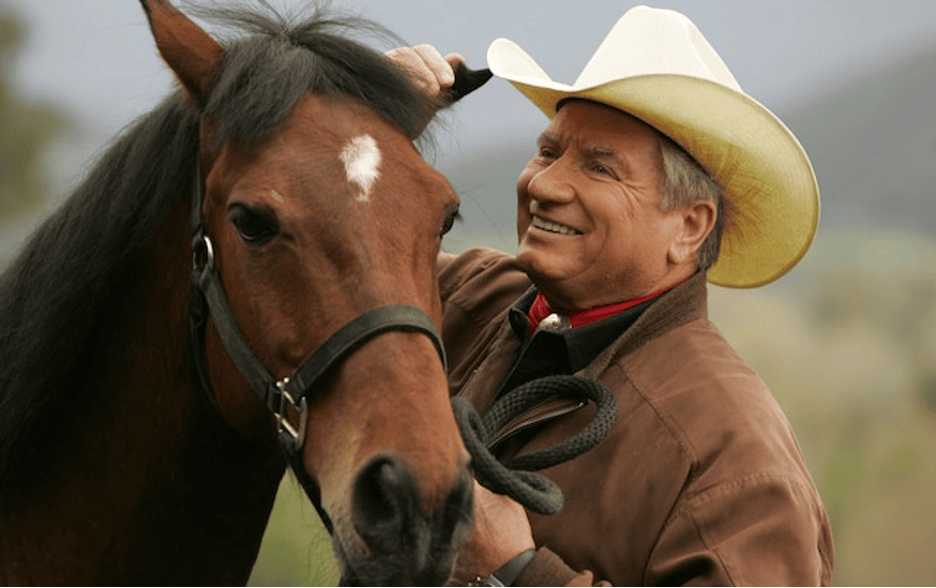
Monty Roberts died at the end of July, at 91, on the same California ranch where he spent most of his life. If the name is unfamiliar, his work will not be. He was the real horseman behind the idea people now call The Horse Whisperer, and he spent his life objecting, gently but firmly, to that word. He did not whisper to horses. He listened to them.
For six thousand years, horses were broken. Roberts grew up watching his own father do it that way, and he grew up questioning it. He spent his youth observing wild mustangs and noticed something that changed the entire profession. Herds are not led by the most dominant animal. They are led by the mare who has earned the trust of the herd through consistency, not force. Roberts built a method called Join-Up around that insight. Instead of breaking a horse’s will, a trainer earns its willingness. The horse is given the choice to approach, and it chooses to.
That is the whole method. Offer trust. Let the choice be real. Wait.
Queen Elizabeth II saw him demonstrate it in 1989 and became one of his most devoted champions for the rest of her life. His memoir sold more than five million copies. But the detail that stays with me is smaller than any of that. He did not call what he did dominance training or performance coaching or anything with an acronym. He called it listening, and he insisted that was the harder skill.
Here is where the horse barn and the boardroom stop being two different places.
The TELUS Mental Health Index has found that Canadian employees who report strong leadership from their manager score up to 21 points higher on measures of overall mental health than those who do not. Twenty-one points is not a rounding error. It is the difference between a workforce that is functioning and one that is quietly breaking down, and the variable driving that gap is not compensation or workload. It is whether people trust the person leading them.
I think about that stat next to Roberts’ mustangs. A horse that trusts its handler will walk into a trailer, jump a fence it cannot fully see over, stand still while someone works near its legs. None of that is natural behaviour for a prey animal. It only happens because trust has replaced fear as the operating system. Canadian employees are not so different. People will follow a leader into ambiguity, into a hard restructuring, into a stretch assignment that scares them, when trust is the foundation. Absent that trust, you can still get compliance. You will not get discretionary effort, and you will not get honesty when something is going wrong.
Join-Up works because it flips the traditional question. Traditional training asks, how do I get this animal to do what I want? Join-Up asks, what do I need to do so this animal chooses to be with me?
Many Canadian workplaces still ask the first question, only with more polished language. Engagement surveys, recognition programs, and wellness perks can all be useful, but they often still come from the same place: how do we get people to do what we want? Leaders who build lasting cultures ask the second question instead: what do I need to do so my team chooses to bring their full selves here, even when no one is watching?
Our own research at CareerJoy, through the upcoming The 2026 Work. Made Better Report, points to the same pattern from a different angle. The teams with the strongest performance outcomes are rarely the ones with the most oversight. They are the ones where trust has replaced surveillance as the default. It is slower to build. It is much faster to destroy. And it cannot be faked, which brings me back to that horse sensing your hesitation before you do.
We built [LQ] around a simple, uncomfortable observation. Most leadership development programs are still organized around competencies. Strategic thinking, communication, decision making, the usual list. Competencies matter, but they are not what determines whether a team chooses to follow someone into difficulty. Character does.
[LQ] defines four dimensions that determine whether a leader earns genuine followership or only compliance. Culture is the dimension most leadership programs overlook. A leader can be technically strong and still lead a team that does only the minimum because people do not trust what will happen if they raise concerns. Roberts understood this about horses long before most organizations understood it about people. The animal is not checking your résumé; it is deciding whether you are safe enough to be honest with.
That, in the end, is what psychological safety measures in a Canadian workplace. Not whether people are comfortable. Whether they believe telling you the truth will cost them something.
You cannot join-up a horse in an afternoon, and you cannot rebuild trust with a team in one all-hands meeting. But you can start the way Roberts started, by changing the question you are asking.
Stop asking how to get more performance out of people. Ask what you need to do so they choose to bring you their best without being prompted. Notice where you rely on control because it is faster, and be honest about what that speed costs in trust, honesty, and discretionary effort. Give people a real choice this week: how to approach a project, where to hold a meeting, or which problem to solve first. Then let their choice stand.
Watch, too, for the moments you are tempted to manage the reaction instead of the relationship. Roberts never tried to control how a mustang felt about him. He controlled what he offered it. Consistency, patience, room to approach on its own terms. That is a harder discipline than it sounds, especially for leaders who are rewarded for speed and decisiveness. But it is the only version of trust that holds up under pressure, which is exactly when Canadian teams need it most.
Roberts spent his whole career proving that force produces obedience and trust produces partnership. Canadian leaders are being asked to build partnership right now, in workplaces still adjusting to hybrid schedules, still absorbing economic pressure, still trying to figure out what loyalty even means anymore. The lesson from a ranch in California, and from a saddle I was not nearly as comfortable in as I hoped to be, is the same lesson either way.
You cannot make the horse drink. You can only become someone worth following to the water.

Along the road with you,
Alan
Get a first look at the 2026 Work. Made Better. Report, featuring national data on leadership, workplace culture, employee experience, and what’s next for work.
It’s built in the hundred ordinary Tuesdays that came before it. That kind of consistency doesn’t happen by accident, and it’s what CareerJoy’s leadership solutions are built to support.
→ We can help you build that trust