
Happy Friday,
This holiday season, Jen Curtis on our team and I have been volunteering with the Salvation Army kettle campaign.
It’s been rewarding in ways I didn’t expect and grounding in a season that can move very quickly.
We chose this volunteer experience intentionally. The Salvation Army is one of our long-standing charity partners and a recipient of the 2025 Work. Made Better Award as a partner of CareerJoy. That recognition wasn’t about visibility. It was about impact. About meeting people where they are and leading with dignity.
There’s a shared sense of community that shows up at this time of year. People slow down, even briefly. You see generosity in many forms. Some people give. Some stop to talk. Some acknowledge you and keep moving.
All of it matters.

Some of the most meaningful moments have come through conversation. I’ve found the best way to begin is simple: a smile and a genuine wish for happy holidays. From there, the conversations unfold.
One of the more interesting ones was with the “bus driver philosopher.” We talked about work, purpose, and what it’s like to show up every day in a role that often goes unnoticed.
He spoke about what he values most and what frustrates him most in his work.
Respect. Or the lack of it.
How a simple thank you or a moment of patience can change the tone of an entire day. And how the absence of those small gestures, over time, can quietly wear people down.
That conversation stayed with me.
It sharpened my thinking about the work my team and I do.
At its core, our work is an invitation.
An invitation for people to see the potential in themselves through their work, their contribution, and how they show up.
One pattern I’ve noticed at the kettle is that when I wish someone happy holidays, some don’t respond with a thank you. Not out of unkindness, but because they’re anticipating an ask.
They’re bracing for a transaction rather than receiving a genuine wish for peace, hope, or a better world.
That’s a helpful reminder at this time of year.
Many people are carrying more than they realize. When there is no pressure, something shifts.
Some people soften.
Some pause.
Some move on.
That’s okay.
That, to me, is leadership. Creating space rather than pressure. Opening doors rather than pushing people through them and helping people reach their potential by how we show up.
And when we get that right, we bring more humanity and, if we’re lucky, a little more joy into the world.
Happy Holidays to you and your team.
May this season bring moments of hope and quiet peace, and remind us how far simple respect, kindness, and being truly present can go.
Along the road with you,
Alan
P.S. CareerJoy helps leaders and organizations evolve with confidence and clarity. To explore how our leadership development and transition programs can support your next chapter, connect with Alan Kearns, Founder at alan.kearns@careerjoy.com or 1.877.256.2569.
Explore our outplacement solutions
P.P.S. If you’re strengthening leadership in your organization, explore our [LQ] Leadership Intelligence Programs and connect with Alan at alan.kearns@careerjoy.com or 1-877-256-2569 to get started.
Work. Made Better. Series
By Alan Kearns, Founder, CareerJoy
Moncton has earned its reputation as one of Canada’s most adaptable and entrepreneurial cities, with a population of over 170,000 in the Greater Moncton area, spanning Moncton, Dieppe, and Riverview. It’s a hub for bilingual business, logistics, contact centres, and growing technology and health sectors.
This is a city where connections matter. Layoffs here don’t just affect individual employees; they ripple through entire communities, where employers and employees often know each other personally. For HR leaders, CFOs, and executives, outplacement is not only about supporting people, it’s about protecting reputation, maintaining trust, and ensuring continuity in a labour market where everyone talks.
The stakes of workforce transition are uniquely high in New Brunswick:
Moncton employers that invest in structured, human-first career transition programs see measurable advantages:
Employers in Moncton operate under the Employment Standards Act of New Brunswick, but case law shows that procedural fairness often extends beyond minimum requirements.
In Smith v. Vitalité Health Network (2022), the New Brunswick Labour and Employment Board acknowledged that providing career transition services demonstrated good faith in a contested termination. While not legally required, it strengthened the employer’s defence and mitigated reputational risk.
For Moncton employers, particularly in unionized and bilingual environments, outplacement can serve as both a legal safeguard and a public relations tool.
Local organizations need an outplacement provider who can deliver:
✔️ Do your exits reflect both compliance and compassion?
✔️ Can your provider deliver fully bilingual, culturally aware services?
✔️ Are your managers trained to communicate layoffs with empathy?
✔️ Are you protecting your legal standing and community reputation?
✔️ Are retained employees engaged and confident post-restructure?
1. CareerJoy
Human-First. AI-Smart. 100 Percent Canadian.
CareerJoy is a national people and culture firm, not a recruiter, delivering personalized career transition programs with a balance of ethical AI technology and deep human connection.
What we bring to Moncton:
Local Leadership Insight:
“CareerJoy helped us manage a sensitive bilingual layoff with professionalism and empathy. It protected our brand and gave our employees a path forward.”
HR Director, Moncton-based transportation company
Case Study: Bilingual Contact Centre Downsizing, Dieppe
In 2024, a major bilingual customer service operation reduced 80 positions due to contract restructuring.
Challenges included:
CareerJoy provided:
Results:
2. Gallagher (formerly Optimum Talent)
National delivery capacity
Consideration: May use more standardized program templates; less flexibility for bilingual nuances
3. RiseSmart (Randstad)
Global tech-enabled platform
Consideration: Primarily U.S.-based coaching; limited New Brunswick ESA expertise
4. CareerMinds
Digital-first, budget-friendly option
Consideration: Minimal in-person bilingual delivery in Moncton
Our clients here value our ability to combine national reach with deep regional understanding:
From Government of Canada departments to World Vision and BMW, we help respected employers navigate change with dignity and precision.
CareerJoy supports Moncton’s most respected employers in delivering career transitions that protect brand, relationships, and compliance.
We are an official learning partner of APEX and proudly hold a 4.7-star Google rating.
📧 Contact Alan Kearns, Founder: alan.kearns@careerjoy.com
📞 1-877-256-2569
Human-first. AI-smart. 100 Percent Canadian. Global reach. Proven results.
Work. Made Better. Series
By Alan Kearns, Founder, CareerJoy
Victoria is more than just British Columbia’s capital, it’s a government powerhouse, a hub for clean technology, education, and tourism, and one of Canada’s most desirable places to live and work. With a population nearing 100,000 in the city proper and over 400,000 across the Capital Regional District, Victoria blends the influence of a provincial capital with the community connections of a mid-sized city.
Here, a layoff is never just an HR transaction. In a city where public sector roles, unionized workplaces, and knowledge-based industries dominate, workforce changes carry both political and personal weight. For HR leaders, CFOs, and executives in Victoria, outplacement is about protecting more than just the company, it’s about safeguarding relationships, reputation, and trust in a community where connections run deep.
Victoria’s unique employment landscape amplifies the stakes of managing terminations well:
Employers in Victoria, whether in the public, private, or nonprofit sectors, see tangible advantages from structured, human-first career transition services:
BC employers follow the Employment Standards Act of British Columbia, but courts and arbitrators now assess procedural fairness beyond statutory minimums.
In Saunders v. Victoria School Board (2022), the BC Labour Relations Board noted that the presence of career transition services reinforced the employer’s good faith in a contested termination. While not legally required, outplacement helped demonstrate fairness and reduced the potential for prolonged disputes.
For Victoria organizations, especially those in unionized or politically sensitive environments, outplacement is a valuable risk management strategy.
Victoria’s employment mix calls for outplacement providers who can navigate complexity and community expectations:
✔️ Do your exits reflect your organization’s culture and public reputation?
✔️ Can your provider deliver in unionized, bilingual, and politically visible environments?
✔️ Are your managers prepared to communicate terminations with empathy?
✔️ Are you protecting both legal compliance and employee well-being?
✔️ Do retained employees feel confident in the organization’s direction?
1. CareerJoy
Human-First. AI-Smart. 100 Percent Canadian.
CareerJoy is a national people and culture firm, not a recruiter, offering personalized career transition programs that blend ethical technology with deep human connection.
What we bring to Victoria:
Local Leadership Insight:
“CareerJoy’s approach helped us navigate a politically sensitive transition without damaging trust. Employees felt respected, and our relationships with stakeholders stayed strong.”
Director of HR, Victoria-based public sector agency
Case Study: Public Sector Restructure, Downtown Victoria
In 2025, a mid-sized provincial ministry office restructured, impacting 28 roles across policy, administrative, and unionized support positions.
Challenges included:
CareerJoy provided:
Results:
2. Gallagher (formerly Optimum Talent)
National network with large-scale delivery capability
Consideration: Standardized programs may lack flexibility for smaller, locally focused organizations
3. RiseSmart (Randstad)
Global tech-enabled platform with strong analytics
Consideration: Primarily U.S.-based coaching; limited familiarity with BC’s ESA and union context
4. CareerMinds
Digital-first, budget-friendly model
Consideration: Minimal in-person presence on Vancouver Island
Our clients in Victoria choose us because we combine national reach with local sensitivity:
From Government of Canada departments to nonprofits and private sector innovators, CareerJoy supports leaders when it matters most.
CareerJoy partners with Victoria’s most respected employers to deliver transitions that protect brand, relationships, and compliance.
We are an official learning partner of APEX and proudly hold a 4.7-star Google rating.
📧 Contact Alan Kearns, Founder: alan.kearns@careerjoy.com
📞 1-877-256-2569
Human-first. AI-smart. 100 Percent Canadian. Global reach. Proven results.
Happy Friday,
There is a moment every December when the world softens just enough for our rituals to speak a little louder. For our family, it is always Handel’s Messiah. The lights dim, the strings rise, and something inside us settles. It is a ritual that reminds us where we belong and what we return to year after year. For others, it is The Nutcracker, an annual concert, or a gathering that anchors the season. These rituals become mirrors. They show us what matters.
This week, I read a piece in The New York Times about the two boys who will share the role of Fritz in New York City Ballet’s production of George Balanchine’s The Nutcracker. Fritz is the little brother with the enormous personality. He is the child who charges through the scene with the confidence of someone who has waited all year for this moment. He is adorable. He is also a touch feral.
And yet the casting director said something that felt more like a leadership book than a theatre article.
“It is not enough just to have a mischievous personality. A Fritz must be cute, yes, but he must also be reliable.”
That line stopped me.
It is never just the talent.
It is the consistency.
It is being someone others can rely on.

This truth sits at the centre of leadership. What surprised me is how clearly the 2025 data echoes the same point.
Gallup’s 2025 Global Workplace Report found that a leader’s everyday dependability shapes 72% of team engagement. HRPA’s 2025 Workplace Trends Report showed that when leaders demonstrate consistent follow-through, organizations experience up to forty percent higher retention during periods of change. The 2025 Public Service Employee Survey summary revealed that employees who describe their manager as reliable are nearly twice as likely to feel psychologically safe at work.
Reliability is often dismissed as a soft skill, but it is actually a core driver of performance that leaders must prioritize.
Across every sector I work in, the same leadership pattern shows up. Someone arrives with enormous potential. They are bright and charismatic. They impress people quickly. For a while, they look like the next great hope.
Then the cracks appear. Deadlines slip. Communication drifts. Energy fluctuates. People around them begin guessing who will show up each day.
The shine fades.
Being Fritz in The Nutcracker is the childhood version of the same reality. A big personality is charming, but charm does not steady a cast of children moving through precise choreography. A Fritz who cannot be counted on affects everyone around him.
Reliability rarely gets applause, but it is what makes applause possible.
Reliability is a key driver of emotional stability, which in turn fuels performance and inspires confidence in your leadership.
We often romanticize big leadership moments. The breakthrough idea. The major win. The heroic push that saves the day. These moments matter, but they do not define strong leadership.
Teams do not thrive on occasional brilliance.
A constant is the colleague who shows up prepared, even when they are tired. A constant is the leader who manages their emotions so others do not have to manage around them. A constant keeps their word, even when circumstances shift.
One of the most compelling insights in the 2025 Gallup report was this. Employees who described their manager as consistent were 58% more likely to report having the energy and focus needed to do high-quality work. Consistency outperformed every other leadership behaviour measured that year.
Constancy is not perfection. It is maturity. Emotional steadiness reassures others and creates a sense of safety.
Reliability becomes a kind of leadership oxygen. When it is present, people breathe easier. When it is absent, everything tightens.
Organizations often select high-potential individuals based on charisma or technical brilliance. Those qualities matter, but they do not predict long-term leadership success.
The individuals who quietly rise are the ones who behave consistently even under pressure.
When others panic, they stay grounded.
When expectations shift, they adapt without drama.
When mistakes happen, they take responsibility quickly.
When their team wobbles, they steady the environment.
The 2025 HRPA report identified reliability as the strongest predictor of upward mobility. Leaders who demonstrated consistent behaviour were twice as likely to be selected for advancement.
The right fit is rarely the most dazzling person.
The right fit is the person who can be counted on.
The two boys chosen to play Fritz did not win the role because they caused the most chaos in the audition room. They won because they paired enthusiasm with discipline. They matched personality with presence. They were children who could be counted on when the curtain rose.
Being Fritz-ready in your own life means:
• Showing up even when the mood is gone
• Doing the fundamentals with quiet consistency
• Keeping your commitments even when they are no longer convenient
• Being emotionally steady in moments where others wobble
• Matching talent with maturity
• Becoming someone people do not have to second-guess
Every exceptional dancer is shaped by thousands of quiet hours at the barre. Every exceptional leader is shaped by thousands of small choices to be reliable. Every strong relationship grows through repeated acts of consistency.
Reliability is the soil where excellence grows.
As the year closes, I often ask leaders a single reflective question.
When people look for you, your guidance, your steadiness, your presence, do they know what they will find?
If the answer is yes, you are already a constant. You are already strengthening the environments you touch.
If the answer is no, the path forward is not about more talent. It is about more reliability. Reliability is a skill. Skills can be built. You begin with one clear action, then another, then another. Over time, the pattern becomes part of who you are.
This is the kind of leader people trust.
This is the kind of colleague people want by their side.
This is the kind of parent or partner who anchors a family.
In our family, it is always Handel’s Messiah. That familiar swell of the Hallelujah Chorus has marked our Decembers for years. It is a ritual that arrives with complete reliability. It shows up every time and asks us to pause, reflect and consider who we are becoming.
Your rituals reveal your values.
Your values reveal your priorities.
And your consistency reveals your leadership.
Talent gets attention.
Reliability builds the life you want.
And whether you are leading a team, shaping a family or navigating your own season of change, the essential question remains the same one the children’s repertory director asked when choosing her Fritz.
Can I count on you?
Because greatness is not about being dazzling.
Greatness is about being dependable.
And that is something every one of us can choose.
Along the road with you,
Alan
|
Work. Made Better. Series
By Alan Kearns, Founder, CareerJoy
In today’s workplace, layoffs are more than just a financial exercise — they’re a test of leadership, culture, and values. That’s why choosing the right outplacement partner is one of the most critical decisions an employer can make during a transition.
Companies like RiseSmart — now part of global HR giant Randstad — offer a wide-reaching platform, built for multinational scalability. On paper, they offer a sleek combination of tech tools, global reach, and virtual coaching.
However, for Canadian employers who care about nuance — including language, labour law, regional industry norms, and leadership continuity — global can sometimes miss the mark.
At CareerJoy, we do it differently: human-first, AI-smart, and 100% Canadian. With bilingual support, deep sector expertise, and real coaches who understand the emotional and strategic reality of transition, we help organizations turn layoffs into moments of leadership, not liability.
RiseSmart is a global outplacement platform based in the U.S., operating as a division of Randstad. Their model is heavily tech-forward: automated dashboards, curated job leads, and scalable matching tools. Their coaching is typically virtual, often assigned randomly, and may vary in quality across regions.
CareerJoy, in contrast, offers a Canadian-made approach: high-touch, bilingual, personalized, and deeply rooted in national workplace trends, regional cultures, and long-term career integration.
Where RiseSmart focuses on scale, CareerJoy focuses on trust, cultural alignment, and continuity.
Canadian employees facing a layoff encounter a distinct legal, cultural, and emotional landscape compared to their global counterparts. Expectations around fairness, bilingual services, unionized environments, and employer care are higher and more scrutinized.
According to the 2024 HRPA State of Work in Canada:
RiseSmart’s model may work well for volume-based transitions in global operations. But it often struggles with:
CareerJoy’s model is built around these gaps, where it is purposefully local, built to meet Canadian standards and expectations.
RiseSmart typically ends support at the point of job landing. But that’s when many Canadian professionals are just beginning to feel the impact of transition. Confidence is still rebuilding. Integration is just starting. Pressure is high.
CareerJoy’s model extends past placement:
These aren’t just nice-to-haves. They’re essential in today’s Canadian workplace — and they mitigate real risks: early attrition, reputational damage, and poor onboarding outcomes.
A national non-profit preparing for a significant transition evaluated several outplacement firms. While RiseSmart offered a cost-efficient, global solution, the organization quickly realized that what they truly needed was a partner who could deliver culturally relevant, bilingual, high-touch support across all their Canadian regions.
They selected CareerJoy because of our:
“It was clear from the beginning that CareerJoy got us, not just our goals, but our values. We needed a partner who could connect with our people, in English and French, and who understood the kind of work we do. That’s what made the decision easy.” — Marie Desrosiers, VP, People & Culture, National Non-Profit
Within two months:
CareerJoy also offered something RiseSmart couldn’t: the ability to support both Canadian and global transitions with a human-first, AI-smart hybrid model.
Employers often ask, “Is it worth the extra investment?” The answer lies in what happens after:
CareerJoy’s post-placement support has helped hundreds of Canadian organizations avoid early exits, re-hiring cycles, and legal blowback. And it’s why our model is increasingly chosen by:
“What set CareerJoy apart was the blend of warmth and strategy. Our people didn’t just get jobs — they got clarity.” — Sarah McMillan, Senior Director, Crown Corporation
“They understood our sector, our regions, and our values. That’s what made all the difference.” — David Levesque, Manager, Talent & Culture, Public Health Sector
“After being laid off, CareerJoy helped me not just land — but lead. They saw me as more than my resume.” — Catherine Boyd, Career Transition Client
“I’ve worked with a lot of firms. CareerJoy felt different. Human, honest, and incredibly effective.” — Thomas Chan, Leadership Coaching Client
“The support I received helped me regain confidence at a critical time. I wouldn’t be where I am without them.” — Jasmine Patel, Outplacement Recipient
If your outplacement support ends at Day One, it might be time to rethink the model.
Let’s do it differently — with support that’s human-first, AI-smart, and built for Canadian workplaces.
CareerJoy is Canada’s national people & culture firm — trusted by the Government of Canada, Shopify, World Vision, BMW, YMCA, BGC Canada, and more. As an APEX partner with a 4.7 Google rating, we support career transitions, leadership development, and hybrid coaching across all sectors.
Work. Made Better. Series
By Alan Kearns, Founder, CareerJoy
You’ve just received news that your organization will be restructuring. Maybe you’re in HR, tasked with designing a respectful transition. Or perhaps you’re one of the employees impacted by a layoff. Either way, one term keeps coming up: outplacement. But what is it?
Outplacement isn’t just about resume help. It’s a structured, professional service designed to help employees affected by layoffs navigate the complex emotional and practical path to re-employment. Done right, it’s support for both the individual and the organization.
And in Canada, where bilingual needs, psychological safety, legal compliance, and regional realities all come into play, how outplacement works—and who delivers it—matters more than ever.
Outplacement is a career transition program offered by employers to support employees who are leaving the organization due to layoffs, restructuring, mergers, or downsizing. These services typically include:
In Canada, the best outplacement services go beyond placement to help people find clarity, confidence, and a meaningful next chapter.
The employer partners with an outplacement provider (like CareerJoy) and offers support to impacted employees, often as part of the termination package.
The employee is invited to begin their personalized career transition journey, which may include live coaching, digital tools, AI-enabled resources, and mental health check-ins.
Depending on the package and provider, this may last from a few weeks to several months. CareerJoy’s model includes:
Canadian-specific offerings often include:
Outplacement is often perceived as a cost centre, but it’s a reputational, legal, and cultural safeguard.
According to the HRPA 2024 Workplace Transition Study:
A real-world example: One major nonprofit that partnered with CareerJoy during a restructuring saw a 35% increase in Glassdoor ratings post-layoff, driven by how departing employees felt about their transition support.
Layoffs hit hard. In Canada, where EI timelines, provincial laws, and job markets vary, it’s easy to feel lost. Outplacement brings clarity:
“It gave me hope when I didn’t know where to start.” — Michelle Levesque, former program manager,
“I didn’t just land a job—I found my next calling.” — David Chan, finance executive
From helping someone understand their severance rights in Ontario to coaching an Alberta engineer into a green tech role, the goal is always the same: help Canadians thrive again.
It’s not about finding a job for you. And it’s not therapy. Outplacement is future-focused and career-centred.
A recruiter works for the hiring company. Outplacement coaches work for you, helping you understand your options, your story, and how to make the most of your next move.
Not all providers are equal. Here’s what to look for:
CareerJoy is proud to be Canada’s national people & culture firm, supporting organizations coast to coast with real coaches, real insight, and real results.
If you’re evaluating whether to offer outplacement or deciding what kind of partner to choose, remember: it’s not just about helping someone land. It’s about helping them lead.
CareerJoy is Canada’s national people & culture firm — trusted by the Government of Canada, Shopify, World Vision, BMW, YMCA, and BGC Canada. As an APEX partner with a 4.7 Google rating, we support career transitions, leadership development, and hybrid coaching across every sector.
Human-first. AI-smart. 100% Canadian. Global reach. Proven results.
Contact: alan.kearns@careerjoy.com | 1-877-256-2569
Work. Made Better. Series
By Alan Kearns, Founder, CareerJoy
In Calgary, resilience is a way of life, but when layoffs hit, leadership is tested.
This is a city that’s constantly evolving. From energy giants to fintech disruptors, from engineering firms to non-profits, Calgary is home to bold ideas and ambitious people. But it’s also a city that has weathered booms and busts, and understands the human toll of market swings.
Whether you’re restructuring due to market volatility, consolidating business units, or navigating an M&A, how you manage transitions speaks volumes about your values as a leader.
In Calgary, where relationships matter as much as revenue, outplacement isn’t just a nice-to-have; it’s a vital investment in dignity, brand, and organizational trust.
Calgary has a population of over 1.4 million and one of the youngest, most educated workforces in the country. It’s a hub for energy, finance, engineering, real estate, technology, and logistics. But it’s also a city profoundly shaped by economic cycles, and where people remember how companies behave in hard times.
What’s at Stake:
In Alberta, while outplacement isn’t legally mandated, it’s increasingly used to demonstrate good faith in terminations. Especially in large restructures, unionized environments, or when long-tenured employees are affected.
In Nguyen v. EnergyCore Ltd. (2022), the Alberta Court of Queen’s Bench considered whether an employee was supported in their job search post-termination. While outplacement wasn’t legally required, its absence was noted in the awarding of additional damages.
The message is clear: even in cost-cutting scenarios, investing in ethical transition reduces downstream risks — financial, legal, and reputational.
HR and leadership teams here consistently value:
✔️ Have your leaders been trained to handle exits with empathy and clarity?
✔️ Are your services aligned with Alberta’s employment standards and case law?
✔️ Do you have outplacement partners who understand both the corporate and industrial sides of the Calgary market?
✔️ Are you supporting not just re-employment, but mental resilience?
✔️ Have you considered the message your approach sends to retained staff?
CareerJoy is Canada’s leading people and culture firm, trusted by organizations across the energy sector, financial services, government, and tech.
What sets us apart in Calgary:
✅ 1:1 coaching for professionals, tradespeople, and executives
✅ Expertise in Alberta labour law and economic context
✅ Coaches with local insight and national reach
✅ Emotional and mental wellness integration
✅ Post-landing support to ensure sustainable outcomes
Voices from Calgary
“We needed more than templates — we needed people who could meet our team where they were, emotionally and professionally. CareerJoy delivered that with heart and strategy.”
— Senior HR Leader, Calgary-based energy company. After being laid off from an engineering firm I’d been with for 12 years, CareerJoy helped me regain confidence. They knew the Calgary market, and they helped me land well.”
— A. Patel, mid-career engineering leader
In early 2025, a Calgary-based mid-cap oil and gas company downsized following a merger, impacting 75 employees across technical, HR, and administrative roles.
CareerJoy was engaged to:
Outcomes:
Longstanding presence in Alberta with structured delivery.
Consideration: Strong with large-scale programs, but feedback often notes a lack of emotional depth and customization.
Global, tech-forward platform.
Consideration: Offers automation and analytics, but coaching may be delivered outside Canada, with limited local relevance.
Enterprise-focused provider with a history in Alberta.
Consideration: Often geared toward high-volume or government contracts; small to mid-size firms may find service less flexible.
Organizations in Calgary choose CareerJoy because we:
Whether you’re sunsetting a business unit or managing industry-wide shifts, we help you preserve culture, reduce risk, and lead well.
The best leaders in Calgary know it’s not just about how you grow — it’s about how you let go.
Outplacement isn’t a soft skill. It’s a core leadership behaviour that builds loyalty, safeguards reputation, and reflects your values in action.
CareerJoy proudly supports organizations across Alberta and Canada, including the Government of Canada, World Vision, BMW, Shopify, YMCA, and BGC Canada.
As an APEX partner with a 4.7-star Google rating, we specialize in human-first, ethical transitions.
📧 alan.kearns@careerjoy.com
📞 1-877-256-2569
Human-first. AI-smart. 100% Canadian. Global reach. Proven results.
Happy Friday,
Something is grounding about a Saturday morning routine. In a world full of change, the comfort of familiar rituals can feel like a small anchor.
This morning, like many others, I stopped at Tim Hortons to pick up my usual large dark roast, two milk, one sugar, and a medium Red Rose tea, one milk, one sugar, for my partner. I usually go through the drive-thru, but ours is under renovation, so I went inside.
While waiting, I noticed something I had never seen before: a detailed design schematic for the Tim Hortons coffee cup. It made me realize how much thought, precision, and leadership are required even for the smallest elements of daily life.
Later that morning, we were on our way to a basketball game for one of the kids, hosted at one of our community partners, BGC Ottawa. Inside the gym, a mural by local artist @falldowng caught my attention. It was bright, layered, and full of meaning.
Among the words painted across the wall was a quote that stood out immediately: “We don’t make excuses, we make adjustments.”
That line could have been written for any great leader.
It is easy to rationalize when things go wrong, to blame external forces or limited resources. But the best leaders, whether they are running a business, a community organization, or a coffee chain, do not make excuses.
They adjust.

Tim Hortons faced a design problem that affected millions of Canadians every day. Their coffee lids leaked, had sharp edges, and were not recyclable. For a brand that serves roughly two billion cups of coffee a year, that minor flaw became a national frustration.
Canadians drink an estimated 14 billion cups of coffee annually, and Tim Hortons holds close to 60 percent of the quick-service coffee market. In a country where the morning coffee run is part of our identity, a faulty lid was more than an inconvenience.
It was a brand problem.
The leadership team could have continued to defend the status quo.
However, instead, Tim Hortons saw an opportunity to listen, redesign, and take action.
The Adjustment
They collaborated with a Canadian design firm and the creative agency One Twenty Three West to redesign the entire lid. Over just two weeks, the design team went through more than twenty prototypes, testing every curve and seal. They combined technology, design, and feedback from real users to create something better.
The result was a small but powerful symbol of innovation, the maple leaf lid. It solved the functional problems, reduced waste by using recyclable polypropylene, and added an unmistakably Canadian touch.
A tiny design change became a national success story.
From Leaks to Lessons
There is a leadership truth buried inside that lid. Every organization has its version of the coffee spill. Something small but persistent, often brushed aside because “it has always been that way.” Over time, those small leaks erode trust, reputation, and team morale.
Leaders who thrive do what that mural at BGC Ottawa reminds us to do. They make adjustments. They observe, listen, and improve. They stay curious instead of defensive.
At CareerJoy, we often see this mindset in organizations navigating transition. When leaders choose to see change as a design challenge rather than a disruption, the outcomes are entirely different. Whether it is outplacement, leadership development, or cultural renewal, success depends less on excuses and more on empathy, clarity, and iteration.
The Prototype Mindset
The redesign team at Tim Hortons modelled a rapid prototype approach that applies directly to leadership. They moved quickly, invited feedback, and continued to refine their approach until it was successful.
The best leaders do the same. They experiment with new communication rhythms, reframe priorities, and learn from the feedback loop. They recognize that the best design is rarely perfect on the first try. Leadership, like design, is about iteration.
When Canadian organizations invest in thoughtful leadership design, they see results. According to the Human Resources Professionals Association (HRPA), companies that actively train and develop their leaders are 1.7 times more likely to retain high performers and twice as likely to maintain strong employee engagement during periods of change.
The lesson is clear: leadership design matters.
The Canadian Edge
There is something beautifully Canadian about the maple leaf lid story. Quiet innovation. Collaboration without ego. Pride in practicality.
The redesign was not about grand gestures. It was about listening, solving, and reflecting shared values. The same is true in leadership. The best leaders are the ones who design workplaces that reflect care and respect for the people who experience them every day.
A great lid does more than keep coffee from spilling. It represents thoughtfulness. A great leader does more than keep things running. They make thoughtful adjustments that build trust, purpose, and pride.
The Leadership Lid Test
As you start your weekend, with a coffee in hand, consider this simple reflection.
What is leaking in your leadership design right now?
Where could you stop making excuses and start making adjustments?
It may be in communication, decision-making, or how you support your team through change. Minor design improvements often yield the most significant benefits to humans.
Whether it is a coffee lid or a culture, both require intention, testing, and care.
And sometimes, leadership is as simple as noticing what’s right in front of you and choosing to make it better.
Along the road with you,
Alan
P.S. To explore how our leadership development and transition programs can support your next chapter, connect with Alan Kearns, Founder at alan.kearns@careerjoy.com or explore our outplacement solutions.
Work. Made Better. Series
By Alan Kearns, Founder, CareerJoy
Right Management, part of ManpowerGroup, is a powerhouse in global career transition and talent development. Their scale is hard to match: global reach, sophisticated platforms, and brand recognition. However, in Canadian transitions—where labour dynamics, bilingual needs, and cultural nuances matter—scale alone can leave significant gaps.
At CareerJoy, we believe outplacement isn’t a commodity—it’s care in action. Built for Canadian workplaces, powered by AI insights, and driven by human connection, our model ensures that transitions become moments of clarity, confidence, and care —not confusion or churn.
And yes, we also support global transitions. From a single executive to over 5,000+ impacted employees, CareerJoy scales with integrity. Whether you’re a Canadian-headquartered organization with international teams or a multinational downsizing in Canada, we’ve got you covered with localized support and centralized oversight.
Right Management’s model prioritizes speed, efficiency, and digital delivery. This may appeal to cost-focused HR leaders, but it can fall short of meeting the psychological and professional needs of employees facing complex or emotionally challenging transitions. Their reliance on global platforms sometimes misses the nuance of Canadian employment laws, bilingual requirements, and public sector sensitivities.
CareerJoy delivers:
We believe in supporting the whole person, not just placing them somewhere fast.
According to HRPA (2024):
Right Management’s global-first approach often places Canadian clients into U.S.-based coaching queues or generic modules. That can mean:
CareerJoy’s 100% Canadian team includes:
Canadian employment law increasingly recognizes post-employment support as part of fair treatment, particularly in high-risk layoffs or when severance packages are negotiated. Poorly managed transitions can lead to:
CareerJoy reduces legal and operational risk by:
We also provide ROI tracking:
A provincial ministry recently underwent a significant reorganization, with 65 employees exiting across English and French zones. Right Management was the incumbent provider, but several issues arose:
After receiving feedback from existing staff and reviewing mid-project outcomes, the HR leadership team decided to switch providers. They selected CareerJoy based on our ability to offer:
Within weeks, sentiment shifted. We provided:
“CareerJoy didn’t just fill boxes. They held space. They helped our staff finish well and stay well. They understood our complexity.”
— M. D. Executive Director of Human Resources
Results:
“This was my second outplacement experience. The difference is night and day. CareerJoy saw me; Right Management felt transactional.”
— Andrew McKenzie, Former Director, Public Services
“They didn’t just send me training modules. They listened. They coached me out of doubt and into action.”
— Sienna Roy, Career Transition Client
“With their AI tools, I could see my market fit. But the real shift was what my coach helped me find in myself.”
— Dev Patel, Leadership Development Participant
Right Management can lead in volume and breadth. But when it comes to the Canadian people’s experience, CareerJoy leads in relevance, responsiveness, and results.
We’re not trying to be everything to everyone. We’re focused on getting outplacement right — for employees, for leaders, for your brand.
That means:
If your outplacement partner centers process over people, it’s time to choose differently.
CareerJoy is Canada’s national people & culture firm — trusted by the Government of Canada, Shopify, World Vision, BMW, YMCA, BGC Canada, and more. As an APEX partner with a 4.7 Google rating, we support career transitions, leadership development, and hybrid coaching across all industries.
Human-first. AI-smart. 100% Canadian. Global reach. Proven results.
alan.kearns@careerjoy.com | 1-877-256-2569
Happy Friday,
We partner with The Financial Management Institute of Canada.
It is the leading national association for public sector financial management professionals in Canada.
This brings together federal, provincial, territorial, municipal, and broader public sector employees who steward the financial and operational health of our public institutions.
Last week we participated in and spoke at their annual national conference in Ottawa. It was a gathering of the people who sit at the centre of public sector decision making.The professionals who carry the responsibility of financial stewardship, program accountability, resource allocation, and modernization across the country.
There was a moment during FMI PD Week when a single word appeared on the main screen in both English and French.
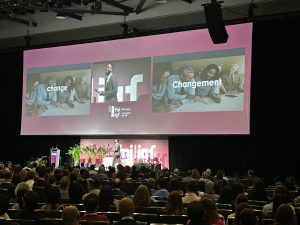
Change. Changement.
The room went still.
Not because the word was new, but because everyone understood the weight it carries this year. Change is no longer a background theme.
It is the climate everyone is working in.
This conference took place in the first days after the new federal budget was released. A budget that signals significant shifts in spending, renewed expectations around modernization, increasing accountability demands, and the possibility of a workforce adjustment that may affect approximately forty thousand public servants over the coming years.
These are not abstract projections. They are structural realities that influence how public servants think, feel, and work. Beneath the fiscal language sits a human experience that cannot be overlooked. People are carrying uncertainty, hope, pressure, pride, and fear all at once. And this emotional landscape is shaping the way teams absorb change, respond to leadership, and navigate the months ahead.
As part of FMI, our team continued its national research project, which is informing The 2026 Work. Made Better Report.
One of the significant findings from The 2025 Work. Made Better Report was that many public servants felt the pace of organizational change was accelerating faster than their teams could absorb. This year, we wanted to understand how change feels in the current environment.
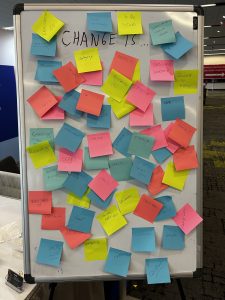
So we asked a simple question at our booth.
Change is…
Hundreds of public servants answered.
Their responses created one of the clearest emotional snapshots we have gathered to date.
When converted into percentages, the pattern became unmistakable.
20% Opportunity
20% Challenging
12% Artificial Intelligence
11% Fear
10% Fun
8% Growth
7% Constant
7% Leadership
7% Adaptable
5% New represented
3% Integrity
3% Important
These words were offered by people who deliver programs, shape policy, manage financial stewardship, support HR and transformation, and serve Canadians every day. They show the emotional reality of work inside the public service at a moment when the institution itself is preparing for structural transition.
Standing at the booth and listening to people write their words, it became clear that this is not only a time of operational change. It is a time of emotional change. Recognizing and validating people’s feelings helps public servants feel understood and supported as their work is shaped by these emotions.
Public servants feel pride in their work.
The most recent Public Service Employee Survey showed that 82% of employees feel proud of the work they do for Canadians. 77% reported being satisfied with their job. These numbers matter because they reveal a workforce that is committed and values-driven, even in moments of strain.
At the same time, Statistics Canada found that 21% of employed Canadians report high or very high levels of work-related stress. Heavy workloads and work-life pressures were the top contributors. In a public service facing modernization pressures and a potential workforce adjustment, that statistic takes on new relevance.
This is why one of the most potent ideas repeated at FMI was simple and true. You cannot solve emotion-based problems without emotion-based solutions.
People do not disengage because they are resistant. They disengage because they are uncertain.
They do not struggle because they are unwilling. They struggle because they are human.
Fear at 11% in our research reflects more than concern. It reflects honesty. It signals that people want clarity, connection, and reassurance. And yet Opportunity at 20% tells us something equally important.
Public servants still see the possibility of change when communication is honest, and leadership is emotionally present.
The future-ready public servant is deeply human, with emotional intelligence at the core of effective leadership in times of change. Across sessions, the alignment with the World Economic Forum’s Future-Ready Skills was unmistakable.
Analytical thinking matters, but not without judgment.
Creative thinking matters, but not without adaptability.
Technological literacy matters, but not without perspective.
Systems thinking matters, but not without calm presence.
The most critical leadership skills now are emotional.
Self-awareness.
Resilience.
Stress tolerance.
Empathy.
Active listening.
Cultural intelligence.
Openness to discomfort.
Confidence in uncertainty.
The public service is filled with people who care about their work. The data proves it.
The conversations at FMI echoed it. What employees are asking for is not perfection, but presence. They want leaders who will listen before they explain. Leaders who will acknowledge the emotional landscape. Leaders who will communicate early rather than perfectly. Leaders who understand that performance and well-being rise and fall together.
This is why a powerful slide at FMI encouraged leaders to shift from emotional avoidance to emotional engagement. It is no longer enough to focus on systems, processes, or policy. The human experience of work must be part of the leadership equation.
One of the visuals at FMI showed the word Change displayed alongside Changement. This was more than symbolic. It reflected the cultural complexity of leading in a country shaped by two official languages, diverse identities, and different regional and lived experiences.
Leadership in the federal public service is not only operational. It is cultural. It requires an understanding that every change is interpreted differently depending on context, history, and experience. It requires humility and emotional intelligence.
We heard this repeatedly at our booth.
A director navigating modernization while holding space for a worried team.
A finance officer is balancing new reporting expectations with mounting workload pressures.
An HR advisor who feels hopeful about the future but tired in the present.
A policy analyst who loves the mission yet feels uncertainty under the new budget.
These stories reflect the emotional diversity that leaders must understand to guide teams effectively.
Future-ready leadership is not abstract. It is practical and immediate.
Leaders can begin by naming what people feel.
They can offer clarity when certainty is not possible.
They can communicate early and consistently to provide reassurance, helping public servants feel more confident and less uncertain during times of change.
They can listen to what is not being said, such as unspoken concerns, to foster trust and understanding within teams.
They can check in before people check out.
They can bring steadiness into rooms where people feel unsteady.
They can reinforce psychological safety by being human first and technical second, fostering a sense of safety and connection that encourages openness and trust.
These behaviours shape whether the public service will move through change with resilience or with exhaustion.
The percentages from our FMI research reveal that public servants are not resisting change. They are interpreting it. They see opportunity and challenge. They feel hope and fear. They want to contribute but need clarity.
They are committed but stretched.
The fact that AI 12% of responses are telling. Technology is not the emotional barrier. Uncertainty is.
This is why emotional leadership will determine how well departments navigate modernization and workforce adjustments in the coming years.
The words collected at FMI give us a map. Not a map of programs or reporting lines. A map of emotions. And emotions are the starting point of all meaningful change.
Change is an opportunity.
Change is challenging.
Change is fear.
Change is growth.
Change is leadership.
Change is human.
As we build The 2026 Work. Made Better Report, these insights will help us understand the emotional and cultural conditions inside the public service at a moment of real transition.
And when leaders meet the human experience of change with emotional skill, clarity, and compassion, we help our people and our institutions become not only future-ready, but human-ready.
Along the road with you,
Alan
|