
Happy Friday,
Something is grounding about a Saturday morning routine. In a world full of change, the comfort of familiar rituals can feel like a small anchor.
This morning, like many others, I stopped at Tim Hortons to pick up my usual large dark roast, two milk, one sugar, and a medium Red Rose tea, one milk, one sugar, for my partner. I usually go through the drive-thru, but ours is under renovation, so I went inside.
While waiting, I noticed something I had never seen before: a detailed design schematic for the Tim Hortons coffee cup. It made me realize how much thought, precision, and leadership are required even for the smallest elements of daily life.
Later that morning, we were on our way to a basketball game for one of the kids, hosted at one of our community partners, BGC Ottawa. Inside the gym, a mural by local artist @falldowng caught my attention. It was bright, layered, and full of meaning.
Among the words painted across the wall was a quote that stood out immediately: “We don’t make excuses, we make adjustments.”
That line could have been written for any great leader.
It is easy to rationalize when things go wrong, to blame external forces or limited resources. But the best leaders, whether they are running a business, a community organization, or a coffee chain, do not make excuses.
They adjust.

Tim Hortons faced a design problem that affected millions of Canadians every day. Their coffee lids leaked, had sharp edges, and were not recyclable. For a brand that serves roughly two billion cups of coffee a year, that minor flaw became a national frustration.
Canadians drink an estimated 14 billion cups of coffee annually, and Tim Hortons holds close to 60 percent of the quick-service coffee market. In a country where the morning coffee run is part of our identity, a faulty lid was more than an inconvenience.
It was a brand problem.
The leadership team could have continued to defend the status quo.
However, instead, Tim Hortons saw an opportunity to listen, redesign, and take action.
The Adjustment
They collaborated with a Canadian design firm and the creative agency One Twenty Three West to redesign the entire lid. Over just two weeks, the design team went through more than twenty prototypes, testing every curve and seal. They combined technology, design, and feedback from real users to create something better.
The result was a small but powerful symbol of innovation, the maple leaf lid. It solved the functional problems, reduced waste by using recyclable polypropylene, and added an unmistakably Canadian touch.
A tiny design change became a national success story.
From Leaks to Lessons
There is a leadership truth buried inside that lid. Every organization has its version of the coffee spill. Something small but persistent, often brushed aside because “it has always been that way.” Over time, those small leaks erode trust, reputation, and team morale.
Leaders who thrive do what that mural at BGC Ottawa reminds us to do. They make adjustments. They observe, listen, and improve. They stay curious instead of defensive.
At CareerJoy, we often see this mindset in organizations navigating transition. When leaders choose to see change as a design challenge rather than a disruption, the outcomes are entirely different. Whether it is outplacement, leadership development, or cultural renewal, success depends less on excuses and more on empathy, clarity, and iteration.
The Prototype Mindset
The redesign team at Tim Hortons modelled a rapid prototype approach that applies directly to leadership. They moved quickly, invited feedback, and continued to refine their approach until it was successful.
The best leaders do the same. They experiment with new communication rhythms, reframe priorities, and learn from the feedback loop. They recognize that the best design is rarely perfect on the first try. Leadership, like design, is about iteration.
When Canadian organizations invest in thoughtful leadership design, they see results. According to the Human Resources Professionals Association (HRPA), companies that actively train and develop their leaders are 1.7 times more likely to retain high performers and twice as likely to maintain strong employee engagement during periods of change.
The lesson is clear: leadership design matters.
The Canadian Edge
There is something beautifully Canadian about the maple leaf lid story. Quiet innovation. Collaboration without ego. Pride in practicality.
The redesign was not about grand gestures. It was about listening, solving, and reflecting shared values. The same is true in leadership. The best leaders are the ones who design workplaces that reflect care and respect for the people who experience them every day.
A great lid does more than keep coffee from spilling. It represents thoughtfulness. A great leader does more than keep things running. They make thoughtful adjustments that build trust, purpose, and pride.
The Leadership Lid Test
As you start your weekend, with a coffee in hand, consider this simple reflection.
What is leaking in your leadership design right now?
Where could you stop making excuses and start making adjustments?
It may be in communication, decision-making, or how you support your team through change. Minor design improvements often yield the most significant benefits to humans.
Whether it is a coffee lid or a culture, both require intention, testing, and care.
And sometimes, leadership is as simple as noticing what’s right in front of you and choosing to make it better.
Along the road with you,
Alan
P.S. To explore how our leadership development and transition programs can support your next chapter, connect with Alan Kearns, Founder at alan.kearns@careerjoy.com or explore our outplacement solutions.
Work. Made Better. Series
By Alan Kearns, Founder, CareerJoy
Right Management, part of ManpowerGroup, is a powerhouse in global career transition and talent development. Their scale is hard to match: global reach, sophisticated platforms, and brand recognition. However, in Canadian transitions—where labour dynamics, bilingual needs, and cultural nuances matter—scale alone can leave significant gaps.
At CareerJoy, we believe outplacement isn’t a commodity—it’s care in action. Built for Canadian workplaces, powered by AI insights, and driven by human connection, our model ensures that transitions become moments of clarity, confidence, and care —not confusion or churn.
And yes, we also support global transitions. From a single executive to over 5,000+ impacted employees, CareerJoy scales with integrity. Whether you’re a Canadian-headquartered organization with international teams or a multinational downsizing in Canada, we’ve got you covered with localized support and centralized oversight.
Right Management’s model prioritizes speed, efficiency, and digital delivery. This may appeal to cost-focused HR leaders, but it can fall short of meeting the psychological and professional needs of employees facing complex or emotionally challenging transitions. Their reliance on global platforms sometimes misses the nuance of Canadian employment laws, bilingual requirements, and public sector sensitivities.
CareerJoy delivers:
We believe in supporting the whole person, not just placing them somewhere fast.
According to HRPA (2024):
Right Management’s global-first approach often places Canadian clients into U.S.-based coaching queues or generic modules. That can mean:
CareerJoy’s 100% Canadian team includes:
Canadian employment law increasingly recognizes post-employment support as part of fair treatment, particularly in high-risk layoffs or when severance packages are negotiated. Poorly managed transitions can lead to:
CareerJoy reduces legal and operational risk by:
We also provide ROI tracking:
A provincial ministry recently underwent a significant reorganization, with 65 employees exiting across English and French zones. Right Management was the incumbent provider, but several issues arose:
After receiving feedback from existing staff and reviewing mid-project outcomes, the HR leadership team decided to switch providers. They selected CareerJoy based on our ability to offer:
Within weeks, sentiment shifted. We provided:
“CareerJoy didn’t just fill boxes. They held space. They helped our staff finish well and stay well. They understood our complexity.”
— M. D. Executive Director of Human Resources
Results:
“This was my second outplacement experience. The difference is night and day. CareerJoy saw me; Right Management felt transactional.”
— Andrew McKenzie, Former Director, Public Services
“They didn’t just send me training modules. They listened. They coached me out of doubt and into action.”
— Sienna Roy, Career Transition Client
“With their AI tools, I could see my market fit. But the real shift was what my coach helped me find in myself.”
— Dev Patel, Leadership Development Participant
Right Management can lead in volume and breadth. But when it comes to the Canadian people’s experience, CareerJoy leads in relevance, responsiveness, and results.
We’re not trying to be everything to everyone. We’re focused on getting outplacement right — for employees, for leaders, for your brand.
That means:
If your outplacement partner centers process over people, it’s time to choose differently.
CareerJoy is Canada’s national people & culture firm — trusted by the Government of Canada, Shopify, World Vision, BMW, YMCA, BGC Canada, and more. As an APEX partner with a 4.7 Google rating, we support career transitions, leadership development, and hybrid coaching across all industries.
Human-first. AI-smart. 100% Canadian. Global reach. Proven results.
alan.kearns@careerjoy.com | 1-877-256-2569
Work Made Better Series
Alan Kearns
Ottawa is more than the seat of government. It’s a city where careers intersect across public service, technology, nonprofits, and global business. With more than 150,000 federal employees, a thriving tech corridor, and major employers in healthcare, education, and advocacy, Ottawa professionals often face career decisions that carry both personal and national weight.
It’s no surprise then that one of the most common questions we hear is:
“How do I choose the right career coach in Ottawa?”
Behind that question lies uncertainty: Am I making the right move? Who can I trust to guide me? And how do I know coaching will make a difference?
Ottawa’s professional landscape has unique pressures:
Career coaching offers clarity and direction in this mix. It helps people take ownership of their next step — whether within the public service, across to the private sector, or into an entirely new field.
If you are considering coaching, five criteria matter most:
One program officer had applied to several EX-level competitions, only to stall at the interview stage. Her bilingual skills weren’t strong enough under pressure, and she struggled to frame her leadership story.
With structured coaching, she:
Within a year, she secured an acting EX role, later moving into a permanent leadership appointment.
Her words:
“Coaching gave me clarity and confidence. For the first time, I felt like my career was in my hands, not just in the system’s.”
An Ottawa-based project manager was laid off from a global tech firm during a restructure. Unsure whether to remain in the private sector or pursue opportunities in government, he turned to CareerrJoy for coaching.
Together with his coach, he:
Within five months, he secured a leadership role in a federal agency, combining private sector expertise with public service impact.
His reflection:
“My coach helped me see a bridge I didn’t even know existed. I thought I had to choose between public or private. Turns out, I could do both.”
Employers across Ottawa gain when they provide coaching support:
Ottawa is at a turning point:
Coaching isn’t a luxury; it’s a necessity for individuals and organizations navigating this capital city’s complexity.
If you’re in Ottawa and wondering how to choose the right career coach, ask:
The right choice won’t just prepare you for your next job. It will equip you to grow, contribute, and thrive in Canada’s capital.
At CareerJoy, we’ve supported over 40,000 Canadians, including thousands of Ottawa-based professionals, from analysts and policy advisors to private sector managers and nonprofit leaders.
📩 Connect with Alan Kearns
📞 1.877.256.2569 | ✉️ alan.kearns@careerjoy.com
🌐 www.careerjoy.com
Let’s start the conversation.
Happy Friday,
We partner with The Financial Management Institute of Canada.
It is the leading national association for public sector financial management professionals in Canada.
This brings together federal, provincial, territorial, municipal, and broader public sector employees who steward the financial and operational health of our public institutions.
Last week we participated in and spoke at their annual national conference in Ottawa. It was a gathering of the people who sit at the centre of public sector decision making.The professionals who carry the responsibility of financial stewardship, program accountability, resource allocation, and modernization across the country.
There was a moment during FMI PD Week when a single word appeared on the main screen in both English and French.
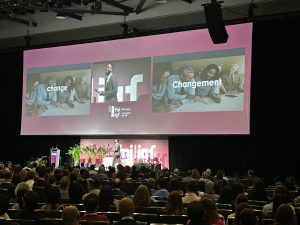
Change. Changement.
The room went still.
Not because the word was new, but because everyone understood the weight it carries this year. Change is no longer a background theme.
It is the climate everyone is working in.
This conference took place in the first days after the new federal budget was released. A budget that signals significant shifts in spending, renewed expectations around modernization, increasing accountability demands, and the possibility of a workforce adjustment that may affect approximately forty thousand public servants over the coming years.
These are not abstract projections. They are structural realities that influence how public servants think, feel, and work. Beneath the fiscal language sits a human experience that cannot be overlooked. People are carrying uncertainty, hope, pressure, pride, and fear all at once. And this emotional landscape is shaping the way teams absorb change, respond to leadership, and navigate the months ahead.
As part of FMI, our team continued its national research project, which is informing The 2026 Work. Made Better Report.
One of the significant findings from The 2025 Work. Made Better Report was that many public servants felt the pace of organizational change was accelerating faster than their teams could absorb. This year, we wanted to understand how change feels in the current environment.
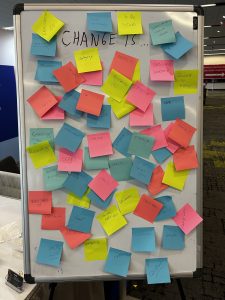
So we asked a simple question at our booth.
Change is…
Hundreds of public servants answered.
Their responses created one of the clearest emotional snapshots we have gathered to date.
When converted into percentages, the pattern became unmistakable.
20% Opportunity
20% Challenging
12% Artificial Intelligence
11% Fear
10% Fun
8% Growth
7% Constant
7% Leadership
7% Adaptable
5% New represented
3% Integrity
3% Important
These words were offered by people who deliver programs, shape policy, manage financial stewardship, support HR and transformation, and serve Canadians every day. They show the emotional reality of work inside the public service at a moment when the institution itself is preparing for structural transition.
Standing at the booth and listening to people write their words, it became clear that this is not only a time of operational change. It is a time of emotional change. Recognizing and validating people’s feelings helps public servants feel understood and supported as their work is shaped by these emotions.
Public servants feel pride in their work.
The most recent Public Service Employee Survey showed that 82% of employees feel proud of the work they do for Canadians. 77% reported being satisfied with their job. These numbers matter because they reveal a workforce that is committed and values-driven, even in moments of strain.
At the same time, Statistics Canada found that 21% of employed Canadians report high or very high levels of work-related stress. Heavy workloads and work-life pressures were the top contributors. In a public service facing modernization pressures and a potential workforce adjustment, that statistic takes on new relevance.
This is why one of the most potent ideas repeated at FMI was simple and true. You cannot solve emotion-based problems without emotion-based solutions.
People do not disengage because they are resistant. They disengage because they are uncertain.
They do not struggle because they are unwilling. They struggle because they are human.
Fear at 11% in our research reflects more than concern. It reflects honesty. It signals that people want clarity, connection, and reassurance. And yet Opportunity at 20% tells us something equally important.
Public servants still see the possibility of change when communication is honest, and leadership is emotionally present.
The future-ready public servant is deeply human, with emotional intelligence at the core of effective leadership in times of change. Across sessions, the alignment with the World Economic Forum’s Future-Ready Skills was unmistakable.
Analytical thinking matters, but not without judgment.
Creative thinking matters, but not without adaptability.
Technological literacy matters, but not without perspective.
Systems thinking matters, but not without calm presence.
The most critical leadership skills now are emotional.
Self-awareness.
Resilience.
Stress tolerance.
Empathy.
Active listening.
Cultural intelligence.
Openness to discomfort.
Confidence in uncertainty.
The public service is filled with people who care about their work. The data proves it.
The conversations at FMI echoed it. What employees are asking for is not perfection, but presence. They want leaders who will listen before they explain. Leaders who will acknowledge the emotional landscape. Leaders who will communicate early rather than perfectly. Leaders who understand that performance and well-being rise and fall together.
This is why a powerful slide at FMI encouraged leaders to shift from emotional avoidance to emotional engagement. It is no longer enough to focus on systems, processes, or policy. The human experience of work must be part of the leadership equation.
One of the visuals at FMI showed the word Change displayed alongside Changement. This was more than symbolic. It reflected the cultural complexity of leading in a country shaped by two official languages, diverse identities, and different regional and lived experiences.
Leadership in the federal public service is not only operational. It is cultural. It requires an understanding that every change is interpreted differently depending on context, history, and experience. It requires humility and emotional intelligence.
We heard this repeatedly at our booth.
A director navigating modernization while holding space for a worried team.
A finance officer is balancing new reporting expectations with mounting workload pressures.
An HR advisor who feels hopeful about the future but tired in the present.
A policy analyst who loves the mission yet feels uncertainty under the new budget.
These stories reflect the emotional diversity that leaders must understand to guide teams effectively.
Future-ready leadership is not abstract. It is practical and immediate.
Leaders can begin by naming what people feel.
They can offer clarity when certainty is not possible.
They can communicate early and consistently to provide reassurance, helping public servants feel more confident and less uncertain during times of change.
They can listen to what is not being said, such as unspoken concerns, to foster trust and understanding within teams.
They can check in before people check out.
They can bring steadiness into rooms where people feel unsteady.
They can reinforce psychological safety by being human first and technical second, fostering a sense of safety and connection that encourages openness and trust.
These behaviours shape whether the public service will move through change with resilience or with exhaustion.
The percentages from our FMI research reveal that public servants are not resisting change. They are interpreting it. They see opportunity and challenge. They feel hope and fear. They want to contribute but need clarity.
They are committed but stretched.
The fact that AI 12% of responses are telling. Technology is not the emotional barrier. Uncertainty is.
This is why emotional leadership will determine how well departments navigate modernization and workforce adjustments in the coming years.
The words collected at FMI give us a map. Not a map of programs or reporting lines. A map of emotions. And emotions are the starting point of all meaningful change.
Change is an opportunity.
Change is challenging.
Change is fear.
Change is growth.
Change is leadership.
Change is human.
As we build The 2026 Work. Made Better Report, these insights will help us understand the emotional and cultural conditions inside the public service at a moment of real transition.
And when leaders meet the human experience of change with emotional skill, clarity, and compassion, we help our people and our institutions become not only future-ready, but human-ready.
Along the road with you,
Alan
|
Work Made Better Series.
Alan Kearns
It often starts quietly. A late-night thought after a long week. A conversation with a spouse about “what’s next.” A subtle frustration at work that grows into something more challenging to ignore. For leaders, it can come during succession planning or when wondering how to keep talent engaged in a hybrid, post-pandemic workplace.
At some point, the question arises: Should I work with a career coach? And if so, how do I choose the right one?
At CareerJoy, we’ve heard this question from over 40,000 Canadians we’ve supported across every province, from entry-level employees to senior executives. In 2025, it’s no longer a niche concern. Choosing the right coach has become one of the most critical career decisions Canadians make.
The demand for career coaching in Canada has surged:
The drivers are clear. AI is reshaping white-collar work. Canadians are working longer and reinventing themselves more than once. And employers recognize that coaching is now part of their duty of care.
The right coach often depends on where you live and work.
Coaching is no longer a luxury in these markets; it is becoming part of the professional toolkit, much like having a financial planner or a lawyer.
Choosing the right coach is about more than finding someone with a polished LinkedIn profile. It’s about credibility, fit, and results.
In Canada, credible coaches often hold certifications from the International Coaching Federation (ICF) or related professional bodies. These designations demonstrate training, ethics, and accountability. Without them, it’s challenging to distinguish seasoned coaches from self-styled “advisors.”
A senior finance leader in Toronto has very different needs than a creative professional in Vancouver. The right coach brings sectoral knowledge and an understanding of the Canadian labour market.
Coaching is ultimately about human connection. In an era where AI can suggest résumés or job postings in seconds, the right coach offers something algorithms can’t: empathy, perspective, and accountability. The best coaches are Human-first. AI-smart. They use data and tools to inform, but the heart of the process is still human insight.
As one client put it:
“My coach asked questions I didn’t want to answer, but needed to. That’s how I knew I was in the right hands.”
In 2024, a mid-sized Canadian manufacturer closed one division and redeployed staff. Instead of limiting support to severance, leadership partnered with CareerJoy to offer career coaching to every impacted employee.
Within six months:
For employees, coaching meant clarity and confidence. For the employer, it meant brand protection, continuity, and reduced risk. This is what Human-first. AI-smart. career support looks like in practice.
One employee shared privately: “I thought being let go meant I’d have to start over from scratch. Coaching helped me see how much value I already had to bring. I landed a new role that was a step forward, not a step back.”
For individuals, choosing a coach is personal. For employers, it’s strategic. The right coaching partner provides:
An HR leader who partnered with CareerJoy reflected:
“Coaching didn’t just help our people through change, it built trust in leadership during a challenging year. It sent a signal that we were investing in them as human beings.”
Employers are also using coaching beyond restructuring. In succession planning, coaching helps rising leaders step into new responsibilities with confidence. In retention strategies, it signals to employees that the organization sees them as part of the future.
In an economy where AI may impact half of white-collar jobs within five years, Canadians need both human-first empathy and AI-smart tools to navigate careers. Coaching provides that bridge.
The cultural stigma around coaching has also shifted. Where once it was seen as remedial, today it is a mark of ambition and investment, a signal that someone is serious about their growth.
For individuals, the right coach helps uncover direction, build confidence, and accelerate results. For employers, it safeguards reputation, retains talent, and creates resilient leadership pipelines.
The right career coach doesn’t just help you “get a job.” They help you discover your value, make informed choices, and build confidence to lead your career forward.
At CareerJoy, we’ve supported over 40,000 Canadians in navigating career transitions, leadership growth, and workplace change. Our track record is reflected in a 4.7-star Google rating with hundreds of real client reviews. We bring a uniquely Canadian approach to coaching:
If you’re asking yourself how to choose the right career coach in Canada, we’re here to help you make that decision with confidence.
📩 Connect with Alan Kearns, Founder
📞 1.877.256.2569 | ✉️ alan.kearns@careerjoy.com
🌐 www.careerjoy.com
Let’s start the conversation.
Happy Friday,
I recently spoke with a new partner who is preparing for a significant restructuring within their organization. As we discussed the transition ahead, one question surfaced that I hear often: We want to provide outplacement support, but given the financial pressure that led to this restructuring, how do we justify the cost?
It is a fair and familiar question. Restructuring usually occurs in response to market realities, such as declining revenues, changing business models, or external factors like tariffs that affect margins. When budgets tighten, every expenditure is examined, and even well-intentioned leaders wrestle with the balance between empathy and economics.
What I often remind leaders is that the logic behind outplacement is not unlike the logic behind onboarding. Every organization instinctively invests in helping new employees succeed. We understand the ROI: engagement, performance, and retention all rise when onboarding is done well. In fact, if a manager failed to onboard new team members properly, we would question their leadership judgment.
Yet when people exit the organization, we often see that same structured investment disappear.
The offboarding process becomes a checklist rather than a leadership moment. But just as onboarding shapes first impressions, how an organization manages departures defines lasting ones, both for those leaving and those who remain.
When layoffs occur, the focus naturally lands on those who are exiting. We think about the conversations, the careers interrupted, and the uncertainty that follows. But another story is unfolding quietly within the organization: the experience of the people who stay.
Every restructuring sends ripples through the workplace, the energy changes. The hallways feel different. In the days that follow, when the boxes are cleared and the farewell emails sent, the real test of leadership begins because the story of a layoff is not only about who leaves, but about how those who stay choose to carry on.
At CareerJoy, we have supported both sides of this equation for more than two decades. Across industries and sectors, one truth stands out: when organizations handle departures with care, they strengthen trust, engagement, and commitment among those who remain. That is not a cost. It is a strategic investment in the business’s culture and stability moving forward.
There is a term that captures this reality well: survivor syndrome. It describes what happens to employees who survive a layoff but feel anxious, guilty, or disconnected. These are the people an organization most depends on to rebuild, yet they are often the ones most shaken by the process.
According to a 2022 study by the Society for Human Resource Management, 58 percent of organizations that offered outplacement support reported improved morale among their remaining staff. It is a simple truth backed by data. When people see their employer take care of others, it reinforces pride and trust in leadership.
Without that support, the cost is high. Research shows that trust in leadership can fall by more than 60 percent when layoffs occur without transparency or compassion. Once trust is broken, engagement and performance quickly follow.
Engagement is often the first casualty of poorly managed layoffs. Companies with formal outplacement programs report that 48 percent of remaining employees stay highly engaged, compared to only 33 percent where no support is offered.
That difference speaks volumes. It reflects the message employees receive when they see leadership act with empathy. The Harvard Business Review found that 82 percent of employees reported higher satisfaction and engagement when their organization provided professional transition support to departing colleagues.
These numbers tell a deeply human story. Engagement is not just about enthusiasm; it is about emotional connection. When people believe their company acts with integrity, they choose to give their best.
Layoffs can drain a team’s energy. People become cautious, less creative, and more inward-looking. Studies show that productivity often drops by 20 percent or more in the months following a restructuring.
But when organizations demonstrate care through clear communication and outplacement support, that dynamic shifts. High-trust environments, where employees see values in action, achieve productivity levels 50 percent higher than in low-trust environments.
Trust is not built through slogans. It grows through what people experience when times are hard.
Many leaders worry about those who are leaving, yet the real risk lies with those you want to keep.
Research shows that voluntary turnover can increase by more than 30 percent in the six months after a poorly managed layoff.
Organizations that provide structured outplacement and communicate openly often see the opposite result. Some report a 27% reduction in voluntary turnover during the same period. When employees feel that their company stands by its people, they are far more likely to stay.
Retention, in the end, is about trust and alignment. It is about believing that leadership will lead with humanity, even in difficult times.
Outplacement has long been viewed as a benefit for departing employees, but its actual value is much broader. It is a leadership signal that says, we take care of our people, all of them.
When outplacement is provided, trust in leadership is maintained or strengthened. Morale improves. Anxiety decreases. The employer brand remains intact. Employees feel proud to be part of an organization that lives its values.
When it is not, the opposite unfolds. Morale drops, anxiety rises, and the company’s reputation suffers. Future recruitment becomes harder, and the layoff story becomes the company’s story.
Beyond engagement and reputation lies something more profound: culture. Outplacement is not just a cost to manage; it is an investment in your organization’s emotional fabric.
We hear it again and again from the employees who stay: “It mattered that my company cared enough to help others. It made me proud to be here.”
This alignment between values and behaviour is what builds long-term loyalty. It transforms a difficult moment into an opportunity to strengthen culture.
In Canada, the balance between compassion and compliance is part of what defines outstanding leadership.
The 2025 Work. Made Better. The report found that 67 percent of Canadian employees said a company’s handling of layoffs would influence whether they would ever want to work there.
That means every layoff is not just an operational event; it is a cultural one. It shapes your reputation in the market and your credibility with the team you still rely on.
Leaders who manage restructuring well share three common practices.
These are not just leadership ideals; they are practical steps to sustain trust and resilience.
Layoffs reveal culture. They test leadership. And they define what people will remember about the organization long after the financials have recovered. Outplacement is more than a service; it is an expression of values in action.
As one HR leader recently shared with our team:
“We were focused on the people leaving, but what surprised us most was the impact on those who stayed. Outplacement helped us rebuild trust faster than anything else.”
Trust is the quiet strength that carries an organization forward.
Along the road with you,
Alan
If your organization is preparing for or recovering from restructuring, now is the moment to think about the people who remain.
CareerJoy helps employers across Canada rebuild trust, engagement, and stability through ethical, human-first transitions. Our bilingual, coast-to-coast team has supported partners including Shopify, BMW, World Vision, and the Government of Canada.
With our APEX partnership and 4.7-star Google rating, we bring both heart and evidence to the work of helping people land well and organizations lead well.
Let’s start the conversation.
Alan Kearns, Founder
alan.kearns@careerjoy.com | ☎️ 1.877.256.2569 | careerjoy.com
Human-first. AI-smart. 100% Canadian. Global reach. Proven results.
Work. Made Better. Series
By Alan Kearns, Founder, CareerJoy
In a year where AI is reshaping roles, hybrid work is still testing norms, and Canadian employees are more vocal about organizational values, companies’ handling of layoffs is under sharper scrutiny than ever before.
When an organization chooses an outplacement partner, it’s not just selecting a service — it’s making a statement about how it treats people, how it manages risk, and what kind of employer it intends to be in the future.
For many HR leaders, the choice comes down to two broad options: a multinational brand with a vast global footprint, or a purpose-built Canadian firm with deep local roots. In this article, we examine the practical, legal, and cultural implications of selecting between CareerJoy and one of the industry’s best-known players, LHH.
Lee Hecht Harrison (LHH) is a global name in outplacement. Backed by the Adecco Group, it offers standardized transition programs in dozens of countries. For organizations with operations in the U.S., Europe, or Asia, this level of infrastructure is reassuring.
But in practice, Canadian HR leaders often face real trade-offs with global firms:
While these challenges may be acceptable in specific enterprise environments, they become liabilities in high-stakes transitions, particularly when supporting senior leaders, public sector teams, or culturally specific populations.
CareerJoy operates from a different starting point. As a 100% Canadian-owned and operated firm, our approach to outplacement is shaped by:
In an era where values alignment, DEI integrity, and psychological safety are part of the employer brand, choosing a Canadian partner is not just a patriotic decision — it’s a strategic one.
Outplacement doesn’t just influence how employees find new roles; it also impacts their overall career trajectory. It also affects how they leave and how they feel about their former employer afterward.
In Canadian legal contexts, especially in Ontario, Alberta, and Quebec, offering tailored, culturally competent, and language-appropriate outplacement can significantly reduce exposure to wrongful dismissal claims or reputational backlash. For example:
By contrast, Canadian firms with regional depth and legal literacy offer more than just empathy — they provide insulation. Properly delivered outplacement is a form of risk management.
Both LHH and CareerJoy offer testimonials. Both publish case studies. But in Canada, there’s a distinct tone shift when reading what clients say about working with a firm like CareerJoy.
“They were with me the whole way — from the moment I got the news to the first day of my new role. It wasn’t just about finding a job; it was about finding a fulfilling career. It was about finding my confidence again.”
— Mark L., Calgary (from Google Reviews)
“I never felt like a number. They got who I was and what I wanted next. It made all the difference.”
— Fatima A., Toronto
These aren’t scripted lines from slide decks. They’re real reflections on human experience — something that’s harder to come by when coaching is fragmented across continents.
In our experience, the real differentiator isn’t just service quality — it’s fit.
CareerJoy’s structure allows us to adapt quickly:
By contrast, global firms often prioritize process over personalization. What works in New Jersey may not work in Newfoundland. And while the platform may be polished, the coaching may feel distant.
One of the most overlooked yet critical elements of outplacement success is coach continuity.
When an employee opens up to a career coach — especially in moments of grief, self-doubt, or significant life change — that trust needs to be nurtured. Being transferred mid-process or bounced between rotating consultants can undermine progress and stall recovery.
CareerJoy’s coaching model is built around one consistent relationship, supported by a national team, and enhanced — not replaced — by technology. It’s not about scaling people out. It’s about keeping people connected.
LHH has invested heavily in digital platforms — some impressive in scope, others reliant on generic content. CareerJoy has invested, too — but with a different goal. Not to reduce human involvement, but to amplify its effectiveness.
Our clients benefit from:
But the core of our model remains human. And it’s the combination — smart AI, stronger humans — that delivers the best results.
If your organization is facing layoffs, restructuring, or role eliminations — and you’re deciding how best to support transitioning employees — the decision you make about your outplacement provider will shape not just exits, but perceptions.
Every departure is an opportunity to protect your brand, reinforce your values, and minimize legal risk. It’s also a moment that your employees, past and present, will remember.
If your goal is to handle layoffs with empathy, professionalism, and Canadian integrity, it may be time to rethink defaulting to a global vendor.
Choosing an outplacement partner isn’t just about contracts; it’s also about finding the right fit. It’s about trust, continuity, and context. It’s about who understands your people — and your values — in a uniquely Canadian environment.
Let’s talk about what works here. And what truly supports the people who’ve helped build your organization?
CareerJoy is Canada’s national people & culture firm — trusted by organizations like The Government of Canada, Shopify, World Vision, BMW, YMCA, and BGC Canada. As an APEX partner with a 4.7 Google rating, we support career transitions, leadership development, and hybrid coaching across every sector.
Human-first. AI-smart. 100% Canadian. Global reach. Proven results.
Contact Alan Kearns, Founder at alan.kearns@careerjoy.com or 1-877-256-2569.
Work Made Better Series
Alan Kearns
For many Canadians in the public sector, the question of how to choose the right career coach has never felt more urgent.
Restructuring, shifting mandates, AI-driven transformation, and leadership retirements are creating uncertainty across departments and agencies. At the same time, federal and provincial governments are investing in leadership development and career transition support at historic levels.
If you are a director at a Crown corporation, a policy analyst in Ottawa, or a senior leader in the provinces, you may be asking:
“Do I need a career coach? And if so, how do I choose the right one?”
It’s a personal question, but it also connects to something larger — the future of Canada’s public service, and the people who make it work.
Career coaching is often misunderstood. It is not therapy. It is not mentorship. And it is not the same as recruiting.
A career coach helps you clarify goals, build confidence, and navigate transitions, whether that means competing for an EX role, exploring a second career, or leading through change. Coaching is future-focused, strategic, and practical.
For public servants, it can include:
What coaching is not: it won’t hand you a job. It won’t rewrite history. And it won’t replace the accountability you bring to your growth.
Why does coaching matter so much now in the public sector? A few key factors:
These are not abstract numbers. They reflect fundamental shifts in departments, Crown corporations, and agencies across the country.
When choosing a career coach in Canada, especially as a public servant, consider these factors:
In 2024, a director at a federal agency in Ottawa faced an uncertain future after her unit was merged into another department.
She engaged a CareerJoy coach through the APEX partnership. Together they:
Within six months, she secured a new EX-01 position in a different department — while also exploring external board opportunities.
Her reflection:
“I thought coaching would be about résumés. It turned out to be about confidence, clarity, and the courage to lead my next chapter.”
While the public sector is distinct, there’s much to learn from private-sector transitions.
In 2025, a financial services firm in Toronto restructured its digital team. With CareerJoy’s support, impacted staff landed new roles in technology, consulting, and government, often with salary growth.
The lesson for public servants? Coaching is not just about surviving change; it’s about leveraging it. When guided strategically, transitions can lead to greater opportunity and resilience.
Departments themselves are increasingly investing in coaching. Why? Because it protects continuity, builds resilience, and reduces reputational risk.
As one Assistant Deputy Minister put it:
“Recruiters filled vacancies. Counsellors supported wellness. But coaching equipped our people to adapt — that’s what preserved confidence in leadership.”
The Canadian public service is entering a decade of unprecedented transition. Choosing the right coach is no longer a luxury; it is part of leading your career responsibly.
For individuals, the right coach can:
For employers, it ensures leadership continuity, mitigates legal risk, and sustains trust.
At CareerJoy, we’ve supported over 40,000 Canadians, including thousands of public servants, through career transitions and leadership growth. Our national reach, bilingual delivery, and APEX partnership position us as a trusted ally in Canada’s public service.
Our foundation is clear:
If you are a public servant wondering how to choose the right career coach, we can help you navigate with clarity and confidence.
📩 Connect with Alan Kearns, Founder
📞 1.877.256.2569 | ✉️ alan.kearns@careerjoy.com
🌐 www.careerjoy.com
Let’s start the conversation.
Work. Made Better. Series
By Alan Kearns, Founder, CareerJoy
Fredericton may be one of Canada’s smaller capital cities, but it punches well above its weight. With a population of over 60,000 in the city and 130,000 in the surrounding area, it’s a centre for government, education, technology, and entrepreneurship. Home to provincial departments, the University of New Brunswick, a growing cybersecurity cluster, and an active arts community, Fredericton’s workforce is skilled, connected, and highly engaged.
In a city where the public sector, academia, and private enterprise often overlap, layoffs are more than just business decisions are public events. For HR leaders, CFOs, and executives, outplacement here isn’t just about compliance; it’s about navigating high visibility, protecting long-standing reputations, and ensuring smooth transitions in a tight-knit professional ecosystem.
Employers in Fredericton face unique pressures:
Fredericton employers who invest in structured, human-first career transition programs see measurable advantages:
Fredericton employers are governed by the Employment Standards Act of New Brunswick, but as in other jurisdictions, courts and arbitrators often assess fairness beyond minimum requirements.
In Smith v. Vitalité Health Network (2022), the New Brunswick Labour and Employment Board noted that offering career transition services reinforced the employer’s commitment to good faith. While not legally required, outplacement was a factor in protecting the employer’s legal and reputational standing.
For Fredericton employers, especially in government, healthcare, and education, outplacement is a strategic safeguard as well as a leadership best practice.
Organizations in Fredericton benefit from an outplacement partner who can provide:
✔️ Do your terminations reflect both compliance and community values?
✔️ Can your provider deliver equal-quality services in English and French?
✔️ Are your leaders trained to communicate difficult news with empathy?
✔️ Are you protecting both legal standing and brand reputation?
✔️ Are retained employees re-engaged and confident post-layoff?
1. CareerJoy
Human-First. AI-Smart. 100 Percent Canadian.
CareerJoy is a national people and culture firm — not a recruiter — providing personalized career transition services that integrate ethical AI technology with deep human connection.
What we bring to Fredericton:
Local Leadership Insight:
“CareerJoy’s ability to deliver equally strong services in both official languages made a big difference for our organization and our employees.”
HR Director, Fredericton-based government agency
Case Study: Public Sector Restructure, Downtown Fredericton
In 2024, a provincial department headquartered in Fredericton eliminated 32 roles due to budget reallocation.
Challenges included:
CareerJoy provided:
Results:
2. Gallagher (formerly Optimum Talent)
National delivery capacity
Consideration: Standardized programs; less flexibility for academic or bilingual nuances
3. RiseSmart (Randstad)
Global tech-enabled platform
Consideration: Primarily U.S.-based coaching; limited familiarity with NB public sector requirements
4. CareerMinds
Digital-first, budget-friendly model
Consideration: Minimal in-person bilingual delivery in Fredericton
Local organizations trust us because we combine national scale with deep provincial understanding:
From the Government of Canada to World Vision and BMW, we help respected employers manage change with dignity and precision.
CareerJoy supports Fredericton’s most respected employers in delivering career transitions that protect brand, relationships, and compliance.
We are an official learning partner of APEX and proudly hold a 4.7-star Google rating.
📧 Contact Alan Kearns, Founder: alan.kearns@careerjoy.com
📞 1-877-256-2569
Human-first. AI-smart. 100 Percent Canadian. Global reach. Proven results.
Happy Friday,
Thank goodness for Amazon. Just before Halloween, I realized we didn’t have enough candy.
Three “add to carts” later, problem solved. Our rockets and chocolate bars arrived before the pumpkins were even lit. What struck me wasn’t just the speed. It was the idea that in today’s world, you can get something not just in 24 hours but sometimes within 12. That has quietly reshaped how we all think about time, planning, and even leadership.
One of my neighbours is a senior leader at Amazon Canada. We were talking about their newest warehouses and how they approach them as products. Each one is treated as a living prototype. They are not repeating the same design with minor tweaks; they are redesigning from the ground up every time. Each new facility is a new version, like a car model release. Warehouse 5.0, 6.0, 7.0, each iteration smarter, faster, and more adaptive. It is an extraordinary example of evolution in action rather than revolution.
In 2012, Amazon acquired a small robotics company called Kiva. That purchase altered the company’s course. It was not a headline-grabbing move at the time, but it quietly reshaped how goods move from shelf to doorstep. What began as a few squat orange robots moving bins across concrete floors has evolved into a fully integrated system of thousands of robots and algorithms working in tandem.
Today, Amazon classifies its automation into six key areas: movement, manipulation, sorting, storage, identification, and packing. Each location has its own engineering teams, research labs, and testing facilities. Every warehouse represents a live experiment in improving one of those six systems. The result is a living laboratory where every product scanned and shipped feeds back into the data model that powers the next iteration.
At their most advanced facility in Shreveport, Louisiana, employees now handle products at only a few stages of production. Robots named Sparrow, Robin, Pegasus, and Cardinal each take on a specialized role. Sparrow identifies and selects items from bins. Robin places them onto shuttles. Cardinal stacks them with the precision of a championship Tetris player. Proteus, a turtle-shaped robot that glides beneath carts, carries them off to the shipping docks; its lights form a smile as it navigates around people.
It is not about one breakthrough moment. It involves thousands of minor, deliberate improvements that build upon one another. The genius of Amazon’s system lies in its ability to make every improvement measurable, every failure instructive, and every innovation scalable. Evolution at that scale is not glamorous, but it is profoundly compelling.
For leaders, it is tempting to crave revolution. We want the dramatic turnaround, the bold new strategy, the big pivot that changes everything. Yet most meaningful progress happens incrementally, not explosively. Inside organizations, the real breakthroughs come from consistent iteration, feedback, and trust in the process.
According to the Harvard Business Review, seven out of ten large-scale change initiatives fail to meet their objectives, often because leaders underestimate the emotional and operational cost of revolution. Significant change without a clear evolution plan can create chaos rather than progress. By contrast, companies that focus on steady innovation and small, testable changes are more than twice as likely to outperform their peers over five years.
Canadian data tells the same story. Statistics Canada found that organizations that invest steadily in digital transformation over a three-year horizon see productivity gains of up to 25 percent. Those who attempt to replace a single large technology often lose momentum or see morale decline within the first year. Incremental evolution, not sweeping reinvention, tends to produce sustainable success.
Evolution also respects the pace at which people can adapt. In a recent HRPA survey, 64 percent of Canadian HR leaders said their most significant barrier to change was not technology, but “change fatigue.” Employees can only absorb so much disruption before their performance and engagement begin to drop. Small, visible progress helps teams regain confidence. Each improvement provides evidence that the next one will also be effective.
At CareerJoy, we often see this in leadership coaching. A manager rarely transforms overnight. Progress happens through minor adjustments — one conversation at a time, one feedback loop at a time. The courage to keep improving is what separates strong leaders from short-lived reformers. It is the mindset of evolution rather than revolution.
When Amazon’s chief technologist for robotics described their philosophy, he said, “We want to have a world-class capability in each of our six areas.” That phrase — world-class capability — captures something essential about leadership. Excellence is rarely the result of a single bold decision. It comes from an ongoing commitment to improvement.
Every leader should know what “version” of their leadership they are currently running. Are you still leading like version 2.0 when your organization has moved to version 7.0? Have you updated your feedback systems, communication style, understanding of AI and automation, and approach to hybrid work?
Leadership evolution means recognizing when a process or perspective has reached the end of its life cycle. It means creating space for new ideas while preserving the parts that still work. It also means letting people see your own evolution as a leader. When leaders model curiosity and humility, teams feel safe experimenting and learning as well.
One study by Deloitte found that organizations where leaders publicly acknowledge and learn from mistakes are 30 percent more innovative and 23 percent more profitable. Evolution is not only a technical process; it is an emotional one. It builds cultures of resilience rather than fear.
There is something poetic about the link between a Halloween candy order and a warehouse full of robots. Behind every piece of chocolate wrapped and shipped lies a philosophy of iteration. Amazon does not wait for the next big idea; it builds toward it, one adjustment at a time.
That same mindset applies whether you are modernizing a department, launching a new program, or preparing for a significant transition. Each new version of your organization should reflect what you have learned from the last. The best leaders, like the best engineers, think in prototypes. They launch, observe, improve, and repeat the process.
Evolution also nurtures a culture of ownership. When employees see that every small improvement matters, they begin to take pride in the process. According to a 2024 Ipsos Canada workplace study, employees who feel their ideas contribute to ongoing improvement are 48 percent more likely to stay with their organization over the next two years. Small progress creates immense loyalty.
We often mistake quiet progress for stagnation, but real growth rarely arrives with fireworks. It happens in the rhythm of daily adjustments, in the humility to ask what version of our leadership we are on, and in the discipline to build the next one.
In a world that rewards immediacy, evolution serves as a reminder that patience is not a sign of passivity. It is precision. The leaders who master iteration lead organizations that can thrive in uncertain times. They understand that every improvement, however slight, compounds over time.
As I watched those Amazon trucks pull up with my last-minute Halloween order, I reflected on how far the system has come since the first online bookstore launched in 1995. From one warehouse in Seattle to more than 185 fulfillment centers worldwide, it has been a story not of sudden reinvention but of relentless refinement. The real power lies in their ability to keep improving the model, year after year, version after version.
For leaders everywhere, that might be the most valuable lesson of all. The future rarely arrives in one dramatic moment. It is built slowly, consistently, and thoughtfully, through the courage to keep evolving.
And just like that, my Halloween candy problem was solved, not by magic, but by a system built on years of thoughtful iteration.
Let’s start the conversation.
Along the road with you,
Alan
P.S. Great leadership starts with trust in your team and in yourself. Our EmpowerHER LeadHERship Program helps women leaders strengthen that belief and lead with confidence. Join an info session, learn more, and get started.
Join an EmpowerHER info session and learn more
P.P.S. CareerJoy helps leaders and organizations evolve with confidence and clarity. To explore how our leadership development and transition programs can support your next chapter, connect with Matt Goff , VP Partner Solutions at matt.goff@careerjoy.com or 1.877.256.2569.