Friday Leadership Report | Alan Kearns, Founder & Managing Partner, CareerJoy
Happy Friday,
This week I sat in a large room with a thousand of the most senior executives in the country, and watched the most senior public servant in Canada deliver a leadership mandate in two words.
Michael Sabia, the Clerk of the Privy Council and the professional head of Canada’s public service, was speaking at the 2026 APEX conference, the annual gathering of the federal public service executive community. The same room heard this week from Kirsten Hillman, Canada’s former ambassador to the United States, and Bob Rae, Canada’s former ambassador to the United Nations. But it was Sabia’s session that the room kept talking about afterward.
His background is the key to everything he said. Appointed by Prime Minister Mark Carney in 2025, Sabia arrived in the role from a career most public servants never live. He spent more than a decade running the Caisse de dépôt et placement du Québec, one of the largest pension funds in the country, then served as Canada’s Deputy Minister of Finance and chief executive of Hydro-Québec. He has spoken openly about what he calls Canada’s ambition deficit. This is a man whose working life has been spent in finance and energy, worlds where managing risk is not a danger to be avoided but the entire job.
So when he gave the room three themes, change, ambition, and leadership, and then sharpened the leadership piece to a point, he was asking the public service to lead the way he always has. Move faster. Take more risk. The two words he leaned on hardest were courage and accountability. The things the public service was built on, he said, stability, deliberation, and process, had become the enemy of success.
Be courageous. Be accountable. That was the mandate.
I had something in my hands that morning that turned that mandate into the most interesting question of the day. Every year at this same event, we run a leadership survey with the executives in the room. We ask them to finish a single sentence in their own words: leadership is. And when I lined up the two words the Clerk demanded against the words the room itself used to define leadership, there was a clear and revealing gap.
Here is what they said, in their own order of emphasis. At the very top, ahead of everything else, was coaching and empowerment. Tied just behind it were empathy and challenge, two qualities that sound like opposites and belong together. After that came purpose and direction, team collaboration, and role modelling, then resilience and trust. And courage and accountability, the two words the most senior leader in the country pressed on hardest, sat near the bottom.
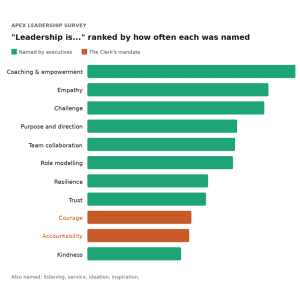
That is the gap. The mandate from the top was courage and accountability. The meaning from the room was coaching, empowerment, and empathy. Same building, same morning, same thousand people, two genuinely different definitions of what public sector leadership is.
It would be easy to wave this away. The Clerk sets direction, the executives describe daily practice, of course they emphasize different things. But that is too convenient. When the mandate from the top and the meaning held in the middle drift apart, you do not get a failure of effort, you get a quiet, persistent friction. Everyone works hard and the change still does not arrive at the pace anyone wants. I see the same gap in financial services, where boards ask for bold transformation while the executives running it define their job as protecting trust and developing people. It is one of the most common and least discussed reasons change stalls in this country.
Naming it is the first act of leadership. You cannot close a gap you have not admitted exists.
When an executive asked Sabia about human-centred leadership and psychological safety, he did not reach for a model or a framework. He reached for one word: culture. And he defined it about as plainly as it can be defined. Culture, he said, is not a fancy idea. It is simply how work gets done.
That definition is the quiet centre of everything he said this week. He was not calling for a revolution. He said more than once that he believes in the public service as an institution, that it rests on values worth protecting. What he was calling for was a shift in how the work actually gets done. Faster, more accountable, more willing to own a decision and move. A deliberate change in the culture of the bureaucracy, not a tearing down of it.
That reframes our survey gap entirely. The distance between the mandate and the meaning is not really a disagreement about goals. It is a cultural gap. It is the space between the beliefs and behaviours that define leadership in the public service today and the expectations the Prime Minister and the Clerk are now setting for the road ahead. Sabia was naming that gap out loud, and asking the room to help close it.
Here is the encouraging part. The executives are not starting from the wrong place. The qualities they put at the top of the survey, coaching, empowerment, and empathy, are exactly the cultural foundation a shift like this requires. You do not build a faster, braver, more accountable public service by stripping the humanity out of it. You build it by aiming that humanity at a clearer target. The shift the Clerk wants is not away from the room’s values. It runs straight through them.
Here is the turn that makes the gap useful rather than discouraging. The executives did not rank courage and accountability last because they undervalue them. They ranked them last because they understand the sequence the Clerk did not name.
Courage is downstream of empowerment. Accountability is downstream of trust. People take real risks when they have first been supported, coached, and given genuine room to own the decision, and they hold themselves accountable when they feel trusted enough to believe the decision is truly theirs. Demand courage from people who have spent years watching the organization punish risk and reward caution, and they will not become brave. They will find the nearest committee. A committee, the Clerk said, socializes risk: if a committee owns the decision, no single person does. Sabia knows the difference from the inside, having spent over a decade in a business where managing risk was the whole job, not a thing to be feared but a thing to be done well.
So the room, by putting coaching and empowerment at the top and courage and accountability at the bottom, was not rejecting the mandate. It was handing the Clerk the method for achieving it. You do not get the bottom of that list by demanding the bottom of that list. You get it by building the top of the list first.
The detail I keep returning to is that empathy and challenge tied near the top, together. That pairing is the whole game. For years, empathy got filed as a nice finish on top of real leadership. Our own executives say the opposite. It sat at the very top of what leadership is, in a room of people running departments through the most demanding period of their careers, right beside challenge. That is not comfort. It is the rare and difficult combination of understanding someone deeply while asking a great deal of them at once.
The wider Canadian data shows why empathy has moved to the centre. APEX’s own executive work and health research has tracked rising work intensity and long hours among federal leaders. Telus Health’s Mental Health Index has shown Canadian workers sitting well below their pre-pandemic mental health baseline, edition after edition. Gallup continues to find that only about one in five employees worldwide is genuinely engaged at work. You cannot extract courage from people who are running on empty. You first have to see them and support them.
This is the heart of what we mean at CareerJoy when we say human first, AI smart. The urgency and the technology are real, the Clerk was right about that. But the leadership that carries an organization through change is, stubbornly, human. Our Work. Made Better. Report points in the same direction the room did. Canadian professionals are not asking to be managed harder. They are asking for trust, room to make the call, and work that matters. Coaching, empowerment, empathy. The same short list, from the front line to the executive suite.
The moment that tied it together came late in his remarks. A mid-level executive stood up and asked the honest question. I hear you on courage and risk, but I am the one running into thirty year old rules. What do I actually do?
The Clerk’s answer quietly proved the room right. He admitted there was no clean solution. He was pushing deputy ministers to delegate, to decentralize, to coach rather than decide for everyone. Then came the part that matters most. I need you to demand it, he said. I need you to agitate. He described change spreading almost as a guerrilla activity, one leader taking a risk, getting backed rather than punished, and a hundred others quietly concluding they have permission too.
That is coaching and empowerment, described by a leader who walked in asking for courage. He wanted the outcome at the bottom of the list. The room handed him the method at the top of it.
If you lead a team in the public service, in financial services, or anywhere change is now non-negotiable, the lesson is not be braver. It is to mind the gap between what you are demanding and how your people define the work, and close it from the top of the list down.
That means coaching more and deciding for people less, pairing empathy with challenge rather than choosing between them, and handing real ownership down the hierarchy, then backing the person when the call does not go perfectly, because that single act teaches everyone watching what is now allowed. The Clerk closed on the most human note of the morning, that nothing motivates people more than pride in their work. After nearly three decades of coaching Canadian leaders, I have watched that hold true. Pride grows in exactly the soil the room described: coaching, empowerment, empathy, and trust. The courage and accountability grow there too, once the conditions are right.
Here is the part leaders most often miss. This is a journey, not a memo. Culture does not shift because someone at the top declares it should. It shifts when thousands of individual leaders change how they work, and when each change is seen, supported, and rewarded until the new way quietly becomes the normal way. That is slow, human work, and it is exactly the work we do at CareerJoy, in the federal public service and across the private sector. We help leaders and their organizations close the gap between what they are being asked to become and how their people lead today. Making work better has always been our north star. Making leadership better is how the shift happens.
The mandate was two words. The meaning was a fuller, wiser list. The Clerk was right that the moment demands a shift, and the room was right about what that shift is built on. The leaders who close the gap, rather than simply repeating the mandate louder, are the ones who will carry this country through the rare moment we are in.

Along the road with you,
Alan
Michael Sabia named the gap out loud. Add your voice to the Work. Made Better. Report 2026 and help shape what we know about how Canada’s leaders are closing it.
If your leadership team is being asked for more courage and accountability — that’s exactly the gap we help close at CareerJoy. Let’s talk about what it looks like to build the top of the list first.
Friday Leadership Report | Alan Kearns, Founder & Managing Partner, CareerJoy
Happy Friday,
I have a confession to make. Before COVID, I was not an F1 fan. Not even close. Formula 1 was background noise, something that happened somewhere far away, involving people I did not know in cars I could not tell apart. Then Formula 1: Drive to Survive landed on Netflix and, like a lot of Canadian families, we got completely hooked.
This past weekend, our family was in Montreal for the Canadian Grand Prix at Circuit Gilles Villeneuve. The city was electric. Around 360,000 fans packed the three-day event, which fell during a Canadiens playoff run, so you had bleu-blanc-rouge mixing with Ferrari red and McLaren orange throughout downtown and the paddock. It was genuinely one of those weekends that remind you why you love sport.
We are a divided household when it comes to teams. Some of my family bleeds Ferrari red. Others are McLaren orange through and through.
Me?
I am a Mercedes fan, and a George Russell fan specifically.

Sunday’s race was gripping. Teammates Kimi Antonelli and George Russell battled for 30 laps, swapping the lead repeatedly and nearly making contact more than once. Then Russell, who was leading, retired with a mechanical failure, and Antonelli took the chequered flag for his fourth straight win. It was a milestone: the first driver in Formula 1 history to claim his first four career victories consecutively. At 19, Antonelli joined Fernando Alonso, Lewis Hamilton, and Max Verstappen as the only active drivers to win four races in a row.
I was gutted for George. But I could not stop thinking about the leader behind all of this.
Before Kimi Antonelli had even driven a single competitive lap in Formula 1, something happened in the paddock that I keep coming back to. At the 2024 Italian Grand Prix, Antonelli made his F1 practice debut in front of his home crowd at Monza. He was 18 years old. Within 12 minutes, he lost control of the car at Parabolica and hit the barrier hard. A 45G crash. The session was over.
Toto Wolff, the Mercedes team principal and CEO, put his arm around him. And Antonelli, to his credit, was honest. He told Wolff he had confidence in himself but genuinely did not understand what had caused the crash.
Toto’s response was simple and completely direct: keep the confidence and trust the data.
Four words that are essentially a complete leadership philosophy.
Not “what were you thinking?” Not “we need to review your performance.” Not reassurance for its own sake, which can ring hollow anyway. Keep the confidence. And trust the data.
Keep the confidence. And trust the data.
That 18-year-old went on to win four consecutive races in his second F1 season. The leadership bet Toto made on him was not made on a podium. It was made in a garage at Monza, after a crash, before a single competitive lap had ever been run.
This is not just a Formula 1 story.
This is the defining challenge of leadership development in Canada right now.
Our Work. Made Better. Report consistently surfaces a tension at the heart of Canadian workplace culture: leaders know they need to be more data-informed, but they worry that leaning into data means losing the human connection that drives performance.
The instinct is to treat these as opposites. The evidence says they are not.
When Canadian leaders are asked what separates high-performing teams from average ones, the answer is rarely the analytics platform or the performance dashboard. It is psychological safety combined with clear accountability. It is a culture where people can be honest about what went wrong because they trust that the response will be measured and constructive rather than reactive and punitive.
Gallup research consistently shows that Canadian employees who feel their manager genuinely cares about them as a person are significantly more likely to be engaged, and engaged teams outperform disengaged teams on every business metric that matters: productivity, retention, profitability, and customer satisfaction. The human element is not separate from performance. It is a driver of it.
But here is the other side of that coin. Warmth without accountability is not leadership. It is avoidance dressed up as kindness. The leaders who do the most damage to their teams are often not the aggressive ones. They are the ones who care deeply about their people but never deliver a clear, direct message about what the data is showing.
Toto Wolff does both. That is the model.
The leaders we have coached at CareerJoy across nearly two decades of Canadian executive coaching, from federal public service leaders to financial services executives to military officers transitioning to civilian careers, share a common pattern when they reach their ceiling.
They have usually mastered one side of the equation.
The challenge is integrating both.
Some are extraordinarily gifted at the human side. They build trust quickly, people would walk through walls for them, and they create the kind of psychological safety that allows teams to take risks and be honest about failures. But when the data says something uncomfortable, they hesitate. They soften the message. They wait. And the team, which trusts them, starts to sense that the data does not quite match what they are being told. That gap erodes exactly the trust that was so carefully built.
Others are brilliant with data. They know their numbers, they can diagnose a performance problem with precision, and they hold people to clear standards. But they have underinvested in the human infrastructure that makes data useful. When they deliver a direct message, people brace instead of leaning in. The data is accurate, but the context is missing, and without context, accurate data can feel like an attack.
The leaders who consistently stand apart are the ones who hold both simultaneously.
Human first. Data smart.
What does that look like in practice? It looks like Toto putting his arm around a teenager who just crashed a race car and saying, in effect, “Your identity is intact, your confidence is warranted, and here is the information you need to get better.”
We see this pattern play out across Canadian organizations every single week.
A senior leader in the federal public service who needs to have a difficult performance conversation with a long-tenured team member. The instinct is often to delay, to soften, to protect the relationship. But the relationship does not actually need to be protected from honest data. It needs honest data delivered with genuine care. Those are not opposing forces.
A financial services executive is trying to build a culture of accountability on a team that has historically avoided hard conversations. The impulse is to focus on the metrics, to let the numbers do the talking, to keep it “objective.” But the metrics land differently when people feel seen as human beings first. The data does not change. Its impact does.
A military leader transitioning to the private sector who knows how to deliver direct, clear direction, but is learning that civilian teams need more context for the reasoning behind decisions. The content of the message is right. The frame around it needs adjustment.
In every one of these cases, the answer is the same. You do not have to choose between being human and being rigorous. The best leaders in Canada are doing both, consistently, under pressure. And for the organizations asking how to build that kind of leadership culture, the 2025 Work. Made Better. Report has been tracking exactly this gap across Canadian workplaces for years. The data is consistent: human-first leadership is not a soft skill. It is a performance strategy.
There is something else in the Montreal story worth sitting with.
George Russell’s retirement was brutal. He threw his headrest across the track. Slammed his fists into the car. Left in fury. And he had every right to be furious. He was leading the race. He had done nothing wrong.
But here is what I noticed: he did not attack his team. He did not attack Kimi. The frustration was real and human and entirely appropriate. And when it was done, it was done.
That is what a winning program looks like from the inside. You can be devastated without destroying the foundation. You can be honest about disappointment without undermining the culture that makes excellence possible in the first place.
That is not an accident. That is Toto.
Mercedes under Wolff won eight consecutive Constructors’ Championships. That run was built on exactly this philosophy: a culture where data is trusted, where honesty is expected, and where the human being in the driver’s seat is treated as the asset, not the liability.
The Work. Made Better. Report data reinforces this finding in Canadian organizational terms. Leaders who consistently integrate human connection with data-informed accountability are not just better liked. They produce measurably stronger outcomes across team retention, performance trajectory, and organizational resilience.
I do not know whether Kimi Antonelli will be a world champion. He is 19, he has four wins, and he is leading the championship. The odds are starting to look interesting.
But I know that the moment Toto Wolff put his arm around him in that Monza garage and said, “Keep the confidence and trust the data,” something important happened that had nothing to do with lap times.
A leader communicated to someone in a difficult moment: “Your value is not contingent on this result. Your growth is the priority. The information is here to serve you, not to judge you.”
That is the leadership model that Canada’s organizations need right now. Not the choice between empathy and accountability, but the refusal to accept that choice in the first place.
Human first. Data smart. Every time.
It was quite a weekend in Montreal.
Along the road with you,
Alan
What Toto Wolff figured out in a Monza garage, Canadian leaders are navigating every day.
Add your voice to the Work. Made Better. Report 2026 and help shape what we know about how Canada’s leaders are closing the gap.
If you recognize your organization in this post – leaders who are brilliant on one side of the equation but struggling to integrate both – that’s exactly the work we do at CareerJoy.
Let’s talk about what a human-first, data-smart leadership culture could look like for your team.
Friday Leadership Report | Alan Kearns, Founder & Managing Partner, CareerJoy
Happy Friday,
I have never seen The Devil Wears Prada.
There. I said it.
A colleague of mine, someone I deeply respect, was at the opening weekend for the new movie & was really looking forward to seeing it; it didn’t disappoint her.
So when The Devil Wears Prada 2 arrived, I figured I had no excuse. I watched both. Back to back. In one sitting.
What I did not expect was to come away thinking about leadership.

The thing about a great movie & a great book is that they do not just entertain. It holds a mirror up to the culture and lets you see what you have been pretending not to notice. Eat Pray Love did that. The Devil Wears Prada did that. And now its sequel is doing it again, but for a different moment, a different fracture in how we work and live and define success.
Anne Hathaway said something in a recent interview in the New York Times. She described Andy not as someone who had everything figured out, but as someone who had lived with real purpose and real adventure, and who was now quietly searching for the one thing that had slipped away: security.
Not success. Security. The distinction matters more than it sounds.
In 2026, in Canada, security is the area where many skilled, experienced, credentialed professionals are hard to find. The 2025 Work. Made Better. The report found that nearly six in ten Canadian professionals carry a persistent undercurrent of uncertainty about their career paths, even among those who, by every visible measure, appear to be thriving. These are not people who lack commitment or capability. These are people operating inside systems that quietly changed the rules without updating the agreement.
Andy Sachs, circa The Devil Wears Prada 2, would recognize that feeling immediately.
The film is not really about fashion. It is about what happens when a woman who made a brave choice, who walked away from power on her own terms, discovers the world did not hold her place. That the seat she vacated did not wait. That ambition, for women, has always carried a tax that men in comparable roles do not pay.
Emily Blunt put it plainly in a recent interview: “Ambition has long been treated as a flaw in women and a virtue in men.” She offered a reframe I think every leader in Canada should carry into their next performance conversation, their next promotion discussion, their next hiring meeting. Ambition, she said, really only means dreams with great purpose.
That is the whole definition. Full stop.
When we hold it that way, the question is no longer whether a woman is too ambitious. The question becomes whether we have built organizations capable of holding people with great purpose, or whether we keep designing systems that reward those who will make themselves smaller to fit.
The data here is not comfortable. Gallup’s 2025 State of the Global Workplace report found that women managers experienced the steepest decline in engagement among all groups tracked. Among managers, 34% of women report burnout compared to 27% of men, a 7-percentage-point gap that has persisted even as overall engagement numbers have shifted. They are absorbing more and being replenished less. That isn’t a personal resilience issue. That is a structural design issue with a personal angle.
What makes this finding particularly striking is its context. The same Gallup research shows that women are more engaged at work than men across eight of the twelve measured dimensions. They are more likely to know what is expected of them, to feel encouraged in their development, and to be invested in their organization’s mission. The ambition is there. The commitment is there. And yet the burnout rate is higher. That combination tells you something important: this is not a motivation problem. It is a sustainability problem.
In the Canadian federal public service, the representation milestone has quietly been reached. According to APEX, women have made up at least 50% of the federal executive community every year since 2020. At every level of the executive ranks, women now exceed workforce availability estimates. By the numbers, parity has been achieved.
And yet the Gallup burnout data tells a different story about what that parity actually costs. Reaching the table and being sustainably supported at the table are not the same thing. The invisible load, the untracked, unacknowledged cognitive and emotional labour that sits beneath the title and never appears on a competency framework, remains disproportionately carried by women executives. The job description does not capture it. The performance review does not see it. But the body keeps the score, and eventually the organization pays it in attrition.
This is the gap that representation statistics cannot close on their own. You can count how many people are in the room. You cannot count the cost of them staying there.
Miranda Priestly, the original, was not a villain. She was an adaptation. She became what the system required of her to survive at the top of it, and then she weaponized that adaptation against every woman who came after her. That is not a personal failing. That is what happens when a culture decides that to lead, you must become the sharpest version of what you once feared.
The Prosperity Project’s 2025 Annual Report Card on gender equity in Canadian corporate leadership further sharpens the picture. Women in the pipeline roles that are supposed to feed tomorrow’s executive table dropped from 55% in 2022 to 45% in 2025. That is a 10-percentage-point decline in three years. At the very moment many Canadian organizations believed the hard work of building the pipeline was largely done, the pipeline itself began to narrow.
I have coached senior leaders across Canada for nearly three decades in financial services, the public sector, and the military community. The leaders I see getting this right are not the ones who figured out how to be softer versions of the old model. They are the ones who did the harder work of becoming genuinely clear about who they are, what they value, and what kind of culture they are building through every decision they make, including the quiet ones nobody notices but everyone feels.
I think of it as grounded authority. You do not perform strength. You have it because you have done the work of knowing yourself. And when your people sense that, something shifts. Engagement deepens. Trust accumulates. The invisible tax on belonging starts to lift.
Gallup is direct on this point: up to 70% of the variance in team engagement traces directly to the manager. Not the strategy. Not the perks. The manager. Which means the investment most worth making right now, in Canada and everywhere else, is not another initiative. It is the development of leaders who know how to hold both results and people at the same time.
The first Devil Wears Prada permitted a generation of young women to want more. To see themselves in ambitious spaces. To believe that the corner office, the editor’s chair, and the boardroom were somewhere they could legitimately aspire to reach.
The sequel is asking the harder question. Not: can you get there? But: once you get there, can you stay whole? And more to the point: should staying require you to surrender the things that made you want the work in the first place?
Miranda Priestly never got to ask that question. The system she operated in did not have room for it.
I hope the leaders reading this on a Friday morning in Canada are asking it. And I hope the organizations they lead are ready to hear the answer.
Along the road with you,
Alan
The Work. Made Better. survey is exploring how Canadians experience ambition, leadership, burnout, clarity, and career sustainability in today’s workplace.
Your perspective helps shape the conversations and solutions organizations need most right now.
👉 https://www.surveymonkey.ca/r/WMB2026
The strongest leaders don’t just drive results, they create cultures where people can grow, contribute, and succeed without losing themselves in the process.
Friday Leadership Report | Alan Kearns, Founder & Managing Partner, CareerJoy
Happy Friday,
It finally feels like spring. And honestly, that shift in the air, that collective exhale after a long Canadian winter, is its own kind of leadership lesson.
I’ve been thinking about Roger Adams this week.
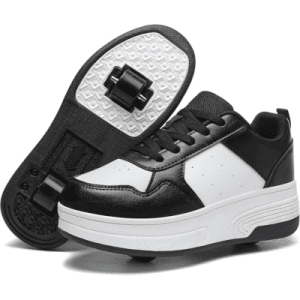
You may not know his name, but you almost certainly know his invention, Heely’s. Adams was the son of roller rink owners in Tacoma, Washington. He spent his early career as a psychologist and crisis counsellor, work he described as genuinely meaningful, right up until he moved into management to earn more money. That’s when things went sideways. “When I moved into management to make more money,” he said, “it was a miserable time.”
In 1998, at the age of 44, Adams was in the middle of a divorce and hating his job. He went on vacation to Huntington Beach, California, sat on the boardwalk, and watched the skaters, cyclists, and rollerbladers go by. Something shifted. He started imagining a shoe that could roll on command, just by shifting your body weight. A few years later, Heelys, sneakers with a retractable wheel embedded in the heel, were selling nearly eight million pairs a year.
But here’s the part that doesn’t make the headline: he didn’t invent it from ambition. He invented it because he needed to move again.
One of the most consistent findings is that leaders who feel stuck are not primarily stuck because of external obstacles. They’re stuck because they’ve lost their personal sense of forward motion. They’re walking, but they’re not rolling.
The language leaders use when this happens is telling. They say things like “I feel like I’m just managing, not leading.” Or “I used to love this work.” Or, quietly, “I wonder if this is it.”
This isn’t burnout in the clinical sense. It’s momentum loss. And it’s one of the most underdiagnosed leadership challenges we encounter at CareerJoy.
According to Gallup’s most recent State of the Global Workplace data, roughly 50 percent of Canadian employees describe themselves as not engaged at work. Among leaders, disengagement carries a multiplier effect. A disengaged leader doesn’t just underperform individually; they also undermine the team. They create what I call a momentum vacuum in the people around them.
Telus Health’s research on psychological safety in Canadian workplaces points in a similar direction: when leaders project certainty and direction, even on uncertain days, team-level wellbeing scores improve measurably. The leader’s State becomes the team’s weather.
Roger Adams didn’t redesign his career from a whiteboard. He sat down near the ocean, let himself rest, and noticed what caught his attention. That noticing was everything.
In coaching, we talk about this as an [LQ] Leadership Intelligence signal, that moment when your actual interests and your daily actions diverge so sharply that your body registers it before your brain catches up. The hair stands up on the back of your neck, as Adams described it.
Most Canadian leaders I work with don’t lack ideas. They don’t have the authority to take their own interests seriously at a professional level. There’s a kind of cultural modesty that runs deep here: the idea that prioritizing what energizes you is somehow self-indulgent.
That the work should just be done, whether it moves you or not.
That’s not leadership. That’s endurance.
Our 2025 Work. Made Better. Report found that leaders who could identify at least 2 areas of genuine interest and connection in their current role reported significantly higher scores in resilience, team trust, and long-term career sustainability. The data point isn’t surprising. The gap between knowing it and acting on it, that’s where the work lives.
Here’s what Heelys actually taught me. The design wasn’t about going fast. It was about allowing normal walking and rolling to coexist. “I wanted the wearer to be able to walk normally and then roll,” Adams said. The transition was the point.
That’s the principle most leaders miss when they’re rebuilding momentum.
They think reinvention means blowing up what exists, starting over and finding a completely new lane. Sometimes that’s true. But more often, the leaders I coach who find their way back to real engagement do it by embedding a wheel into what they’re already doing, one intentional shift, in a domain they already occupy, that lets them transition from walking to rolling.
In practical terms, this sounds like taking on a mentoring relationship in an area you’ve quietly wanted to develop. Volunteering to lead a cross-functional initiative that pulls on skills your current role underuses. Asking for a different kind of assignment, not a different job and having an honest conversation with your leader about what energizes you and what has stopped.
BCG’s research on leadership effectiveness in North America consistently finds that the leaders who sustain high performance over the longest period are not the ones who change jobs most frequently. They’re the ones who successfully renegotiate the terms of engagement within their existing roles, multiple times throughout their careers. Reinvention, at its most practical, is usually internal before it’s external.
There’s something particular about the Canadian leadership moment right now. After several years of economic uncertainty, labour market disruption, and the long psychological tail of the pandemic, Canadian leaders are tired in a specific way. Not the tiredness of overwork, exactly. They are tired of having operated in a sustained crouch, protective, cautious, waiting to see what comes next.
Spring, as a metaphor, earns its place.
The leaders who are moving well right now are the ones who are allowing themselves to stand up again. To ask what they actually want to build, rather than only what needs to be defended. To have the kind of conversations about their own development that they’ve been deferring.
The 2025 Work. Made Better. The report captures this tension clearly: Canadian leaders consistently rank “career clarity” among the top three things they wish they had more of, yet they are among the least likely to invest formal time in addressing it. There’s a gap between knowing you’ve lost momentum and giving yourself permission to find it again.
That gap is exactly where CareerJoy does its most important work.
Roger Adams lived 44 years before he sat on a boardwalk and let himself imagine something new. He had to hit a real low point before he gave himself permission to look.
You don’t have to wait for the low point.
This spring, I’d invite you to ask yourself one question:
Where in my work am I walking when I want to be rolling?
The answer usually knows where to find you. The question is whether you’re willing to hear it.
Work. Made Better. isn’t a tagline. It’s a direction. And it starts with you.
Along the road with you,
Alan
The Work. Made Better survey is exploring how Canadians experience work, leadership, clarity, and momentum in today’s workplace. Your perspective helps shape the conversations and solutions organizations need most right now.
Your perspective helps shape that understanding.
👉 https://www.surveymonkey.ca/r/WMB2026
The strongest leaders don’t just sustain performance, they create clarity, trust, and direction for themselves and the people around them. Explore how CareerJoy Leadership Solutions support leaders navigating growth, change, and reinvention in today’s world of work.
Friday Leadership Report | Alan Kearns, Founder & Managing Partner, CareerJoy
Happy Friday,
I almost made it through the week without the weight of it landing on me.
This morning, picking up flowers for my partner, I realized this is the first Mother’s Day I will not have my Mum on this side of heaven. Last year was the last time. She passed over a year ago now, and on the anniversary of that day, I sat with some things she had written and shared during her time in palliative care.
My mother was Irish. And if you know anything about Irish women, you know two things are non-negotiable: they have the gift of the gab, and they carry a wisdom that sounds casual but cuts right to the bone. Reading her words again reminded me how much of what I know about leadership I learned from watching my mother.
So this week, I want to write something a little different. I want to talk about mothers, women leaders, and the impossible tension we continue to ask women to hold in Canadian workplaces.
Here is what a mother does before 8 am on a Tuesday: she reads the emotional temperature of every person in the house, adjusts her communication style to meet each of them where they are, holds the anxiety of one child while redirecting the conflict of another, and somehow ensures that lunches are packed and the day moves forward. She does all of this without a title, a budget code, or a performance review.
That is not caretaking. That is leadership.
The qualities we now spend millions of dollars developing in senior leaders; emotional intelligence, psychological safety, situational awareness, and the ability to hold competing priorities without losing perspective, are qualities that good mothers have been practicing long before those terms existed in any corporate framework.
Our Work. Made Better. Report | 2025 shows that the leadership qualities Canadian employees most want from their managers cluster around communication, empathy, presence, and consistency. The qualities people say their leaders are missing. These are, almost precisely, the qualities that define effective mothering. That is not a coincidence. It is a signal.
Women make up nearly half of Canada’s workforce, but hold only 36% of management positions, and just 5% of Canadian companies have a woman as CEO. Let that sit for a moment. Half the talent. Five percent of the top chair.
The Prosperity Project’s Annual Report Card on Gender Equity and Leadership found that while women’s representation increased modestly across corporate director and executive officer roles in Canada, the consistent theme remains glacially slow progress, particularly for Indigenous women, Black women, and women of colour.
Canadian women earn 87 cents for every dollar men earn in comparable roles. Progress is being made. It is just not being made fast enough or evenly.
What troubles me most, after nearly three decades of coaching Canadian leaders, is not just the numbers. It is the invisible cost. The women I work with who are carrying both worlds, leading organizations and leading families, are doing so with a level of [LQ] Leadership Intelligence that most of their organizations do not even recognize, let alone reward.
There is a version of this conversation that is tidy and resolved. Women can have it all. Organizations are getting better. Things are improving.
I prefer the honest version.
Working mothers in Canada are navigating a structural contradiction. Three-quarters of part-time workers in Canada are women, and the top reason women give for working part-time is caring for children. Interruptions to women’s careers tend to be longer and more frequent than those experienced by men, and both short and long-term absences are linked to fewer promotions and salary increases.
The system has not been redesigned to support the full arc of a woman’s career. It has been patched. A parental leave policy here, a flexible work arrangement there. But the underlying architecture, how performance is measured, how presence is rewarded, how leadership identity is constructed, still tends to favour a model that does not account for what it actually takes to be both a committed leader and a committed parent.
I have coached many women in senior roles across Canada, including in financial services, healthcare, technology, and the public sector. The pattern I see most often is not a lack of ambition or capability. It is exhaustion from being exceptional in two places at once, with no permission to be human in either.
That is not a personal failing. That is a design flaw.
Canada’s federal investment in affordable childcare, the $10-a-day daycare mandate, and provincial engagement have already led to a roughly 25% drop in childcare costs since 2019, supporting a meaningful increase in the labour force participation of Canadian women with young children. That is what structural change looks like when it is real.
Organizations that are genuinely making progress on this are doing a few things consistently. They are measuring not just representation but retention across the full career arc. They are designing actual flexibility, not flexibility that quietly penalizes people who use it. And they are explicitly naming and rewarding the kind of leadership that comes from emotional intelligence, coaching capability, and the ability to build trust across differences. The leadership, in other words, that many working mothers have been developing their whole lives.
Organizations with higher psychological safety scores also tend to have stronger gender diversity at leadership levels. Those two things are not unrelated.
Psychological safety is, at its core, about creating conditions where people can show up honestly. That is a culture built by leaders who understand, often from lived experience, what it costs to suppress who you are to fit in.
She was a senior HR leader at her firm for over 30+ yrs.
She led. Every day. With warmth and with backbone, which is a combination that is rarer than people admit.
She would have had no patience for the version of leadership that requires you to perform strength by hiding what you feel. She understood, instinctively, that the ability to feel something and keep moving is not weakness. It is the whole thing.
I think about the women I know who are doing both right now, leading teams, raising families, holding more than any one person should have to hold, and I want to be honest with them: what you are doing is remarkable. Not because it should be this hard. But because you are doing it anyway, and doing it with more grace than the system deserves.
This Mother’s Day, I am thinking about my Mum. And I am thinking about every working mother who shows up on Monday morning with the full weight of the weekend still on her shoulders, and leads anyway.
That is [LQ] Leadership Intelligence.
That is Work. Made Better.
Along the road with you,
Alan
The future of work is shaped by the people experiencing it. Add your voice to the Work. Made Better. Survey.
Your perspective helps shape that understanding.
👉 https://www.surveymonkey.ca/r/WMB2026
EmpowerHer was created to invest more intentionally in the leadership women have been carrying long before most organizations recognized it.
Friday Leadership Report | Alan Kearns, Founder & Managing Partner, CareerJoy
Happy Friday,
There is no magic pill.
I know. You have heard about Ozempic. Maybe you have tried it, or know someone who has. The promise is seductive: one injection, one weekly ritual, and the weight dissolves. The problem, of course, is that when people stop, the weight returns. The pill was never the point. The lifestyle was the point.
Leadership works exactly the same way.
Every few years, a new framework arrives promising to transform how you lead. A new model. A new certification. A new workshop. And some of them are genuinely useful. But the leaders I have worked with across nearly three decades of coaching in Canada, from Calgary to Halifax, from corner offices to remote work-from-home setups, know something that the magic-pill crowd does not: sustainable leadership is not something you take. It is something you build.
The real question is not “what is the best tool?” The real question is: what is your superpower, and are you staying the course with it?
Jeffrey Katzenberg, the legendary co-founder of DreamWorks Animation, once explained his studio’s philosophy. He said they made movies for adults, and for the adult in the child, because that part of every kid already understands the more complex realities of life: beauty, friendship, love, and loss.
Think about that for a moment.
That’s very different from Disney, which creates movies for children & the child in the adult.
One of my favourite examples of that philosophy in action is Shrek. On the surface, it is a fairy tale about an ogre. Underneath, it is a story about belonging, about the courage to be seen as you actually are, about friendship that costs something. My kids watched it. I watched it. We were both watching completely different movies, and we both got exactly what we needed.
Most studios made children’s movies that talked down to their audience, simplified the hard parts, and wrapped everything in a bow. Katzenberg identified something different. He saw that the adult already living inside every child could engage with something real. The superpower of DreamWorks was not animation. It was emotional honesty delivered through a medium most people underestimated.
That is what great leaders do. They identify the thing they can do better than anyone else, the thing others overlook or undervalue, and they stay the course with it even when the market pressure says to simplify, to dumb it down, to chase the trend.
Michael Porter, the Harvard strategist, made the same argument from a different angle. Porter Airlines in Canada did not try to out-muscle Air Canada or match the race-to-the-bottom pricing of the discount carriers. They made economy flying something you actually enjoy. Not business class. Not a flying bus. Something you could look forward to. That single, stubborn commitment to a specific experience became the foundation of one of the most loyal customer bases in Canadian aviation
The leaders who struggle are rarely struggling because they lack talent. They are struggling because they haven’t named their superpower, or they have named it but abandoned it when things got hard.
The Work. Made Better. Report | 2025 Edition tracks the state of Canadian workplace experience, and what we are consistently seeing is a leadership identity crisis hiding inside a productivity conversation.
Canadian organizations are investing heavily in AI tools, process optimization, and organizational redesign. That investment is not wrong. But our research shows that the leaders who are thriving through this transition share a common characteristic: they have a clear, human-centred point of view on what they are actually trying to build, and they have not let the noise of transformation displace that clarity.
According to Gallup’s most recent State of the Global Workplace data, only about 23 percent of employees worldwide are engaged at work. In Canada, that number fluctuates but consistently falls short of what organizations believe they are achieving. Telus Health’s Mental Health Index has tracked sustained psychological strain across the Canadian workforce, with middle managers and senior leaders carrying disproportionate weight, not because they lack resilience, but because many of them are executing against someone else’s superpower instead of their own.
The BCG research on leadership effectiveness tells a related story: organizations led by people with a coherent, consistently communicated sense of purpose outperform their peers on both financial and human outcomes. Not occasionally. Systematically.
This is not soft data. This is competitive intelligence.
Here is where [LQ] comes in.
[LQ] is Leadership Intelligence, and it lives at the intersection of four things: commitment, character, competencies, and culture. Not one of them alone. All four, working together, visible under pressure.
Most leadership development focuses on competencies because competencies are the easiest to measure. Communication. Delegation. Strategic thinking. And these matter. But the leaders I sit across from in coaching sessions who are genuinely stuck are not stuck because of a competency gap. They are stuck because the other three dimensions have gone quiet. Their commitment has become habitual rather than intentional. Their character is shaped by the organization’s pace rather than the other way around. And the culture around them no longer reflects what they actually believe.
[LQ] is the capacity to lead from all four dimensions at once, to keep that thread visible under pressure, to use it as a navigation tool when the quarterly numbers are difficult, when a key team member leaves, or when the board is asking for a pivot.
The leaders with high [LQ] do not need a magic pill because they are not looking for a shortcut. They are looking for alignment between what they believe and how they lead. When commitment, character, competencies, and culture are pointing in the same direction, you do not lose energy to the gap. You are not performing leadership. You are practicing it.
And there is a measurable difference.
I want to name our own superpower here, because I think it is relevant to this conversation.
At CareerJoy, we have one job: Work. Made Better.
Not work made perfect. Not work optimized beyond recognition. Not work stripped of its human complexity in the name of efficiency. Better. Incrementally, sustainably, meaningfully better, for the people doing the work and the organizations they work within.
Our approach is human-first, AI-smart. We believe that the tools of this moment, including artificial intelligence, are genuinely powerful. But we have never believed that any tool replaces the judgment, the relationship, and the courage that real leadership requires. Tools amplify what is already there. If what is already there is unclear or misaligned, no tool closes that gap.
This is why the Katzenberg insight matters so much to me. He did not say “we make movies.” He said, “We make movies for adults, and for the adult in the child, because that part already knows.” That level of specificity is the superpower. That is what separates a studio from a legacy.
What is your version of that sentence?
The hardest part of having a superpower is not identifying it. It is defending it.
In the Canadian leadership context, the pressure to conform is real. There is pressure to follow the American leadership playbook. There is pressure to adopt whatever framework is trending in the Harvard Business Review. There is pressure, particularly in our current moment of AI acceleration and economic uncertainty, to abandon the long game in favour of the short win.
The leaders I admire most have a particular quality. They do not ignore the pressure. They feel it completely. And then they ask: Does responding to this pressure make us better at the thing we are actually here to do, or does it take us away from it?
That question is a compass. It does not tell you to stay rigid. It tells you to stay true.
People do not need perfect leaders. They need leaders who are predictable in the right ways: who show up, who name what they believe, and who lead from that place even when it would be easier to hide behind process or strategy or the next transformation initiative.
Before you head into your weekend, I want to leave you with one question to sit with.
If someone asked your team to describe your leadership superpower in one clear sentence, the way Katzenberg described DreamWorks, what would they say?
If the answer comes easily and your team agrees with it, you are already on the path.
If the answer feels uncertain, or if you suspect your team would describe something you no longer fully believe in, that is not a failure. That is the work. That is exactly where the most important leadership conversations begin.
Have a great weekend.
Along the road with you,
Alan
Through our Work. Made Better. national survey (in partnership with MNP), we’re building a clearer picture of how leadership, work, and experience are actually showing up right now.
Your perspective helps shape that understanding.
👉 https://www.surveymonkey.ca/r/WMB2026
Knowing your leadership superpower is one thing. Leading from it consistently, especially under pressure, is where the real work begins.
That’s the space we support leaders in every day, helping them align commitment, character, competencies, and culture so leadership feels less like performance and more like practice.
Friday Leadership Report | Alan Kearns, Founder & Managing Partner, CareerJoy
Happy Friday,
This week, I had the privilege of moderating a panel with some very thoughtful leaders in the public sector. Ima Okonny, Assistant Deputy Minister and Chief Data Officer at Employment and Social Development Canada: Heather DiPenta, Director General of Leadership and Learning at the Canada Revenue Agency. And Sven Byl, one of the sharpest minds in AI implementation from the healthcare sector in Canada.
The event was hosted with our friends at APEX, serving Canada’s public service executives.
We were talking about AI adoption. But honestly, we weren’t really talking about AI at all.
We were talking about courage. About psychological safety. About what it means to lead people through profound uncertainty when the map hasn’t been drawn yet, and the terrain is shifting under everyone’s feet.
At CareerJoy, we talk about Leadership Intelligence, or [LQ], as the integrated set of capacities that leaders who thrive in complexity possess over those who merely survive it. And the first principle of [LQ] is Leadership of Self. Knowing who you are. Understanding your own fears, biases, and blind spots and being honest about what you know and what you don’t.
That principle showed up in this panel, even when nobody named it directly.
Today, I want to share what I took from that conversation, because I think it matters well beyond the public sector. It matters for every leader in Canada who is trying to navigate a world where the tools are changing faster than the cultures they serve.
“AI is not a technical challenge. It is a human, an organizational, and a cultural one.”
Sven Byl, AI Strategist
This is the finding that keeps showing up, and our own 2025 Work Made Better. Report reinforces this: when transformations fail, it’s rarely because of the technology. They fail because of how people are led through the change. McKinsey’s research consistently puts that failure rate at around 70 percent of major organizational changes, not because the tools don’t work, but because the humans weren’t brought along.
When I asked the panel what drew them to this conversation, every answer circled back to the same place. People. The technology is real and accelerating, but the harder problem is what happens in the hearts and minds of the people sitting in those offices, working those files, serving those Canadians.
When ESDC went out and listened to its own network about the role AI will impact, what they found wasn’t resistance to AI. What they found was anxiety. People were afraid. Afraid of being replaced. Afraid of saying the wrong thing. Afraid to tell their manager that the AI tool they were told to adopt actually had some limitations they’d noticed.
That’s not an AI problem. That’s a human challenge and an opportunity.
“At one point, leaders managed tasks. Now they’re going to have to manage outcomes, because they’re going to do that with a combination of a digital and human workforce.”
Sven Byl, AI Strategist
Sven’s observation stayed with us throughout our session. He said we are moving from managing tasks to managing outcomes. That shift sounds subtle, but it is enormous. It means the leader who used to oversee the work now needs to develop judgement, the kind that lets them assess results they may not fully understand, produced by tools they’re still learning to use.
That’s a genuinely destabilizing experience for many leaders. And the instinct, understandable and human, is to pull inward. To control. To slow down and wait until the picture is clearer.
But Sven said something else that I’ve been turning over since. He said that when organizations genuinely run toward AI, when they give their people real exposure and real agency, those people will surprise you. They will find applications you never imagined. They will solve problems in ways that didn’t exist in any playbook. And the reason for that is simple: no one knows their work better than the person doing it.
That insight only becomes available to you when you build a culture of psychological safety, learning, and outcome focus. Take any one of those three away, and you lose it.
“If you were to ask me today what is the most important critical thing we need to worry about in leadership, I will tell you it’s courage. People are afraid to say they’re afraid.”
Ima Okonny, Assistant Deputy Minister and Chief Data Officer, ESDC
Ima shared wisdom for all leaders, saying courage is the most important leadership quality right now.
Not vision. Not a strategy. Courage.
Her reasoning was specific. She attends many speaking engagements on AI and data. She hears the same thing over and over. People are afraid to say they’re afraid. They’re afraid to tell their leaders what they’re observing. They’re afraid to admit they’ve adopted a tool but aren’t actually proficient at it, that they’ve learned to type prompts but haven’t matched the capability to the right problem.
That gap between adoption and proficiency is real, and we’re tracking it in our own research. There’s a meaningful difference between an organization that has rolled out AI tools and an organization that has actually integrated AI into how its people think and work.
Closing that gap takes courage from leaders first. The courage to model their own uncertainty. The courage to say to their teams: “I’m also learning this.” The courage to hold space for questions that don’t have answers yet.
Heather talked about her own experience of this as both a leader and a mother. Her observation was crisp, and it tracks with everything I’ve seen in leadership coaching over the years. Your people aren’t listening to what you say about AI. They’re watching what you do. They’re watching whether you actually use it. Whether you experiment. Whether you acknowledge what you don’t know. Whether you treat a failed pilot as information rather than failure.
“When people understand the sandbox, there is a sigh of relief. They know they’re not going to get in trouble if they’re courageous and try something.”
Heather DiPenta, Director General, Leadership and Learning, CRA
One of the strongest questions from the audience was about sandboxes. How do you create safe environments to test AI in organizations where risk tolerance is low and accountability is high?
Heather described it well. CRA’s approach was to start with the policy instruments that already define what’s permissible, particularly around privacy and employee information, and then build guidelines within that frame. Not a heavy policy. More like a clear articulation of where the boundaries of the experiment sit, so people know they can be courageous without wondering if they’re going to get in trouble.
The result she described is one I’ve heard echoed across the organizations we work with at CareerJoy. When people understand the sandbox clearly, there is a visible sigh of relief. They can move. They can try. They can fail forward without fear of consequence.
I’m going to take it further. ESDC built a platform that embeds the privacy, security, and cyber controls directly into the environment, so the guardrails travel with the tool rather than sitting outside it. Over 200 initiatives are running across the organization right now. The practice became embedded, not bolted on.
The key, she said, is defining the problem first. The failure mode she keeps seeing is organizations that treat AI as a solution looking for a problem, rather than starting with a clear problem and asking whether AI is the right tool to solve it. Heather echoed the same point. Sometimes you do the work and realize the answer isn’t AI at all. Maybe it’s a process change. Maybe it’s a different way of thinking about the work. The discipline of starting with the problem rather than the tool is itself a form of leadership maturity.
“This wasn’t an AI project. This was a clinical improvement project which happened to use AI. And when you think about it that way, that’s where you really do expand the power of the technology.”
Sven Byl, AI Strategist
The panel was asked a question I think every Canadian leader should be asking right now. How do we define success for AI beyond cost savings? What human-centred KPIs should we actually be tracking?
Sven gave concrete examples. In a healthcare context, the measure wasn’t whether patients showed up on time for colonoscopies. The real measure was whether the intervention improved test viability specifically in First Nations communities, where historical failure rates had been significantly higher. The AI was incidental. The clinical improvement was the point. The equity outcome was the success metric that mattered.
That reframe is worth carrying into every sector. This isn’t an AI project. It’s a clinical improvement project that happened to use AI. Or a service delivery project. Or a policy outcome project. The technology is the how. The human benefit is what?
Consider ESDC’s fairness assessment framework, which explicitly examines demographic characteristics and indicators of who is advantaged and who is not when AI systems are deployed. The question isn’t just whether the system works. The question is whether it works equitably across languages, geographies, and the full diversity of Canadians the public service exists to serve.
“We’re doing it for people. For Canadians from coast to coast to coast. The technology is a means. The people are always the point.”
Ima Okonny, Assistant Deputy Minister and Chief Data Officer, ESDC
I want to come back to something that ran underneath the whole conversation.
The first principle of [LQ], Leadership Intelligence, is Leadership of Self. It’s the foundation on which everything else is built. You cannot lead a team through uncertainty until you’ve made peace with yourself. You cannot create psychological safety for others if you haven’t done the internal work of acknowledging your own fears and gaps. You cannot model the courage you’re asking for if you haven’t found it first.
Every one of the panellists came back to this, in their own language. Ima talked about self-awareness and knowing your blind spots. Heather talked about modelling the behaviour you want to see and doing it visibly. Sven talked about building the judgment and learning orientation that allows you to run toward uncertainty rather than away from it.
That’s not a coincidence. That’s the same principle surfacing across three very different leaders in three very different organizations because it’s true regardless of sector, title, or the nature of the change.
The leaders on this panel weren’t talking about the future of work as though it were coming. They were talking about it as if it were already here.
What changed during COVID wasn’t capability. It was permission. People had a joint purpose, a burning platform, and they moved at a speed that most of them had been told was impossible for the public sector.
AI is the next version of that question. Not whether it’s possible. But whether we have the courage, the common purpose, and the leadership culture to actually to do it.
The CareerJoy Work. Made Better. Report have consistently shown that the leaders who navigate change successfully are not the ones with the best change management frameworks. They’re the ones who understand their people deeply, communicate with radical transparency, and model the behaviours they’re asking others to adopt.
Only 16 percent of employees in Canadian organizations feel adequately prepared for the change management dimension of technology adoption and the move toward agentic AI. That number should stop every leader reading this in their tracks. It means the vast majority of your people are navigating something that feels genuinely threatening without the support, clarity, or confidence they need to do it well.
That’s not an AI gap. That’s a leadership gap. And closing it starts with [LQ].
The future of work in Canada is now & will be built by leaders who are willing to be courageous, visible, and honest about what they know and what they don’t. It will be built by organizations that invest in the human side of change with the same seriousness they invest in the technology itself.
As Ima put it in her closing thought, “We are doing this for people. For Canadians from coast to coast to coast. For the colleagues we work alongside. The technology is a means. The people are always the point.”
That’s something I’ve believed since the first day of my work at CareerJoy. Work. Made Better doesn’t mean work made perfect by machines. It means work made more human, more meaningful, and more worthy of the people doing it.
If you’re a leader looking for support navigating this moment, coaching your team through change, or building the leadership culture your organization needs to run toward this rather than away from it, I’d love to start that conversation.
Along the road with you,
Alan
We’re continuing to explore how leaders and teams across Canada are experiencing this shift.
If you haven’t yet, take 3 minutes to share your perspective through the Work. Made Better. Survey:
👉 https://www.surveymonkey.ca/r/WMB2026
The leaders who move through this well won’t have all the answers—but they will invest in how they show up.
If you’re looking for space to think, challenge your assumptions, and lead with greater clarity through change, our coaching work is designed for exactly that.
Explore how we can support you:
FLR | Behind Every Mission: What Artemis II and Canada’s Families Teach Us About Leadership Support Systems
Friday Leadership Report | Alan Kearns, Founder & Managing Partner, CareerJoy
Happy Friday,
I have a confession. Last Friday night, I was not doing anything particularly sophisticated. I was glued to a screen, heart rate slightly elevated, watching a capsule carrying four human beings splash down in the Pacific Ocean after orbiting the moon.

I have been a space junkie since I was a kid. My parents were curious people in the best possible way, and they took me to Cape Canaveral a couple of times for tours. Something about that place, the scale of it, the ambition of it, never left me. So when Artemis II launched, I was all in. For ten days, I followed it with real intention, tracking every phase, every update.
What I expected to be inspired by was the science. The engineering. The audacity of pointing four humans at the moon and saying, go.
What actually moved me most was the humanity.
Canadian astronaut Jeremy Hansen. Commander Reid Wiseman. Christina Koch. Victor Glover. Four people representing, in a very literal sense, tens of thousands of people who made that mission possible. Engineers. Rocket specialists. Weather teams. Finance professionals. Nutritionists. Health professionals. Helicopter pilots. Navy crew. Manufacturers. And behind every single one of those people are families.
Christina Koch shared something really special. On launch morning, the crew was woken up by a knock on the door from Transportation Secretary Sean Duffy himself. And then, before she went to sleep aboard the ship on the return leg, a nurse asked if it was okay to hug her. She described it as the human bookend of the trip.
That phrase lodged itself in my head immediately, because it is exactly what great leadership culture looks like. It starts and ends with the human being in front of you.
And then there was the moment that genuinely made me tear up. On 6 April, as the crew conducted their lunar flyby, Jeremy Hansen proposed naming a previously unnamed bright crater on the boundary of the moon’s near and far side after Carroll Taylor Wiseman, Commander Reid Wiseman’s late wife. This registered nurse passed away from cancer in 2020. The crew asked Mission Control. Mission Control said yes. The name Carroll now sits on the surface of the moon, awaiting official approval from the International Astronomical Union, visible from Earth with the right equipment on a clear night. They also proposed naming the second crater “Integrity” in honour of their spacecraft.
Think about what that moment represents. In the middle of one of the most technically complex missions in human history, four people took a breath and made space for grief, for love, for the people who didn’t make it to the launch but shaped the ones who did.
Here is what most of the coverage missed: this mission did not succeed because four extraordinary people got into a capsule. It succeeded because of the quality of the ecosystem surrounding those four people.
The 2025 Work. Made Better. Report. consistently surfaces something that leaders underestimate: the degree to which individual performance is downstream of relational infrastructure. When people feel supported, not just professionally but as whole human beings with families and lives and grief and hope, they perform at a different level.
The Artemis II team understood this. The nutritionists, the health professionals, the families gathered at Cape Canaveral, the nurse who asked Christina if she could have a hug. None of these people had their name on the side of the rocket. All of them were part of why it came home.
This brings me to something close to my heart.
CareerJoy has a meaningful, ongoing partnership with CFMWS (Canadian Forces Morale and Welfare Services), supporting military family spouses in career development and transition. And when I watched the Artemis II families on that beach, watching that capsule come down, I thought about them immediately.
Because military families know something about this better than almost anyone.
Statistics Canada released its first comprehensive portrait of Canadian military families in January 2025, drawing on census data collected for the first time in fifty years. There are 345,180 military family members in Canada. Nearly half of the people in active military couples had lived in a different Canadian city or municipality in the five years before the census. The Vanier Institute of the Family puts it plainly: Canadian military families move three times more often than civilian families.
That is not a career inconvenience. That is a life rebuilt, repeatedly, on someone else’s timeline.
It is not just the months-long overseas deployments that reshape a family. It is the constant movement, the base-to-base transitions, the career interruptions for spouses who gave up their own professional trajectories so the family unit could hold together. A 2023 Canadian Armed Forces study found that military spouses face higher unemployment rates due to the nature of their mobile lifestyle. And the consequences ripple outward: research cited by HRD Canada indicates that CAF members are leaving the military service sooner because their partners are having a harder time sustaining their careers.
This is not just a family issue. It is a retention and readiness issue for one of Canada’s most important institutions.
The astronaut’s spouse waits at home and watches a rocket launch. The military spouse waits at home, manages a household, raises children, builds something resembling a career, and does so without the spotlight and often without recognition. Then they do it again at the next posting.
The work we do through our CFMWS partnership is not charity. It is an acknowledgment of a leadership truth: you cannot have high-performing people without high-functioning support systems. The spouse who keeps the family stable is doing leadership work. The parent who holds it together for three months while their partner is deployed is doing leadership work. They don’t have a job title for it.
You may not be sending anyone to the moon this quarter.
But I would invite you to think about your own Artemis II question: who are the people in the ecosystem around your high performers that you have never formally acknowledged? The partner who picks up the children every time there is a late deadline. The parent who took on more so their adult child could take a stretch assignment. The colleague who covered quietly during a difficult season.
Our 2025 Work. Made Better. Report data show that Canadian leaders consistently rate team culture as a top driver of engagement. Yet, fewer than half describe having formal practices to acknowledge the broader support systems their people rely on. We recognize the astronaut. We rarely recognize the nurse who asked if a hug was okay.
That gap is a leadership opportunity.
[LQ] Leadership Intelligence asks us to consider the quality of our awareness, not just of our direct reports, but of the full human context they are operating within. The Canadian leaders I coach who get this right do not just retain talent longer. They build cultures where people bring more of themselves to work because they trust the organization sees more of who they actually are.
A bright spot on the moon, named after someone who never made it to the launch. Visible from Earth with the right equipment.
That is what a great organizational culture does. It holds space for the people who shaped us. It makes the invisible visible. It acknowledges that behind every high performer is a constellation of support, sacrifice, and love that never appears in a performance review.
We are in the business of making work better for Canadians. That starts with seeing the whole person, and the whole team behind the team.
Have a great weekend.
Along the road with you,
Alan
We’re continuing this work through our 2026 Work. Made Better. national survey, in partnership with MNP. It takes just 3 minutes, and your perspective will help shape a clearer picture of how work is actually experienced across Canada.
👉 https://www.surveymonkey.ca/r/WMB2026
Our CareerCOACH+ program, delivered in partnership with CFMWS, helps military spouses navigate career transitions and build continuity in the face of constant change. Because strong systems support strong people.
FLR | The Bookend Principle: The Simple Daily Practice Helping Canadian Leaders Beat Burnout and Perform at Their Best
Friday Leadership Report | Alan Kearns, Founder & Managing Partner, CareerJoy
Happy Friday,
I was sitting with one of our long-standing corporate partners in financial services earlier this week. We were deep in a conversation about why their senior leadership team keeps running out of runway by Thursday, and somewhere between the second coffee and a candid admission that their strategy wasn’t the real problem, they said something that stopped me cold.
“Alan, I think we have a morning problem. And an end-of-day problem.”
I asked them to say more. What they described next was so elegantly simple that it almost didn’t feel like it should carry the weight it does. They called it the bookend practice. And after nearly three decades coaching Canadian leaders, I can tell you this: the simplest principles are almost always the ones that address the most complex challenges.

Before I get into the bookend practice itself, let’s ground this in what is actually happening in Canadian workplaces right now, because the stakes for getting daily structure right have never been higher.
According to the Telus Health 2025 mental health index, 59 percent of Canadian workers report feeling somewhat or extremely burnt out, and nearly a third say their mental health is directly affecting their productivity. That is not a rounding error. That is a crisis hiding in plain sight inside most leadership teams.
A 2024 Boston Consulting Group report surveying 11,000 workers across eight countries found that 52 percent of Canadian respondents reported being burnt out, above the global average of 48 percent. We are not performing well on this metric as a country.
Here is what strikes me about those numbers. The problem is not that Canadian leaders are working longer days by a dramatic amount. What has changed is the quality of how those hours are entered and exited. The burnout is not happening in the middle of the day. It is accumulating at the edges, in the unstructured, reactive gaps at the start and end of every workday that nobody has claimed with intention.
Our own CareerJoy Work. Made Better. Report data reinforces this pattern. Canadian leaders who report high engagement and sustained energy throughout the week are not necessarily working fewer hours or carrying lighter portfolios. What they share, almost without exception, is something intentional at the edges of their day. The beginning. And the end. The bookends.
The Telus Health data also found that employees in high-trust organizations were 76 percent more engaged and reported lower rates of stress and burnout, and that workers in supportive environments lost an average of 27 days per year to mental health challenges, compared to 55 days in unsupportive workplaces. That gap, 28 days per person per year, is the cost of culture. And culture starts with how leaders show up. How leaders show up starts with how they prepare.
My corporate partner’s practice is straightforward. Every morning, they take thirty minutes before the first meeting, before the first message, before the reactive fog of the day sets in. In that window, they do two things: they scan their calendar with intention, and they identify two positive outcomes from the day before.
Not what went wrong. Not the backlog. Two things that actually moved.
At the end of the day, before they leave the office, their desk is completely organized. Not tidied. Organized. Papers filed, notebooks closed, surfaces clear. Every time. No exceptions.
That is the whole practice. A morning orientation and an evening close. Thirty minutes in. Five minutes out. Bookends.
When I heard this, I did not just nod politely. I recognized it immediately. This is what our Work. Made Better. Report data keeps pointing to, but rarely names this precisely. When we ask Canadian leaders what separates those who sustain performance across quarters from those who flame out, the answer is rarely strategy. It is almost always structured at the margins of the day.
This is not soft thinking. The research here is substantial.
Research from the University of California, Irvine, found that after a single interruption, it takes an average of 23 minutes to fully return to a state of deep concentration, and the average knowledge worker experiences between 50 and 60 interruptions per working day. Without a structured morning orientation, most leaders are reactive from the moment they receive the first notification. They never reach depth. They manage the surface all day long and wonder why they feel exhausted but unaccomplished by Thursday.
The morning review of positive outcomes is not a gratitude exercise in disguise. It is a cognitive priming strategy. When you deliberately surface evidence of your own effectiveness before the day begins, you activate a completeness orientation rather than a deficit orientation. You walk into your first meeting not scrambling to prove yourself but anchored in what you already know you can do. You ask better questions. You make cleaner decisions. Research on decision fatigue, drawn from Roy Baumeister’s work and replicated across multiple studies, consistently shows that decision quality degrades throughout the day. Morning hours, before the day’s decisions accumulate, are a time of peak cognitive capacity for most people.
The end-of-day desk ritual is the other half of the equation, and the one most leaders skip because it feels optional when you are in a hurry to get home. It is not optional. Research in environmental psychology points consistently to the relationship between physical workspace organization and cognitive closure, the brain’s ability to signal that a period of work is genuinely complete. When you leave a desk in disarray, your nervous system does not fully disengage. You carry micro-tension home. You sleep lighter. You arrive the next morning already mid-loop on yesterday’s unfinished thinking. That is not a productivity issue. That is a resilience issue.
Research has also found that regular work processes allow people to spend less cognitive energy on recurring tasks, freeing up focus and creativity for more complex work. The bookend practice is exactly this. It converts two of the most cognitively expensive moments of a leader’s day, the transition into work and the transition out of work, into low-effort, high-payoff rituals that the brain can eventually run almost automatically.
From an [LQ] leadership intelligence lens, the bookend practice is more than a productivity habit. It is an expression of something more fundamental: the belief that how you enter a moment and how you exit a moment shapes everything that happens in between.
Leaders with high [LQ] understand that leadership intelligence is not just about what you know or how quickly you can process complexity. It is about the daily architecture of your attention. Where does your focus land first? What signals do you send your team by how you arrive and how you close? What does your presence communicate about your relationship to the work?
When a leader begins their day anchored in two genuine wins from yesterday, they bring a different quality of energy into the room. It is not manufactured positivity. It is grounded momentum. And when they leave a clear desk at the end of the day, they are making a quiet declaration: I have closed this chapter. Tomorrow, I start fresh.
Our Work. Made Better report consistently finds that Canadian employees who describe their leaders as effective and steady also see those leaders as prepared and intentional rather than perpetually reactive. The bookend practice is one of the clearest operational expressions of that quality I have seen.
We are in a moment in Canadian workplaces where the complexity is genuinely high. Economic uncertainty, hybrid work friction, talent retention pressure, and the accelerating demands of AI adoption are all landing on the same desks at the same time.
According to a 2025 national survey by Mental Health Research Canada and Canada Life, for a company with 500 employees, burnout-related productivity losses and salary costs can exceed 3.4 million dollars annually. Organizations that prioritize burnout prevention can save approximately 1.7 million dollars per year. That is a structural argument for daily leadership rituals, not a wellness argument.
The same research found that only 36 percent of employees say their workplace offers real programs to prevent burnout, and that heavy workloads are the primary source of stress for 74 percent of employees. Leaders cannot always fix the workload. But they can model what intentional leadership looks like at the edges of the day. And that modelling matters more than most organizations realize.
When leaders build bookend practices, they create permission structures for their teams to do the same. Culture does not flow from policy. It flows from what leaders actually do, every day, at the margins of their time.
If the bookend practice resonates, here is how to begin without overhauling your entire schedule.
First, set aside 30 minutes before your first meeting tomorrow morning. No email. No messages. Open your calendar and read it with intention. Then write down two specific outcomes from yesterday that genuinely moved forward. They do not have to be large. They have to be real.
Second, set a reminder for fifteen minutes before you plan to leave today. Use that time to clear your desk completely. File what needs filing. Close what needs closing. Leave the surface clean.
Third, do both of those things for five consecutive days and notice what shifts. Not in your productivity numbers. In your quality of attention. In how you enter rooms. In how quickly you reach clarity in the morning rather than spending the first hour finding your footing.
The smartest leadership advice is often the simplest. Not because complexity does not matter, but because disciplined simplicity is what holds when everything else gets complicated.
And everything always gets complicated.
Start strong. Close clean. Repeat.
Along the road with you,
Alan
As AI reshapes how work gets done, the real challenge isn’t the technology, it’s how leaders manage focus, decision-making, and team capacity under increasing demands.
Join us at our upcoming APEX panel to explore the human side of AI adoption.
👉 Register to be part of the conversation.
We help leaders build the habits, structure, and focus needed to perform at their best, without burning out.
Why the Best Brands Know Exactly Who They Are (And Canadian Leaders Should Too)
Friday Leadership Report | Alan Kearns, Founder & Managing Partner, CareerJoy
Happy Friday,
I have been a car guy my whole life. Long before I understood anything about leadership, I understood brands. I could spot a car three blocks away and tell you not just the make and model but what that driver was probably telling the world about themselves. Cars were the first place I learned that identity is not accidental. It is a choice, whether you make it consciously or not.
The tagline has always fascinated me as the sharpest expression of that choice. A few words that have to carry enormous weight. They have to attract the right person and, just as importantly, repel the wrong one. That precision is not marketing cleverness. It is clarity of identity.
Think about what BMW did with “The Ultimate Driving Machine.” Four words. And you immediately knew who that car was for. Someone who wanted to feel the road, who cared about performance over prestige, who saw driving as an act, not a commute. Compare that to Lexus and “The Relentless Pursuit of Perfection.” It spoke to a different buyer entirely. Someone who wanted to arrive, who valued refinement and quiet excellence, who equated quality with status. Both taglines worked, for a long time, because they were true. The product delivered on the promise.
But here is something I want to share with you because it matters for how you lead and how you build your organization’s identity. There is something quietly dangerous in the word “relentless.” And there is something philosophically impossible in the word “perfection.”
You can never get there by design.
I want to be empathetic here because I understand the instinct. Leaders who set high standards and chase excellence are not wrong to do so. That drive is usually born from genuine care about the Work. The problem is not the ambition. It is what happens when ambition becomes the culture.
A 2025 meta-analysis in the Journal of Occupational and Organizational Psychology found that while perfectionism was linked to longer working hours, it produced only a marginal improvement in actual performance. People work more. They do not necessarily produce better results. The cost to the individual, however, is high. Research consistently shows that concern-based perfectionism, the kind where fear of failure and worry about others’ expectations drive the Work, is strongly associated with exhaustion and burnout.
And in Canada right now, that is not an abstract risk. According to a March 2025 Robert Half survey of 1,500 Canadian professionals, 47% of workers report feeling burned out, up from 42% the year before and 33% the year before that. The trend line is not encouraging. Canadian workers in high-trust organizations, by contrast, are 76% more engaged and report significantly lower rates of stress and burnout. The culture is the variable. Not the people.
Research from French and Canadian organizations found that perfectionist work cultures are associated with increased employee burnout and disengagement, particularly in high-pressure industries. When the organizational promise is a relentless pursuit of an unreachable standard, what you often get is not excellence. You get people who are exhausted, insecure, and quietly starting to check out.
In our CareerJoy Work. Made Better. Report, we see this pattern clearly. Leaders who define their culture around an unreachable ideal tend to attract high performers initially, but struggle to keep them. People arrive energized and leave depleted. Not because the Work was not meaningful, but because the standard was never actually achievable, and everyone quietly knew it.
Your leadership brand is not your resume. It is not your title. It is the consistent impression you leave on the people around you. The things they say about you when you are not in the room. The emotional signature of what it feels like to work with you or for you. And like every great brand, its power comes from two things: consistency and clarity.
Ninety percent of consumers buy from brands they trust, and consistent branding has been shown to increase revenue by more than 20% for a significant portion of businesses. The leadership parallel is direct. People follow leaders they can predict, not in a boring way, but in a trustworthy way. They need to know what you stand for and what you will not compromise on.
The problem is that most leaders have never deliberately defined it. They operate on instinct and assume their team just knows. Research shows that only 28% of organizations have a solid, consistent employer branding strategy. In my experience coaching leaders across Canada, the number with a clear personal leadership brand is even lower. Leaders often know what they do. They rarely know how to articulate who they are.
Over 60% of people say their decisions about who to follow, buy from, or Work for are heavily influenced by the values a brand or leader visibly demonstrates. Your people are making the same calculation about you every single day. Does this leader mean what they say? Do their actions match their words? Is there a there there?
The best brands in the world know who they are and who they are not. They do not drift. They do not rebrand every time the market shifts nervously. They evolve, yes, but their core identity remains stable.
Weaker brands keep changing their story. They chase what is popular. And in leadership, we see it constantly. The manager who is collaborative one quarter and autocratic the next, depending on the pressure they are under. The leader who espouses psychological safety in the town hall and then shuts down dissent in the next meeting. That inconsistency does not go unnoticed.
This is where [LQ] becomes essential. One of the things we work on deeply in the [LQ] framework is helping leaders build what I call identity clarity. A precise, honest articulation of the values and strengths that are consistently true about you. Not aspirational. Not performative. True. The kind of thing your best people would say about you without being prompted. That is your brand. And when it is clear, it becomes a compass.
I want to name something directly. At CareerJoy, our brand promise is Work. Made Better. Not Work. Made Perfect.
That was a deliberate choice. And it reflects everything I have been describing.
Better is achievable. Better is measurable. Better acknowledges where you are today and points honestly toward where you are going. Better creates momentum. Perfect creates paralysis.
When we work with corporate partners across Canada on leadership development and career strategy, we are not promising their leaders will be flawless. We promise that their leaders will be more self-aware, more consistent, and better able to build the kind of trust that actually retains people and drives results. That is a promise we can keep. That is a brand we can live.
The 2025 WorkMade Better Report reflects the same thinking. We gather real data from real Canadian workplaces, not to hold up an impossible benchmark, but to help organizations understand where they are and what a meaningful step forward looks like for them. Progress over perfection. Clarity over aspiration.
Here is what the data consistently shows: the organizations that perform best over time are not the ones claiming to be perfect. They are the ones that are honest about where they are, clear about what they value, and relentless, if you will allow me that word just once, about actually living those values day to day.
So here is what I want you to sit with today. What is your tagline?
Not the one you would put on LinkedIn. The real one. The one that captures what you actually stand for as a leader. What would your team write on the inside cover of the book about your leadership? The promise you implicitly make every time you walk into a room.
And then ask the harder question. Is that a promise you can actually live by? Not just on your best day, but on a Tuesday in November when the budget is tight, and the team is stretched, and nothing is going right? Because a brand promise you can only keep under ideal conditions is not a brand. It is a marketing campaign.
Choose your brand carefully. Make it true. Make it something you can sustain, something that does not hollow you out or exhaust your people in pursuit of an unreachable ideal.
Better is enough. Better, lived consistently, is actually remarkable.
That is not relentless. That is just good leadership.
Along the road with you,
Alan
We help leaders define their leadership identity, build consistency, and create cultures people trust.
👉 Explore our leadership development programs.
Supporting women in defining their leadership identity, building confidence, and leading with clarity and consistency.