
Friday Leadership Report | Alan Kearns, Founder & Managing Partner, CareerJoy
Happy Friday,
I would love golf if it were six holes. I’ve said this out loud to more than one club member and gotten the same polite, pitying look each time, but I’m sticking to it. I love being outside, I love the game’s rhythm, I just don’t need eighteen holes of it to feel the pull. Give me six and I’m satisfied.
There’s a course I pass every time I drive up to the cottage, tucked along the Rideau corridor near Smiths Falls, Ontario. It’s an unassuming stretch of fairway you’d drive right by without a second look, except that it happens to be where one of Canada’s most successful female golfers learned the game. Brooke Henderson started swinging a club there at age three, taught by family, shaped by a small-town club, and eventually turned into a two-time major champion and the winningest Canadian professional golfer in history, man or woman.
Henderson made headlines again this summer, not for a tournament finish but for an engagement. What struck me wasn’t the announcement itself, it was what she said around it. After a stretch that included the loss of her longtime caddie (her sister Brittany, on maternity leave), a run of quiet results, and then a resurgence at the majors, Henderson credited her life off the course for fuelling her success on it. Not despite it. Because of it.
That is not a small thing for a leader to sit with.

I hear this phrase constantly in coaching conversations: “I’m good at compartmentalizing. Work stays at work.” It’s said with a kind of pride, as though the ability to wall off one part of life from another is a leadership skill worth boasting about.
I don’t believe it’s true, and I don’t think it’s even possible in the way people mean it. We are not two different people, a work version and a home version, switching costumes at the office door. We are one person carrying one nervous system, one set of relationships, one capacity for patience and presence, through every room we walk into. What depletes you in one context shows up as residue in the next. What restores you in one context shows up as fuel in the next. Henderson’s own words made that plain: her relationship, her family, her faith, all of it was not a distraction from her golf, it was the foundation under it.
Canadian leaders are, slowly, starting to reckon with this. But the data suggests we still have real ground to cover, and it lands hardest on the people running the organization.
Statistics Canada’s new Canadian Survey on Working Conditions, released in January 2026, is the first release of its kind, and it puts hard numbers to something leaders often only sense anecdotally. Workers in management occupations reported frequently working to tight deadlines at nearly double the rate of workers in jobs requiring a high school diploma or less, and over a third of managers said they completed unpaid work in their free time several times a month or more just to keep up. Men in particular reported workdays stretching past ten hours at close to double the rate of women, a pattern that quietly reshapes what happens at home long after the workday is supposed to have ended.
A separate national study from Mental Health Research Canada, surveying over five thousand employed Canadians, found that thirty-nine per cent of employees now report feeling burnt out often or always, up from thirty-five per cent just two years earlier. The same research points to something leaders can actually act on: organizations that treat burnout prevention as a real priority see burnout rates nearly cut in half compared to those that don’t, translating into meaningful savings per employee and a far healthier culture to lead inside of.
Read those numbers together and a pattern emerges. It isn’t that Canadian workers, or Canadian leaders, lack resilience. It’s that the structure of modern work, tight deadlines, blurred hours, unpaid overflow into evenings and weekends, keeps asking people to absorb strain quietly rather than address it structurally.
This is the part of the conversation I find leaders resist the longest, because it asks them to take responsibility for something that used to be considered private territory. But the research keeps closing that gap. When work strips someone of energy, patience, and a sense of control, that depletion doesn’t stay behind at the parking lot. It sits down at the dinner table. It shortens tempers with kids. It shows up as a distraction during a partner’s story about their day. And the reverse holds too, a stable, energizing, respected role at work becomes a resource people carry home and spend on the people they love.
I was in exactly this conversation yesterday with a CEO who is building an intentional leadership development program across their organization, specifically because they’ve started connecting the dots between how their leaders show up day to day and the ripple effects landing in their people’s homes, marriages, and communities. It wasn’t framed as a wellness initiative. It was framed as a culture strategy with a business case attached, because retention, engagement, and performance are all downstream of it.
This is the terrain we dug into with our Work. Made Better. Report, which looked closely at how Canadian organizations are rethinking the relationship between workplace culture and the wider lives their people lead. The throughline in that research mirrors what I hear in coaching rooms across the country: leaders who treat “work” and “life” as one continuous system, rather than two competing ones, build teams that are steadier, more loyal, and more resilient under pressure.
Start by retiring the language of separation. Stop praising people, including yourself, for the ability to shut work off like a switch or to never let home “leak into” the office. Neither is realistic, and pretending otherwise just pushes the strain underground where it’s harder to see and harder to support.
Instead, look at your culture through a single, integrated lens. Ask what your team’s workload, your meeting culture, your response-time expectations, your definition of a “committed” employee, are actually costing people once they leave the building. Then ask what a healthier version would look like, not as a perk, but as a design principle.
At CareerJoy, we use our [LQ] framework with leaders to help them see exactly where their own capacity is being spent, and where it could be protected and reinvested, both in their teams and in their own lives outside of work. It’s one small piece of a much bigger truth: leadership development isn’t just an organizational lever. It’s a family and community lever. Coast to coast, when we help someone lead better at work, we are, whether we name it explicitly or not, also helping them show up better at their kitchen table.
Brooke Henderson didn’t get engaged and then, coincidentally, play some of the best golf of her career. She built a life that made the golf possible. That’s not a coincidence available only to elite athletes. It’s available to every leader willing to stop pretending they’re two people, and start building a life, and a workplace, that supports the one person they actually are.
Even if, like me, you’d still rather play six holes than eighteen.

Along the road with you,
Alan
Get a first look at the 2026 Work. Made Better. Report, exploring how leadership, workplace culture, and the employee experience shape how people show up, not just at work, but in their lives beyond it.
Leadership isn’t about separating work from life. It’s about building the capacity to lead in a way that supports your people, performance, and life beyond work. That’s what CareerJoy’s leadership solutions are designed to help you do.
Friday Leadership Report | Alan Kearns, Founder & Managing Partner, CareerJoy
Happy Friday,
There is an old line that gets repeated so often it has lost most of its bite: you can lead a horse to water, but you cannot make it drink. I used to think that was a tidy little proverb about stubbornness. I do not think that anymore.
A few years ago, I took riding lessons. I expected to feel confident, perhaps even a little in control. Instead, I felt much like a new leader in their first week with a team they did not build: fascinated, humbled, and more than a little intimidated. A horse weighs half a tonne and can sense hesitation in your hands before you recognize it yourself. There is no faking that relationship. The horse knows whether you are truly present or merely acting the part, and it responds accordingly.
A family member competes at a high level in equestrian sport; watching her with her horse shows what many workplaces have forgotten how to build. It is not command and obedience, but a relationship formed through countless small moments. The horse follows because it trusts where she is leading. No one drags a half-tonne animal over a jump; it goes because it chooses to go with her.
What strikes me most, watching that relationship up close, is how much of it happens before competition day. The trust is not built in the ring. It is built in the quiet, repetitive, unglamorous work of grooming, feeding, showing up the same way every single day, long before there is a ribbon on the line. Leadership works the same way. Nobody trusts a leader because of what happens in the crisis meeting. They trust a leader because of the hundred ordinary Tuesdays that came before it.
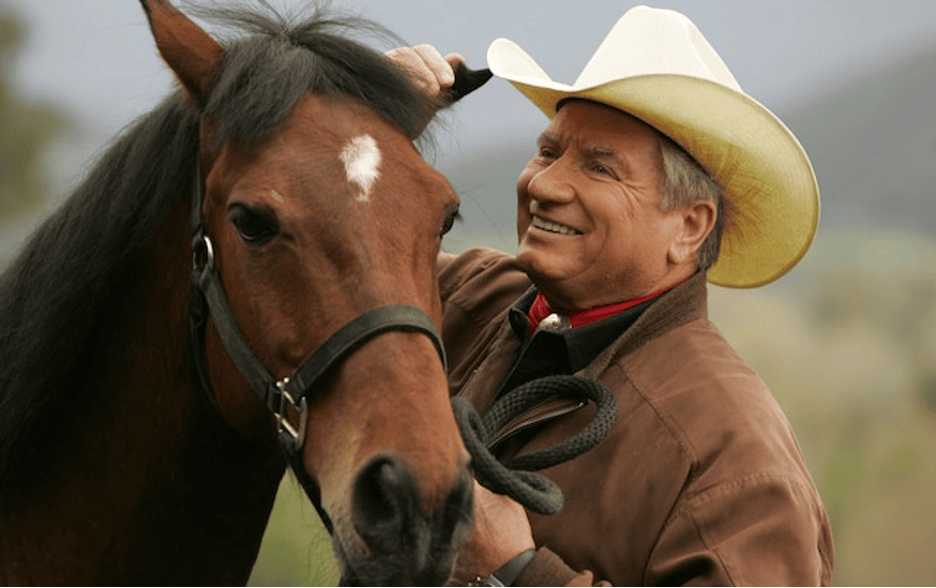
Monty Roberts died at the end of July, at 91, on the same California ranch where he spent most of his life. If the name is unfamiliar, his work will not be. He was the real horseman behind the idea people now call The Horse Whisperer, and he spent his life objecting, gently but firmly, to that word. He did not whisper to horses. He listened to them.
For six thousand years, horses were broken. Roberts grew up watching his own father do it that way, and he grew up questioning it. He spent his youth observing wild mustangs and noticed something that changed the entire profession. Herds are not led by the most dominant animal. They are led by the mare who has earned the trust of the herd through consistency, not force. Roberts built a method called Join-Up around that insight. Instead of breaking a horse’s will, a trainer earns its willingness. The horse is given the choice to approach, and it chooses to.
That is the whole method. Offer trust. Let the choice be real. Wait.
Queen Elizabeth II saw him demonstrate it in 1989 and became one of his most devoted champions for the rest of her life. His memoir sold more than five million copies. But the detail that stays with me is smaller than any of that. He did not call what he did dominance training or performance coaching or anything with an acronym. He called it listening, and he insisted that was the harder skill.
Here is where the horse barn and the boardroom stop being two different places.
The TELUS Mental Health Index has found that Canadian employees who report strong leadership from their manager score up to 21 points higher on measures of overall mental health than those who do not. Twenty-one points is not a rounding error. It is the difference between a workforce that is functioning and one that is quietly breaking down, and the variable driving that gap is not compensation or workload. It is whether people trust the person leading them.
I think about that stat next to Roberts’ mustangs. A horse that trusts its handler will walk into a trailer, jump a fence it cannot fully see over, stand still while someone works near its legs. None of that is natural behaviour for a prey animal. It only happens because trust has replaced fear as the operating system. Canadian employees are not so different. People will follow a leader into ambiguity, into a hard restructuring, into a stretch assignment that scares them, when trust is the foundation. Absent that trust, you can still get compliance. You will not get discretionary effort, and you will not get honesty when something is going wrong.
Join-Up works because it flips the traditional question. Traditional training asks, how do I get this animal to do what I want? Join-Up asks, what do I need to do so this animal chooses to be with me?
Many Canadian workplaces still ask the first question, only with more polished language. Engagement surveys, recognition programs, and wellness perks can all be useful, but they often still come from the same place: how do we get people to do what we want? Leaders who build lasting cultures ask the second question instead: what do I need to do so my team chooses to bring their full selves here, even when no one is watching?
Our own research at CareerJoy, through the upcoming The 2026 Work. Made Better Report, points to the same pattern from a different angle. The teams with the strongest performance outcomes are rarely the ones with the most oversight. They are the ones where trust has replaced surveillance as the default. It is slower to build. It is much faster to destroy. And it cannot be faked, which brings me back to that horse sensing your hesitation before you do.
We built [LQ] around a simple, uncomfortable observation. Most leadership development programs are still organized around competencies. Strategic thinking, communication, decision making, the usual list. Competencies matter, but they are not what determines whether a team chooses to follow someone into difficulty. Character does.
[LQ] defines four dimensions that determine whether a leader earns genuine followership or only compliance. Culture is the dimension most leadership programs overlook. A leader can be technically strong and still lead a team that does only the minimum because people do not trust what will happen if they raise concerns. Roberts understood this about horses long before most organizations understood it about people. The animal is not checking your résumé; it is deciding whether you are safe enough to be honest with.
That, in the end, is what psychological safety measures in a Canadian workplace. Not whether people are comfortable. Whether they believe telling you the truth will cost them something.
You cannot join-up a horse in an afternoon, and you cannot rebuild trust with a team in one all-hands meeting. But you can start the way Roberts started, by changing the question you are asking.
Stop asking how to get more performance out of people. Ask what you need to do so they choose to bring you their best without being prompted. Notice where you rely on control because it is faster, and be honest about what that speed costs in trust, honesty, and discretionary effort. Give people a real choice this week: how to approach a project, where to hold a meeting, or which problem to solve first. Then let their choice stand.
Watch, too, for the moments you are tempted to manage the reaction instead of the relationship. Roberts never tried to control how a mustang felt about him. He controlled what he offered it. Consistency, patience, room to approach on its own terms. That is a harder discipline than it sounds, especially for leaders who are rewarded for speed and decisiveness. But it is the only version of trust that holds up under pressure, which is exactly when Canadian teams need it most.
Roberts spent his whole career proving that force produces obedience and trust produces partnership. Canadian leaders are being asked to build partnership right now, in workplaces still adjusting to hybrid schedules, still absorbing economic pressure, still trying to figure out what loyalty even means anymore. The lesson from a ranch in California, and from a saddle I was not nearly as comfortable in as I hoped to be, is the same lesson either way.
You cannot make the horse drink. You can only become someone worth following to the water.
Along the road with you,
Alan
Get a first look at the 2026 Work. Made Better. Report, featuring national data on leadership, workplace culture, employee experience, and what’s next for work.
It’s built in the hundred ordinary Tuesdays that came before it. That kind of consistency doesn’t happen by accident, and it’s what CareerJoy’s leadership solutions are built to support.
→ We can help you build that trust
Friday Leadership Report | Alan Kearns, Founder & Managing Partner, CareerJoy
Happy Friday.
Last weekend at the cottage, we noticed something strange out on the bay. A whole gathering of loons. We are not loon experts, but we know our lake. Two loons live in our bay, and they are territorial by nature. Seeing a crowd of them together was something we had never witnessed before, so naturally, we looked it up.
If you spend any time on Big Rideau this time of year, this is a good question to ask, because loon behaviour changes noticeably in late summer. Chicks raised through July and August are becoming independent, foraging on their own, which makes family groups overlap in ways that look like a sudden population boom. Adults are also molting, shedding flight feathers and becoming temporarily grounded, so they gather on large, food rich lakes where it is safer to feed while they cannot fly. And with breeding season winding down, birds that spent June defending their patch of water become far more tolerant of company. The territorial yodel gives way to softer tremolos and contact calls. The choir changes because the purpose changes.

On a lake the size of Big Rideau, five to fifteen loons together in late August is not unusual. Occasionally, especially as migration nears, you will see twenty or more in one spot. It is a quiet, slightly bittersweet marker of the season. The adults lose their sharp black and white breeding plumage, turn a duller grey, and begin the journey toward the Atlantic coast or the Great Lakes. If you have been hearing loons calling at dusk lately, that is the sound of families regrouping before the trip south.
I could not stop thinking about what that gathering means, because our team is doing something similar this September. We are moving to a hybrid model, in the office together every Tuesday and Thursday. And the loons, it turns out, are a pretty good metaphor for why that matters.
Canada’s remote work numbers have been telling a consistent story for four straight years. Statistics Canada reports that only 17.4% of employed Canadians were working mostly from home by mid-2025, down from the pandemic peak, while 77.6% were working entirely outside the home. The drift back to shared space has not been dramatic, but it has been steady, and it has not reversed.
What has changed is not just where people work, but how deliberately companies are designing the days people spend together. Robert Half Canada’s most recent workplace research found that a large share of employers now offer hybrid arrangements to employees at every level, not just senior staff, and that most workers are spending fewer than five full days a week in the office. In other words, the fight over full-time in-office versus full-time remote has mostly settled into something more interesting: leaders choosing which days matter enough to gather for, and building those days on purpose rather than defaulting to habit or policy.
That is exactly what our loons were doing. They were not gathering because a memo told them to. They gathered because late summer made proximity useful again. Food was concentrated. Safety in numbers mattered more than territory. The value of being together, for a season, outweighed the value of staying apart.
Our Work. Made Better. Report continues to surface the same pattern across Canadian organizations. The leaders whose teams stay engaged in a hybrid model are rarely the ones enforcing the most in-office days. They are the ones who make shared days feel meaningfully different from remote days, building real conversation, problem-solving, and relationship-building into the calendar instead of leaving them to chance.
That distinction is central to what we call [LQ] at CareerJoy. Leadership Intelligence is not about how many hours a leader spends in a boardroom; it is the ability to recognize what a moment requires—connection, focus, recognition, or space- and respond with intention instead of habit.
A loon does not gather out of routine; it gathers because the season calls for it. The best leaders I know do the same.
They do not fill office days with status updates that could have been emails. They use time together for the work that truly requires a room.
If your team is moving to a Tuesday-and-Thursday office model this fall, or something similar, it can be tempting to treat in-office days as the same online routine in a different location: the same meetings, the same screens, just without bedrooms and kitchen tables in the background. That wastes the opportunity and is one of the quickest ways to make people resent coming in.
Instead, try this: protect at least one block on each in-office day for agenda-free conversation, a walk, a coffee, or a genuine check-in on how someone is doing. Save decisions that benefit from real-time debate, especially those that get flattened into Slack threads, for the room.
And pay attention to who goes quiet online but comes alive in person. That person is showing you how they do their best thinking, and a purely online-centric culture can quietly cost you their best ideas.
Gallup’s global research on engagement has long shown that people who feel genuinely connected to their colleagues are dramatically less likely to disengage from their work. A hybrid model does not build that connection automatically. It only creates the conditions for it. What leaders do inside those conditions is the whole game.
Here is where this hits closest to home for me. A meaningful share of the people I coach are between roles, and the isolation of that stretch is real. Statistics Canada’s most recent data shows more than one in ten Canadians report feeling lonely often or always, and separate research on remote work found that roughly three in ten people with remote work experience have felt disconnected during it.
Job searching, for most people, is an even more remote experience than remote work itself. No team, no Tuesday and Thursday in the office, no one to grab a coffee with between calls.
If you are in transition right now, borrow the loons’ behaviour with intention. Gathering is not weakness; it is strategy. Find the bay that works for you, a peer group, a networking breakfast, or an old colleague you have been meaning to call, and show up the way those birds gather around good water.
Not to perform confidence, but because being near other people can change what you notice, who you meet, and how quickly you move forward. Careers, like lakes, are more generous to those who make themselves visible.
If you are the leader on the other side of that transition, a September gathering is not only about your team’s output. It also sends a signal to everyone watching from the shore: a new hire, an anxious employee, or someone in career transition wondering whether any workplace still values people over headcount. It shows that connection is something your organization still takes seriously.
Our bay only fills with loons for a few weeks a year. It is worth noticing when it happens, and it is worth asking why.
The same is true of your office on a Tuesday morning this fall. Notice who shows up, why they showed up, and what you are doing with the time once they are there. That is the whole difference between a hybrid policy and a human-first culture.
Along the road with you,
Alan
Be among the first to receive an advance copy of the 2026 Work. Made Better. Report, featuring national insights on leadership, workplace culture, employee experience, and the future of work.
Whether you’re navigating hybrid work, leading through change, or developing stronger leaders, CareerJoy helps organizations build the skills and cultures that make work better.
Friday Leadership Report | Alan Kearns, Founder & Managing Partner, CareerJoy
Happy Friday,
Like over a billion people around the planet, our house was glued to the World Cup Final last weekend. We had our cottage neighbours over, snacks everywhere, kids running between the dock and the couch every time a whistle blew. Spain beat Argentina 1-0 after extra time, with substitute Ferran Torres scoring the winner in the 106th minute, and the place erupted like we’d scored it ourselves. It was one of those nights you want to bottle. Good food, good neighbours, a game that actually delivered.
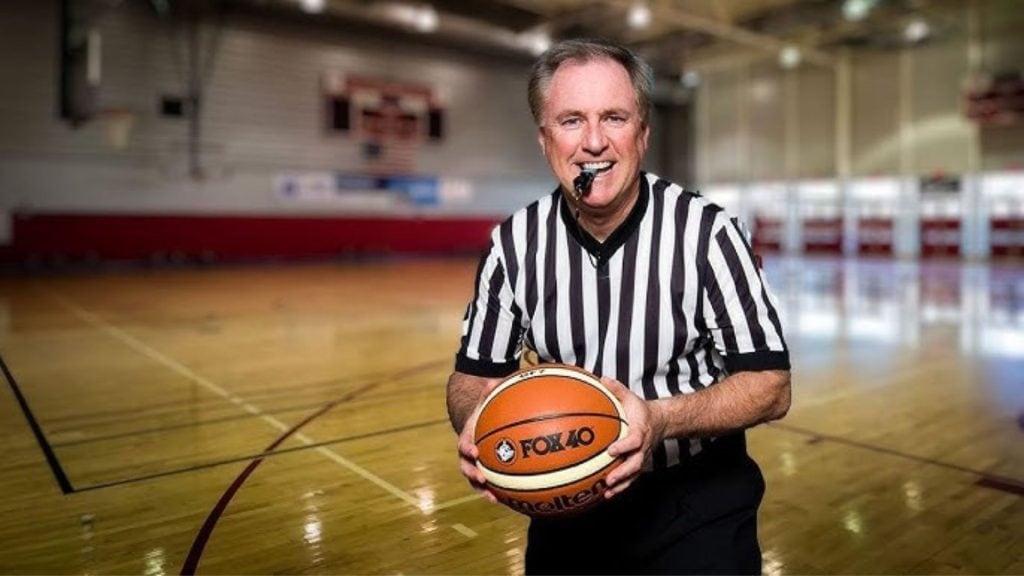
Somewhere around the second half, one of our neighbours mentioned something I had no idea about. Every time that referee’s whistle cut through the noise, we were hearing a Canadian invention.
The Fox 40, the pealess whistle used in nearly every major sport on earth, was invented by Ron Foxcroft, a referee from Hamilton, Ontario. Foxcroft officiated the men’s Olympic gold medal basketball game in Montreal in 1976, and the whistle he was using that night had a small cork pea inside it, the traditional design at the time. Peas jam. When they jam, the whistle goes silent at exactly the moment it matters most.
Years later, working a pre-Olympic game in Sao Paulo, Foxcroft blew his whistle on a foul at centre court and nothing came out. The pea had stuck. Play continued, the crowd erupted, and things nearly turned ugly around him. That was the moment he decided enough was enough. Not because he saw a business opportunity. Because he was tired of being the guy standing there with a silent whistle in his hand.
Here’s the part I keep coming back to. Foxcroft wasn’t trying to build a global whistle empire. He made a wish list of features for a better whistle and brought it to a small plastics moulding shop in Ontario to see if they could build what he’d sketched. He was solving his own problem. The whistle now used by the NFL, NBA, NHL, FIFA, and dozens of other organizations worldwide started as one frustrated referee fixing the thing that kept failing him personally.
I see a version of this mistake constantly in my coaching work. Leaders reach for the big strategy. The five year vision. The transformation initiative with a consultant deck and a catchy name. Meanwhile, the actual thing breaking their team’s performance is sitting three feet in front of them, unaddressed, because it feels too small to be worth a leader’s attention.
New research on Canadian workplaces backs this up in a way that surprised me. HRD Canada’s Best Places to Work survey found that almost half of employees at Canada’s top rated employers were not formally asked for their views in the past year, and that figure runs considerably higher across Canadian employers more broadly. Think about that. These are the good employers, the ones making the lists, and still close to half their people haven’t been asked what’s actually going wrong on the ground.
The AI conversation is showing the same pattern from a different angle. BCG’s global AI at Work research found that while more than three quarters of leaders and managers now use generative AI regularly, frontline employee usage has stalled well below that. The gap isn’t a tools problem. It’s a leadership attention problem. BCG’s data shows positive sentiment toward AI among frontline employees rising from 15 percent to 55 percent when leadership support is strong, yet only a quarter of frontline employees currently experience that level of support from their leaders.
In both cases, the fix isn’t a bigger vision. It’s a leader deciding to notice the pea stuck in the whistle.
There’s a reason Foxcroft’s story lands the way it does. He didn’t set out to change officiating worldwide. He set out to never again stand silent and humiliated in front of a packed arena because a two dollar part failed him. The global impact was a byproduct of solving a real, specific, personal frustration well.
Leadership works the same way, in my experience. The leaders who build real trust with their teams aren’t the ones chasing the grandest possible mandate. They’re the ones who notice that one recurring complaint, that one broken handoff between departments, that one meeting where good people go quiet, and they actually fix it. Not because it will look impressive on a slide. Because it’s the thing standing in the way of their people doing good work.
That’s a harder discipline than it sounds. Big vision work is genuinely more comfortable for a lot of leaders. It’s abstract, it’s future focused, and nobody can accuse you of having missed the mark yet. Fixing the specific, present, unglamorous problem in front of you requires admitting something is broken right now, on your watch, and that you’re the one who has to deal with it.
This doesn’t require a new program or a survey nobody will fill out honestly. It starts smaller than that. Ask one person on your team, this week, what’s the one thing that keeps slowing them down that nobody higher up seems to notice. Then actually fix that one thing, visibly, before you move on to anything else.
Foxcroft didn’t start with a market study. He started with a wish list, a plastics shop down the road, and a specific, personal irritation he refused to keep living with. Most of the real fixes I’ve seen leaders make in organizations started the same way. Small, local, unglamorous, and completely solvable once someone with authority actually decided to pay attention to it instead of stepping over it on the way to the next big initiative.
The pattern holds whether you’re running a five person team or a national organization. Vision matters. But vision without the discipline of noticing what’s actually broken in front of you is just a nicer way of ignoring your people.
This is exactly why presence sits inside [LQ] as one of the traits I coach leaders on directly. Not vision. Not charisma. The discipline of actually seeing what’s happening in the room you’re standing in, rather than the room you wish you were leading instead. Leaders with high [LQ] don’t ignore the small, local, unglamorous problem because it feels beneath their title. They treat it as the whole job.
Foxcroft eventually built a company that sells whistles in over a hundred countries. But that came after the fix, not before it, and it came because he was still, first, a guy who wanted his own whistle to work.
This is the same lens we bring to our work with leaders and teams across Canada. Not another framework to memorize. A discipline of noticing the real, specific problem sitting in front of a leader right now, and building the capability to actually deal with it well. If your team has a pea stuck in the whistle somewhere, and you’re not sure where, that’s a conversation worth having.
Congratulations to Spain on a well earned title, and to every neighbour, cottage or otherwise, who made this an easy game to gather around.
Along the road with you,
Alan
Every team has them, a stuck complaint, a quiet handoff nobody fixed. The best leaders don’t wait for a bigger problem to justify their attention.
Foxcroft didn’t build a global company by thinking bigger. He built it by refusing to ignore what was broken right in front of him. Most leaders skip that step.
Friday Leadership Report | Alan Kearns, Founder & Managing Partner, CareerJoy
Happy Friday,
I have loved flying for as long as I can remember. It was one of the quiet gifts my parents gave me, the adventure of travel. As an only child, I got to see a good chunk of the world before most kids my age had left their province. But honestly, some of my favourite moments happened before we ever reached the destination.
I still remember my first time on a 747, watching the little screen in the seatback track our descent, the runway growing on the map until the wheels touched down.
That memory came back this past week after the Air Canada flight that went off the runway landing in Montreal. I follow these stories more closely than most people do. My son is a first officer with WestJet, based in Vancouver, and if you talk to anyone in aviation, they will tell you the same thing: takeoff and landing are where the real risk lives. Cruising altitude is the easy part. It’s the first and last few minutes of a flight that demand everything a pilot has.
So this week sent me down a research rabbit hole, and I found something that stopped me. It turns out that chasing a smooth landing, the kind that makes passengers clap, is often the very thing that causes accidents.

Most passengers judge a flight by two things: how the captain sounds on the PA, and how gently the plane sets down. Andrew McKechnie, a former British Airways captain who now runs his own aviation consultancy, says that instinct is misleading.
“From a safety standpoint, the best landing isn’t the softest one. It’s the one where the aircraft touches down at the right spot on the runway, at the right speed.”
Chasing that buttery smooth touchdown can actually push a pilot to float too far down the runway before setting the wheels down, or to flare too aggressively and risk a tail strike. In wet conditions, that extra float can be the difference between stopping safely and sliding off the end of the tarmac.
Read that again, because it is not intuitive.
The outcome everyone applauds, the smooth landing, is sometimes the by-product of a decision that quietly increases risk. Meanwhile, the landing that feels like a small thump is often the one that was flown correctly.
I think about this constantly in leadership work. How many of us are managing for the applause instead of the outcome?
The team member who never pushes back, who agrees in every meeting, who makes every interaction feel smooth, can look like your best player. But smoothness and safety are not the same thing. The people who tell you what you want to hear are not always the people you can trust with what actually matters.
The colleague who raises the uncomfortable question, who flags the risk nobody wants to name, is often doing the harder and more valuable work, even though the meeting feels bumpier because of it.
There is a second layer to this story that I think matters even more for how we lead.
Captain Chris Eades, who spent decades training pilots, shared that the best captains he flew with were the ones who gave their first officers real room to make their own calls, including the freedom to occasionally get it wrong and learn from it in real time.
One captain described a first officer misreading the landmarks on descent into Edinburgh, confidently announcing the wrong hill as their position marker. Rather than jumping in to correct him immediately, the senior captain let the moment play out, then calmly walked him through it once the mistake became obvious.
The first officer has said that single moment taught him more than a dozen textbook corrections would have.
That is not how most of us were taught to lead. Most of us were taught that the mark of a good manager is catching the error before it happens. But there is a cost to that instinct. When we intervene too early, every time, we do not just fix the mistake, we quietly teach our people to stop trusting their own judgment. We train dependence instead of capability.
The best leaders I know, and the best pilots by every account I have read this week, understand the difference between a mistake that is dangerous and a mistake that is instructive. Letting the second kind happen, inside a safe enough margin, is not weak leadership. It might be the most respectful thing you can do for someone’s growth.
This is where the runway metaphor lands squarely on the desk of every Canadian manager.
Most performance conversations still default to comfort metrics. Did they show up on time. Did they follow the process. Did they make the meeting feel easy. Those are the equivalent of judging a flight by how smooth the touchdown felt. They tell you almost nothing about whether the person is actually navigating well.
Gallup’s ongoing workplace research has found that managers alone account for roughly seventy percent of the variance in how engaged their teams are, and that employees who genuinely trust their leadership are dramatically more likely to stay and to bring their full effort to the work.
Trust, not compliance, is the variable doing the heavy lifting. A team member who is technically compliant but emotionally checked out, who never tells you what they actually think, is not a stable landing. They are a smooth touchdown that happened to work out this time
We see this same pattern in The 2025 Work. Made Better. Report. Across the Canadian organizations we studied, the healthiest teams were rarely the quietest ones. They were the teams where people felt safe enough to disagree with a leader without fear of being sidelined for it.
The report kept surfacing the same uncomfortable truth: leaders often mistake harmony for health, when what they are actually looking at is silence. And silence, like a landing that only looks smooth from the cabin, can be hiding a problem that surfaces later, often at a much higher cost.
The Canadian workplaces bucking this trend share a common trait. Their leaders built systems where dissent was treated as data, not disloyalty. They rewarded the people who spoke up early, even when the message was inconvenient, because catching the problem on approach is always cheaper than dealing with it after the wheels are down.
This is precisely what [LQ] Leadership Intelligence is built to measure. Not how smoothly a leader sounds on the PA, but how they actually perform in the moments that carry the most risk, the decisions on approach, the willingness to let someone else fly, the discipline to reward accurate feedback over easy agreement. A leader with a strong [LQ] does not need every landing to feel effortless. They need every landing to be safe, and they need their people to trust them enough to say so when it isn’t.
The next time a member of your team pushes back on you, or admits a mistake before you catch it, resist the urge to see that as turbulence. That is often the sound of the plane being flown correctly.
If you are curious where your own leadership tendencies sit on this spectrum, that is exactly the kind of conversation my team at CareerJoy exists to have with Canadian leaders.
Along the road with you,
Alan
The smoothest team isn’t always the healthiest one. If you’re not sure whether your team feels safe enough to disagree with you, that’s worth a conversation.
The instinct to jump in early often builds dependence, not capability. If that sounds familiar, let’s talk.
Friday Leadership Report | Alan Kearns, Founder & Managing Partner, CareerJoy
Happy Friday,
I was having an interesting conversation this week with one of my executive coaching clients. A large part of our conversation was about how much longer she was going to stay in her role. She’s good at what she does. She’s respected. And she’s tired in a way that has nothing to do with sleep.
One of my favourite books to read to my kids was Goodnight Moon. Page after page, a small rabbit says goodnight to everything in the room, the light, the clocks, the mittens, until finally, goodnight to the moon itself. The closest anyone has actually been able to say goodnight to the moon is Canadian astronaut Jeremy Hansen.
This week, Hansen said his own kind of goodnight. Three months after becoming the first Canadian to travel around the moon on the Artemis II mission, he announced he’s stepping back from full-time astronaut duties this September.
Here’s the part that caught me, though: Hansen didn’t call it an ending. In his own words, the move is “far from a departure.” He’s transitioning to serve as a reservist with the Royal Canadian Air Force, deliberately keeping the door open for what he called “creative, ongoing ways to support and enable the vital work happening in Canada with respect to space.” After 32 years of military service and 17 years as a CSA astronaut, he chose the moment.
Nobody pushed him out.
He looked at the mission he’d just completed and asked himself what came next, and he answered that question before the answer was made for him.
That’s exactly the conversation my client and I were having.

Most leaders don’t leave too early. They leave too late. They stay past the point where the role is stretching them and start living in the place where the role is depleting them, and the difference between those two states is enormous, even though it’s quiet and gradual enough that it’s easy to miss from the inside.
I ask my clients a version of the same question Hansen seemed to have already answered for himself. Are you still growing here, or are you just enduring here? Growth and endurance can look identical from the outside. Both involve showing up, doing the work, hitting the targets. But one is building something in you. The other is slowly using you up.
Character, not just competency, is what makes this distinction visible. A competent leader can endure a role for years past its expiry date and still perform well enough that nobody raises an alarm. A leader of strong character is the one willing to ask the harder question before performance actually slips, because they know the cost of staying isn’t always measured in output. Sometimes it’s measured in who they’re becoming while they wait too long to decide.
This isn’t a small or rare pattern. Deloitte Canada and LifeWorks surveyed more than 1,100 senior leaders across Canada, Europe, and the United States and found that slightly more than half, 51 percent, had contemplated leaving their roles. Not idly wondered. Contemplated. That’s one in two leaders sitting across the table from a decision they haven’t yet made.
And the pressure behind that number is real. Robert Half Canada’s most recent workforce data shows burnout among Canadian professionals has climbed sharply, up from 47 percent in late 2024 to well over six in ten workers reporting burnout now, with the trend still intensifying. Leaders are not exempt from that curve. If anything, they’re often the last to admit they’re on it, because admitting it can feel like admitting failure rather than admitting a season has changed.
I think that’s the trap. We’ve built a cultural story where staying equals loyalty and leaving equals giving up. But overstaying a role isn’t loyalty. It’s often just avoidance dressed up in a title.
Here’s where Hansen’s framing is worth sitting with a little longer. He didn’t leave space. He left one specific role inside a much bigger commitment to the same mission. That’s a distinction I try to help my clients see for themselves. Leaving a role isn’t the same as abandoning the work you care about. It’s often the only way to keep serving that work well.
Our 2025 Work. Made Better. Report, found that only 19 percent of Canadians say they’re fully engaged at work. Not disengaged. Not burned out. Just not fully in.
That gap, between showing up and actually being present, is where overstayed leadership tends to live. It’s rarely a dramatic collapse. It’s a slow drift toward going through the motions, and it’s contagious. Teams can feel when their leader has quietly checked out long before the leader admits it to themselves.
Real transition, done well, protects both the leader and everyone who depends on them. It means naming the moment honestly instead of waiting for a crisis to name it for you. It means grieving the loss, because there is a true loss in endings, even good ones, even chosen ones. And it means trusting that the space you create by leaving well is exactly the space where the next chapter, for you and for whoever steps into that role next, actually gets to begin.
This is where [LQ] becomes practical rather than theoretical. Leadership intelligence isn’t just the ability to run a role well. It’s the self-awareness to recognize when your season in that role is ending, and the courage to say so before the evidence forces your hand. The leaders I respect most aren’t the ones who never leave. They’re the ones who know exactly why they’re staying, and exactly when that reason has run its course.
Hansen’s retirement announcement noted something else worth mentioning. Once you leave certain roles, you genuinely cannot go back to them. There’s no re-entry path to being the astronaut who hasn’t yet flown to the moon. My client is facing something similar. If she leaves her role now, on her own terms, there’s no undoing that choice either. That permanence is precisely what makes the decision so hard, and precisely why it deserves more thought than most leaders give
But permanence cuts both ways. Staying too long is also, in its own quiet way, irreversible. Every month spent enduring instead of growing is a month you don’t get back either.
I shared with my client what I’m telling you now. There is a time to say goodnight to a role, the same way that small rabbit says goodnight to everything in the room before the lights go out and morning starts again. It’s not a failure to notice when that time has come. It’s one of the clearest signs of leadership character there is.
Jeremy Hansen flew farther from Earth than almost any human in history and came home knowing exactly when to say goodnight to that chapter. My client is doing the same work, closer to the ground but no less real. Wherever you are in your own leadership story this week, I’d ask you the same question I asked her.
Are you still growing in this role, or are you just enduring it?
The honest answer is usually the one you already know.
Along the road with you,
Alan
Most leaders don’t leave too early — they leave too late. If you’re asking yourself whether it’s time, let’s talk.
Good judgment under pressure isn’t luck. It’s built long before the pressure shows up.
Friday Leadership Report | Alan Kearns, Founder & Managing Partner, CareerJoy
Happy Friday,
I have always been fascinated by human performance. Not in an abstract, academic way. In a personal one. The quiet question running underneath my whole career has been simple. How do I keep growing, as a leader and as a professional, year after year, decade after decade?
So a while back I went looking for the secret. And I found it. We peak at 27.
Well. Not exactly.
The science is real, but it is narrower than the headline. For athletes, raw power and speed tend to land in the early to mid-twenties. Anaerobic performance peaks around 23. Aerobic endurance peaks closer to 26. Basketball players hit their best in their late twenties, the moment pure athleticism finally meets a deep read of the game.
Musicians follow a strikingly similar arc. The raw technical command of a performer, the speed and the dexterity in the hands, tends to arrive early. It is why so many of the virtuosos we celebrate are young. And for a certain kind of creative mind, the poets and the physicists who make one bold conceptual leap, the research lands in that same window again. Mid to late twenties. Call it 27 and you are close enough.
Here is the part that matters for the rest of us. Leadership does not work that way.
The same body of research describes a second kind of performer entirely. The experimental innovators. The composers rather than the players. The ones who build slowly, who test and revise and accumulate, and who do their finest work in their fifties. Leadership lives on that second curve. It compounds. Experience is not a consolation prize for getting older. It is the raw material of the craft.
I am comfortably past 27. I suspect many of you reading this are too. And I have watched enough leaders up close to know that age, on its own, guarantees nothing. There are remarkable young leaders in every sector in this country. There are also people three decades into a career who quietly stopped growing two decades ago. Age is a factor. It is not the factor.
Which leads to a better question. If the secret is not a number, then what is it?

I was having a conversation this week with a partner I respect, and it pulled hard on a thread I have been tugging at for years. We were not really talking about how to build one good leader. We were talking about how to build a whole culture of them.
And the pattern is clearer than most people assume. High performing leadership cultures share three things. A common set of values. A common understanding of what leadership actually means inside that organization. And a common language to talk about both.
Not slogans on a wall. A real, shared operating system for how people lead.
The Canadian data backs this up, and frankly it should give us pause. In Culture Amp’s most recent Canadian benchmark, the single thing people felt most negative about was decision making. One in five disagreed that they were even satisfied with how decisions get made where they work. Sit with that for a moment. It is not that Canadians do not care. The same benchmark found that 94 percent believe the work they do is important. The problem is not commitment. It is clarity. When there is no shared model for how we lead and how we decide, every team quietly invents its own, and over time the seams start to show.
Now the encouraging flip side. Gallup’s 2026 global study found that inside the best practice organizations, the ones that treat engagement as a long term strategy rather than a campaign, 79 percent of managers were engaged. Nearly four times the global average of 20 percent. The difference there is not better people. It is a better shared system that good people get to operate inside.
That is the whole game. Talent gets you in the room. A common model is what lets the talent compound.
Here is where I want to be careful, because this idea gets misread constantly.
A common leadership model is not a script. It is not a manual that turns warm, distinct human beings into interchangeable parts reciting the same lines. That is the fear, and it is a fair one. Nobody wants robotic leaders. I certainly do not.
So think about a great rock band instead. Or a soccer team. Everyone understands the shared system. The key the song is in. The shape of play. The values that hold when the pressure comes and the score is close. And inside that shared structure, the individuals are gloriously themselves. The drummer and the lead singer are not interchangeable. The playmaker and the striker are not the same player. The structure does not erase the individual. It is the very thing that lets the individual shine without the whole thing falling apart.
And here is the quiet payoff. Remember the young virtuoso. An individual player may hit a technical peak early. But a great band can make its best record decades into its life, long after any single member’s hands have slowed, because the band was never one player. It is a shared sound. A shared sense of timing. A set of values about what the music should feel like. The system is what compounds, even as the individuals age and change. That, to me, is leadership.
When a team genuinely has this, three things happen. Decisions get faster, because everyone is reading from the same map. Trust climbs, because behaviour becomes predictable in the best sense of the word. And people can finally be themselves at work, because the structure carries the weight so they are not forced to perform some borrowed version of leadership that was never theirs.
This is the thinking behind [LQ]. It is not a personality quiz and it is not a list of rules to obey. It is a common framework and a shared language for leadership. The kind of operating system that lets a group of very different people lead in a way that is recognizably aligned and still authentically their own.
A shared model is how you scale character and judgment across an organization without flattening the humans inside it. It is the rock band and the soccer team, applied to the work you do every day. Earned alignment, not enforced sameness.
This is exactly what we are digging into right now. We are in the final phases of the Work. Made Better. Report, 2026 edition, produced in partnership with MNP, one of Canada’s leading mid market firms. The focus is on what actually builds high performing cultures in this country. Real Canadian organizations. Real Canadian data.
And I would genuinely love your voice in it.
If you have a view on what the true components of a high performing team are, and I suspect you do, we want to hear it. It takes about three minutes. As a thank you, we will share the findings with you the moment they land.
The secret was never 27. The secret is what we choose to build together, and how clearly we are willing to name it.
Along the road with you,
Alan
You just read the theory. Now help us test it. Add your voice to The Work. Made Better. Report 2026.
If your organization is still building its shared leadership model, let’s talk. CareerJoy can help.
Friday Leadership Report | Alan Kearns, Founder & Managing Partner, CareerJoy
Happy Friday,
Canada Day lands next Wednesday, mid next week, and at the cottage that means one thing. The party.
Every July 1, the cottage fills up with friends and neighbours. We bring in a proper Canadian spread, pulled pork burgers and mac and cheese, the kind of food that asks you to sit down and stay a while. And every year we bring in Zac Martin, a wonderfully talented young artist who has become as much a part of the day as the food. There are kids tearing down to the dock, and of course there is the moose. Our giant blow up moose stands guard by the water, and somewhere along the way he became an institution.
Our guests line up to take their annual photo with him. Same moose, same Zac, new year, another snapshot of the people we love. It is a little ridiculous and completely wonderful, which is to say it is very Canadian.
Canadian food, live music, friends on the dock. It sounds like a party, and it is. But it is also a small, happy version of a commitment we made a long time ago.
Early in CareerJoy’s history, we made that commitment real. Canada would be our primary focus.
Not a market we served on the side. The centre of the work.
That decision did not come from a strategy session. It came from a conversation. I was speaking with one of our international partners who ran a Canadian division, and we were trying to untangle why certain things kept going sideways for them here.
The more we talked, the clearer it became.
The core of their challenges was not really about strategy or talent. It was about understanding how to lead in Canada, with Canadian professionals.
Then a bigger realization landed. So much of the leadership development world that supported this work, the tools, the models, the firms behind them, was American or European. Good work, often, but work built for another culture and then translated for ours. Translated, not designed. And the values underneath did not always fit.
Leading in Canada is its own thing. We tend to lead with a little more humility. We earn trust before we ask for it. We are direct, and we are kind about it. We care about fairness in a way that shows up in a hundred small daily decisions. None of that is softness. It is a distinct leadership culture, and it deserves Canadian leadership development built for it, not borrowed from somewhere else and reworded.
The country seems to feel this more sharply than ever right now. Statistics Canada found that pride in being Canadian climbed across nearly every province through 2025, with a strong majority saying they feel proud or very proud to call this place home. One detail stayed with me.
New Canadians, the people who chose this country, reported even higher pride than those of us born here. We are not just waving the flag. We are choosing Canada, on purpose.
So are we.
That commitment shaped how we invest in research. A few years ago it became one of our anchor projects, the Work. Made Better. Report. The 2025 edition began the work of mapping what actually makes the Canadian workplace tick, in real organizations, with real Canadian data.
This year we are going deeper. We are partnering with MNP, one of Canada’s leading mid market firms, to build a richer analysis of work and leadership in this country.
This is also where [LQ] comes from. A leadership framework shaped by Canadian values, not imported and translated. Built here, for the way we actually lead.
So here is my Canada Day ask, and it is a small one.
We want this report to reflect real Canadian workplaces, which means we need real Canadian voices.
Yours.
You have a perspective on what makes work better in this country, we want to hear it.
It takes about three minutes. As a thank you, we will share the findings with you the moment they land
Take the photo with the moose. Enjoy the long weekend with the people you love. And if you find three minutes between the barbecue and the fireworks, add your voice to the work.
Happy Canada Day.
Along the road with you,
Alan
Friday Leadership Report | Alan Kearns, Founder & Managing Partner, CareerJoy
Happy Friday,
When the kids were small, the first computer that came into our home was a brand-new iMac, the blue one.
I can still picture it glowing on the desk like something from the future. My daughter had her heart set on pink, unfortunately that colour was not available.
That little machine started something in our house.
I have been a fan of Apple ever since. I even owned a Newton, the handheld Apple built long before anyone dreamed up an iPhone. So when the news broke that Tim Cook is stepping down as Apple’s CEO on September 1, with John Ternus taking over, I paid attention.
Not because of the products. Because of what Cook said about the man taking his seat.
Cook succeeded Steve Jobs in 2011, at one of the most uncertain moments in the company’s history. Jobs died six weeks after handing over the reins. Almost no one believed Apple could survive being separated from its founder. Cook proved them wrong, growing the company’s value by trillions and building entire new categories along the way. By any measure, he earned the right to choose his successor carefully.
So listen to how he described his pick. Cook called Ternus a brilliant engineer and a deep thinker. Then he went somewhere more revealing. He called him a person of remarkable character and a born leader. He said there was no one on the planet he trusted more to lead Apple into the future.
Read that again. The most valuable company in the world, run for a quarter century by two of the most analytical minds in business, and the handoff comes down to character. Not the resume. Not the patent count. The person.

I have been coaching leaders for nearly three decades. Our team at CareerJoy has worked with thousands of leaders and teams across Canada, from the federal public service to the Canadian Forces to financial services boardrooms. There is a pattern I see at the start of almost every leadership journey.
We begin with skills. We begin with competencies, benchmarking, and personality styles. Those things matter. Know thyself is ancient advice for a reason. Understanding how you show up, where your strengths sit, and how your style lands on others is genuinely useful. I would never tell a leader to skip that work.
But here is what I have noticed after all these years. We rarely talk about character.
We spend hours on a leader’s communication style and very little on their integrity under pressure. We will benchmark their strategic thinking and never ask whether they keep their word when it costs them something. And yet, when I look back at the real breakthroughs in a leadership development program, the moments where someone becomes the leader they were meant to be, character is almost always at the centre. So are the things that hold people back. It is rarely a missing skill. It is usually something deeper.
A leader can learn to run a meeting. A leader can learn to read a balance sheet. What a leader cannot fake, not for long, is who they are when no one is watching.
This is not just my observation from the coaching chair. Some of the best research on the subject comes from right here in Canada. At the Ivey Business School in London, Ontario, a team of researchers spent years studying what separates leaders who hold up under pressure from those who come apart. Their work began in the wake of the 2008 financial crisis, when they studied more than three hundred leaders across business, government, and the nonprofit sector. Their conclusion was striking. Good leadership rests on three pillars: competencies, commitment, and character. When any one of them is missing, it quietly undermines the other two.
Sit with that for a moment. The competencies we obsess over in most development programs are one of three pillars. Character is not the soft addition at the end of the workshop. It is load-bearing. The same researchers mapped character into roughly a dozen dimensions, qualities like courage, integrity, humility, and compassion. They made the case that these can be developed deliberately, just as we build a skill.
That matters because it means character is not the hand you were dealt. It is the leader you choose to become.
The reason this is urgent right now is that Canadian workplaces are running low on the very thing character produces. Trust.
Recent research found that only about a third of employees say they trust senior leaders. Let that sink in. Only one out of three people look up to the people running their organization and place their trust in them. Gallup’s latest workplace data adds the why. Manager engagement has fallen to roughly 22%, down sharply over the past few years, and managers account for around 70% of the variation in their teams’ engagement.
The people meant to carry the culture are themselves running on empty, and their teams can feel it.
Here is the connection that ties it all together. People do not follow competence. They follow character. They will give grace to a leader who is still learning the job. They will not follow a leader they do not trust. Trust is not a program you roll out. It is the residue of character, observed over time.
There is a phrase we often return to in our work. Earned authority outperforms claimed authority. A title gives you a position. It does not give you a following. People decide whether to truly follow you based on what they see you do in the small moments, far more than on the big speeches.
This is why Cook’s choice resonates. Ternus has spent twenty-five years inside Apple. He did not claim the role. He earned it, one product and one hard decision at a time, until the person who knew the company best looked around and trusted him above everyone else. That is character compounding over a career. You cannot install it in a workshop. You build it, day by day.
And this is the part that gives me hope for the leaders I work with. Character is not fixed. It is not a lucky accident of personality. It is formed, tested, and strengthened in the same way muscles are. The leaders who grow the most are the ones willing to look honestly at who they are becoming, not just what they can do.
This is the heart of how we approach leadership development at CareerJoy in Canada. The Canadian research I mentioned lands on three pillars: competencies, commitment, and character. Our own [LQ] Leadership Intelligence model builds on that foundation and adds a fourth, because we have seen what happens after a leader grows.
Commitment comes first because nothing else matters if a leader is not all in. Character comes next because it is the foundation on which everything else stands. Competencies come third, the skills and capabilities we so often start with and should probably hold a little more loosely. And culture comes fourth because a leader’s truest legacy is the environment they leave behind for those who come after them.
Notice what that ordering says. Most leadership programs and most companies run it backwards. They lead with competencies and treat character as a nice-to-have. We think that is exactly why so many talented people stall. They have polished every skill and never done the deeper work. The [LQ] framework puts character where it belongs, near the foundation, because that is where great leaders actually build from.
Apple just reminded the entire business world of this in the most public way possible. The most analytical company on earth chose its next leader on character. If that is the standard in Cupertino, it is worth asking what standard we are holding in our own organizations here at home.
You do not need to run a four-trillion-dollar company for this to apply to you. Whether you lead a team of three or a department of three hundred, the question is the same. When your people describe you, do they reach first for your skills or for your character?
That is the question worth carrying into the weekend.
If you are wrestling with it, that is a good sign. It usually means you care about becoming the kind of leader people choose to follow. That work, the genuine inner work of leadership, is exactly what our coaching at CareerJoy is built for. We help Canadian leaders go beyond benchmarks and develop greater skills that change how they lead. If this is your season for that, we would be glad to walk it with you.
Steve Jobs built something extraordinary. Tim Cook protected it and grew it. And by choosing character first on his way out the door, he left the rest of us with the only question that has ever really mattered in leadership. Not whether you are capable enough.
Whether you are someone worth following.
Along the road with you,
Alan
One in three Canadian employees trust their senior leaders. We are trying to understand why and what changes it. The Work. Made Better. Report 2026 needs your voice.
If your organization is in the middle of a leadership transition, the character of how you handle it matters as much as the outcome. Let’s talk about how CareerJoy can help.
Friday Leadership Report | Alan Kearns, Founder & Managing Partner, CareerJoy
Happy Friday,
This past weekend my family spent the day choosing new furniture for our cottage.
That sounds like a pleasant Saturday errand, and it was. But it came with a backstory. Last fall we had a fire at the cottage. It damaged part of the building, destroyed things we cared about, and landed in the category of hard things you do not see coming. We were fortunate. Most of the cottage was untouched. Nobody was hurt. But there was real loss, and a real mess to deal with, and for a while the path forward was not obvious.
We found a project manager who was exceptional, calm, organized, and focused on what was possible rather than what had been lost. The rebuild is coming in on time and under budget. The damaged sections are being restored better than they were. And this weekend, choosing furniture for a space that did not exist six months ago, the feeling in the room was not loss. It was excitement.
Hard things are temporary. What shapes the outcome is not the event itself but how you respond to it.
Not denial of the challenge, not minimizing the loss, but a clear decision to move through it with the right process and the right support alongside you. That is exactly what I see in career transition work every day.
Most people who have been through a restructuring will tell you the same thing. It was not the news itself that was hardest. It was the disorientation that followed. You lose a role, that is real, but you also lose the community of colleagues you built over years, the projects you took pride in, the rhythm and identity that came with the work. And underneath all of that is a practical and pressing worry: how do I land well from here?
Canada’s labour market is in the middle of a significant restructuring cycle. The federal public service is managing a deliberate culture shift, as Clerk of the Privy Council Michael Sabia made clear at this year’s APEX conference. The private sector is navigating AI-driven transformation, compressed timelines, and the pressure to do more with leaner teams. When restructuring lands on top of a workforce already carrying that weight, the human cost compounds quickly.
The time cost compounds too. Statistics Canada’s Labour Force Survey shows the average Canadian job search rising to roughly 22 weeks, up from 18 the year prior, with long-term unemployment near multi-decade highs.
Every week of that timeline matters, both to the person living it and to the organization carrying the severance, benefits, and brand cost of an open transition.
There is a tendency in organizations to think of career transition support as a cost to be minimized. I want to push back on that directly.
The way an organization handles the end of the employment relationship is one of the clearest signals it sends about its actual values. Not its stated values. Its actual ones. Every employee watching a colleague walk out the door is asking a quiet question: is this a place that does the right thing, even when it is hard?
Onboarding has received enormous attention in recent years, and rightly so. But offboarding sends a signal of equal weight. The employee being transitioned will carry their experience of this moment for the rest of their career. The colleagues who remain will calibrate their trust in the organization based on what they witnessed. Reputation in the Canadian talent market is shaped by these moments more than most leaders realize.
The Canadian data on this is worth sitting with. The cost of a single departure, the rising risk of turnover, the time it now takes to land, the quality of the landing itself, the legal exposure of getting an exit wrong, and the cultural cost of being watched by the people who remain, are all measurable and all moving in the same direction.
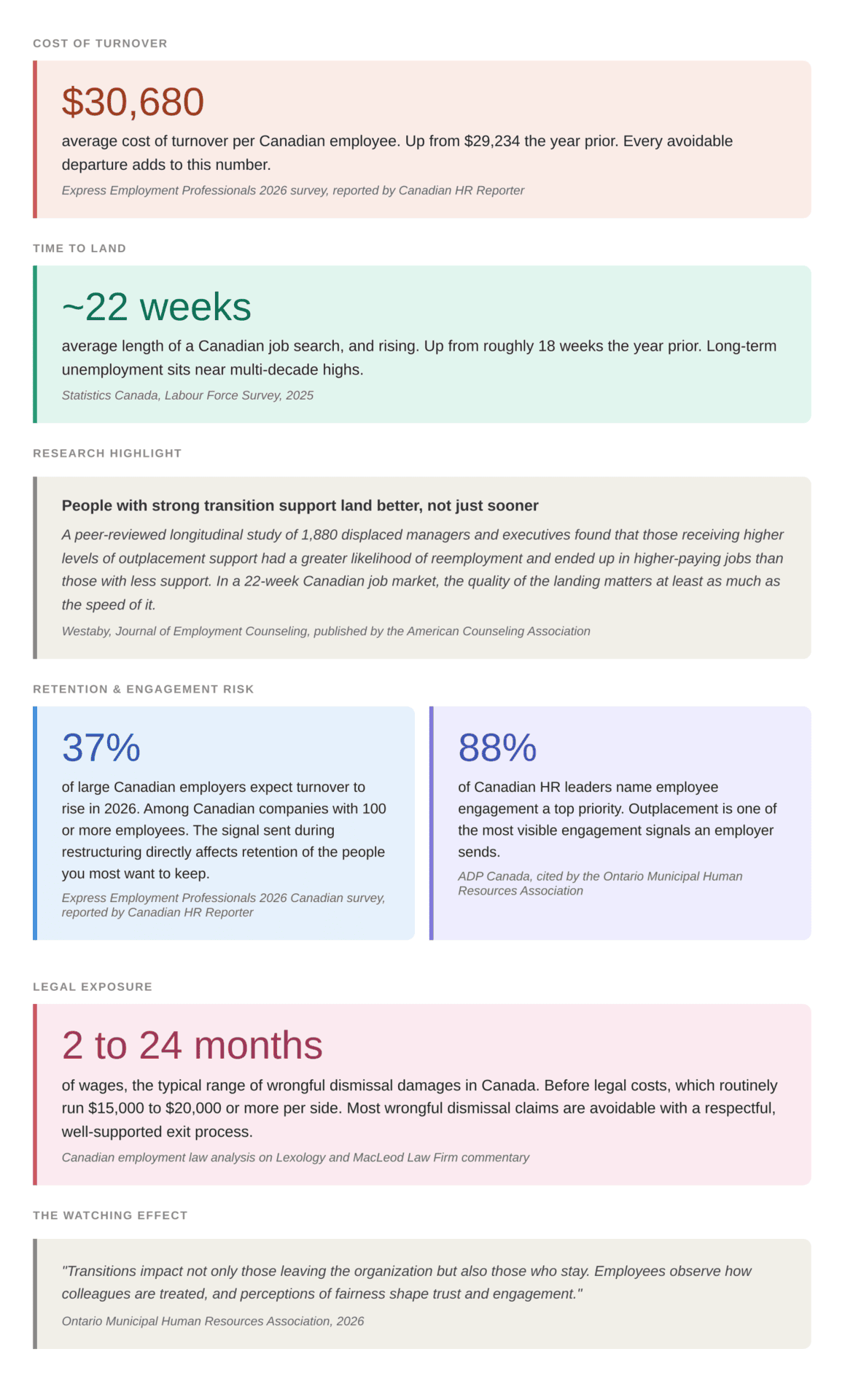
Together these numbers tell a single Canadian story. The strongest peer-reviewed evidence is clear. Career transition support is less about landing faster and more about landing better, at a better job, at better pay, with a better likelihood of landing at all.
In a Canadian market where job searches are now stretching past five months, that quality matters more than ever.
Here is what we know from nearly two decades of career transition work with Canadian professionals. The people who move through restructuring well are not the ones who were least affected. They are the ones who had a clear process, a trusted partner, and permission to grieve the loss before building the next chapter.
The loss is real. The role mattered. The team mattered. The projects mattered. Acknowledging that is not weakness. It is the honest starting point for figuring out what comes next. And what comes next, when the process is right, is often better than what was left behind.
Not because the loss was not real, but because the space it created was used well.
The cottage needed a fire, in a strange way, to become what it is becoming. Nobody would have chosen that. But the response to it, the right project manager, a clear process, a decision to rebuild better rather than just restore what was, made the difference.
That is the work. In a rebuild, and in a career.
Numbers tell one story. The people who have lived through a transition tell another. From a recent Google review of our practice, in their own words:
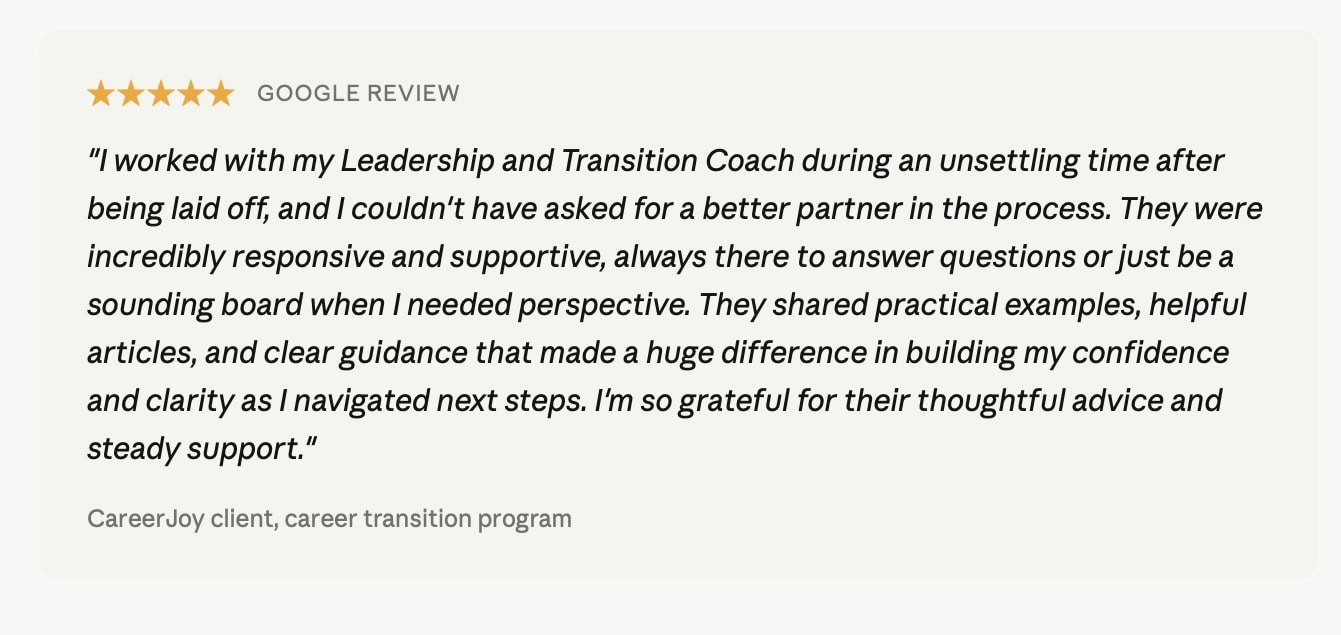
Two phrases land for me every time I read a note like this one. Unsettling, not catastrophic, just unsettling, because that is the honest texture of a layoff for most people. And the pairing of confidence and clarity at the end, because those are the two things a good coach actually delivers, and the two things that, when present, change what someone does next. That is what career transition support, done with humanity and rigour, sounds like from the inside.
If your organization is navigating restructuring, whether in the federal public service responding to the mandate for a culture shift or in a private sector company managing transformation, the human dimension of that work is not separate from the strategy. It is part of it.
How you treat the people leaving shapes the culture of the people staying. The trust, engagement, and discretionary effort of your remaining workforce is directly affected by what they watch happen to their colleagues. And in a tight Canadian talent market, where your employer brand follows you everywhere and every departing employee is a future reference, boomerang hire, or client, the long game matters.
Outplacement and career transition support is not a cost. It is a signal. It is the organization saying, out loud and in practice, that it values the people who gave it their effort, and that it will do the right thing even when the moment is difficult.
That is the work we do at CareerJoy, and the philosophy behind it is simple. Human First. AI Smart. 100% Canadian. Practical results.
Human first is not in tension with AI smart.
They are designed to reinforce each other. The human work in a career transition, the grief, the identity questions, the confidence rebuild, the courage it takes to say yes to a different chapter, will never be done by software. That belongs to the transition coach and the person they are walking beside. But the surrounding work, the market research, the role mapping, the application drafts, the interview prep, the pattern recognition across thousands of Canadian transitions, is exactly where smart AI tools earn their place. Used well, they take the friction out of the mechanics so the human time stays focused on what only humans can do.
That is what AI smart means at CareerJoy. Not AI in place of a coach, ever.
AI in service of the coaching relationship, in service of the person living through the transition, in service of getting them to a better landing in less time and with more clarity than they would find on their own.
The hard things are temporary.
How you respond is what lasts.
Along the road with you,
Alan
Canada’s workplaces are shifting. The Work. Made Better. Report 2026 is measuring what’s actually happening. Add your voice.
The way you handle it matters — for the people moving on, and for the team moving forward. Let’s talk about how CareerJoy can help.